Department of Health Sciences, Lund University, PO Box 157, 22100, Lund, Sweden.
Division of Orthopaedics, Department of Clinical Sciences, Lund University, Lund, Sweden.
Knee Surg Sports Traumatol Arthrosc. 2020 Oct;28(10):3382-3392. doi: 10.1007/s00167-020-06005-5. Epub 2020 Apr 25.
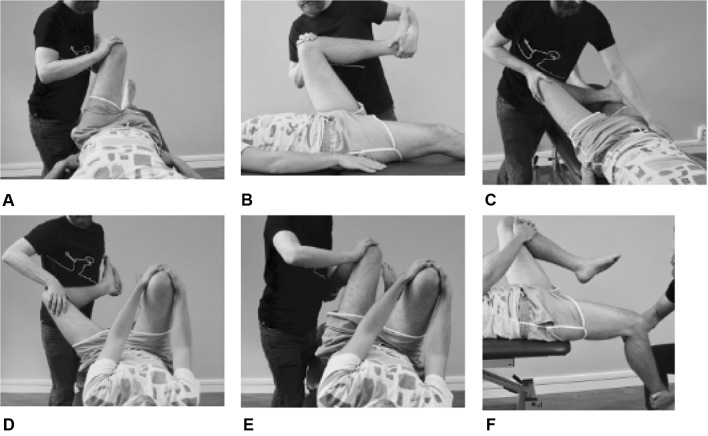
Clinical examination is an important part in the diagnosis of femoroacetabular impingement (FAI) syndrome. However, knowledge on reliability and validity of clinical diagnostic tests is scarce. The aims were to evaluate the inter-rater agreement and diagnostic accuracy of clinical tests to detect patients with FAI syndrome.
Eighty-one patients (49% women) were recruited. Two experienced raters performed impingement and range of motion (ROM) tests. Three criteria had to be fulfilled for the diagnosis of FAI syndrome: (1) symptoms; (2) CAM and/or Pincer morphology; and (3) being responder to intra-articular block injection. For inter-rater agreement, the Cohen's kappa statistics were used (0.41-0.60 = moderate, 0.61-0.80 = substantial agreement). For diagnostic accuracy, sensitivity, specificity, positive and negative predictive values were calculated.
Anterior impingement test (AIMT), FADIR test and FABER test showed kappa values above 0.6. All passive hip ROM, except extension, had kappa values above 0.4. AIMT and FADIR showed the highest sensitivity, i.e., 80%, with a specificity of 26% and 25%, respectively. Passive hip ROM in internal rotation with neutral hip position had a sensitivity of 29% and a specificity of 94%.
The AIMT, FADIR and FABER tests were reliable between two experienced raters, while results from different raters for hip ROM should be interpreted with caution. The AIMT and FADIR test can only be used to rule out patients with FAI syndrome, while evaluation of ROM in internal rotation with neutral position may be more suitable to rule in patients with FAI syndrome.
II.
临床检查是髋关节撞击综合征(FAI)诊断的重要组成部分。然而,关于临床诊断测试的可靠性和有效性的知识却很匮乏。本研究旨在评估临床测试检测 FAI 综合征患者的组内一致性和诊断准确性。
共招募了 81 名患者(49%为女性)。两位经验丰富的评估者进行了撞击试验和活动度(ROM)测试。FAI 综合征的诊断需要满足以下三个标准:(1)症状;(2)凸轮和/或钳夹畸形;(3)关节内阻滞注射有反应。对于组内一致性,使用 Cohen's kappa 统计量(0.41-0.60=中等,0.61-0.80=高度一致)。对于诊断准确性,计算了敏感性、特异性、阳性预测值和阴性预测值。
前撞击试验(AIMT)、FADIR 试验和 FABER 试验的 kappa 值均大于 0.6。除伸展外,所有的被动髋关节 ROM 的 kappa 值均大于 0.4。AIMT 和 FADIR 显示出最高的敏感性,分别为 80%,特异性分别为 26%和 25%。中立位髋关节内旋的被动 ROM 敏感性为 29%,特异性为 94%。
AIMT、FADIR 和 FABER 试验在两位经验丰富的评估者之间具有可靠性,而不同评估者的髋关节 ROM 结果应谨慎解释。AIMT 和 FADIR 试验只能用于排除 FAI 综合征患者,而中立位髋关节内旋 ROM 的评估可能更适合诊断 FAI 综合征患者。
II。