Department of Preventive Medicine, School of Public Health, Fujian Medical University, Fuzhou, Fujian, 350122, China; Department of Molecular Pharmacology, Albert Einstein College of Medicine, Forchheimer 209, 1300 Morris Park Avenue, Bronx, NY, 10461, United States.
Department of Molecular Pharmacology, Albert Einstein College of Medicine, Forchheimer 209, 1300 Morris Park Avenue, Bronx, NY, 10461, United States.
Redox Biol. 2020 Jul;34:101475. doi: 10.1016/j.redox.2020.101475. Epub 2020 Apr 18.
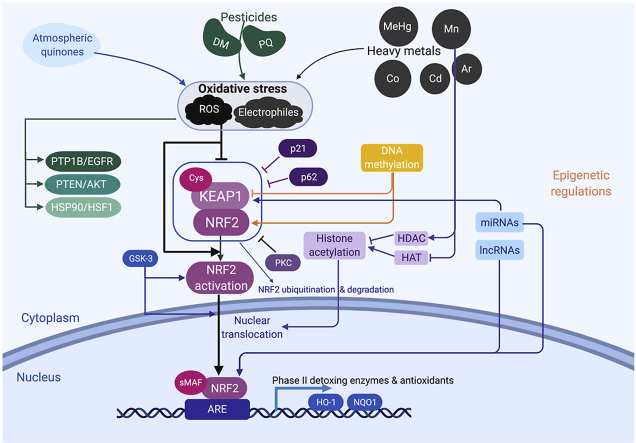
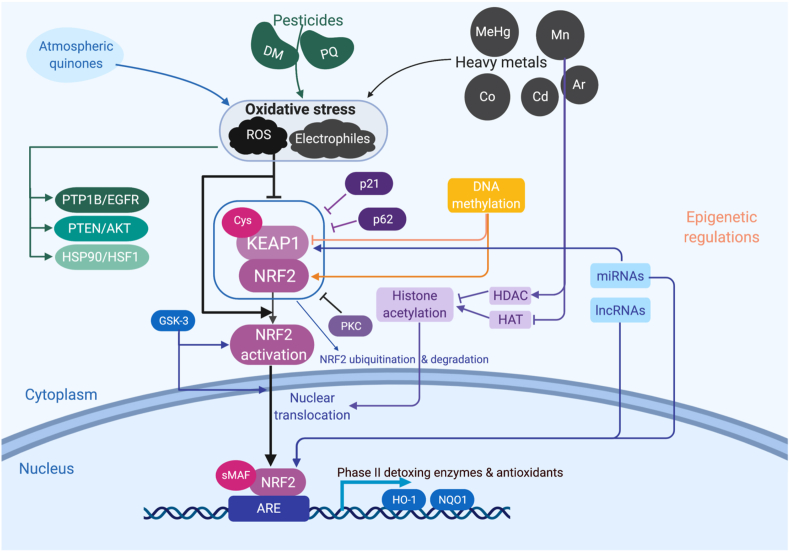
Living organisms are surrounded with heavy metals such as methylmercury, manganese, cobalt, cadmium, arsenic, as well as pesticides such as deltamethrin and paraquat, or atmospheric pollutants such as quinone. Extensive studies have demonstrated a strong link between environmental pollutants and human health. Redox toxicity is proposed as one of the main mechanisms of chemical-induced pathology in humans. Acting as both a sensor of oxidative stress and a positive regulator of antioxidants, the nuclear factor erythroid 2-related factor 2 (NRF2) has attracted recent attention. However, the role NRF2 plays in environmental pollutant-induced toxicity has not been systematically addressed. Here, we characterize NRF2 function in response to various pollutants, such as metals, pesticides and atmospheric quinones. NRF2 related signaling pathways and epigenetic regulations are also reviewed.
生物体周围存在大量重金属,如甲基汞、锰、钴、镉、砷,以及农药如溴氰菊酯和百草枯,或大气污染物如醌。大量研究表明,环境污染物与人类健康之间存在很强的关联。氧化还原毒性被认为是化学物质引起人类病理学的主要机制之一。核因子红细胞 2 相关因子 2(NRF2)作为氧化应激的传感器和抗氧化剂的正调节剂,最近引起了关注。然而,NRF2 在环境污染物诱导的毒性中的作用尚未得到系统解决。在这里,我们描述了 NRF2 对各种污染物(如金属、农药和大气醌)的反应功能。还综述了 NRF2 相关信号通路和表观遗传调控。