Melnyk Bernadette Mazurek, Kelly Stephanie A, Stephens Janna, Dhakal Kerry, McGovern Colleen, Tucker Sharon, Hoying Jacqueline, McRae Kenya, Ault Samantha, Spurlock Elizabeth, Bird Steven B
The Ohio State University, Columbus, OH, USA.
The Ohio State University College of Nursing, Columbus, OH, USA.
Am J Health Promot. 2020 Nov;34(8):929-941. doi: 10.1177/0890117120920451. Epub 2020 Apr 27.
This systematic review focused on randomized controlled trials (RCTs) with physicians and nurses that tested interventions designed to improve their mental health, well-being, physical health, and lifestyle behaviors.
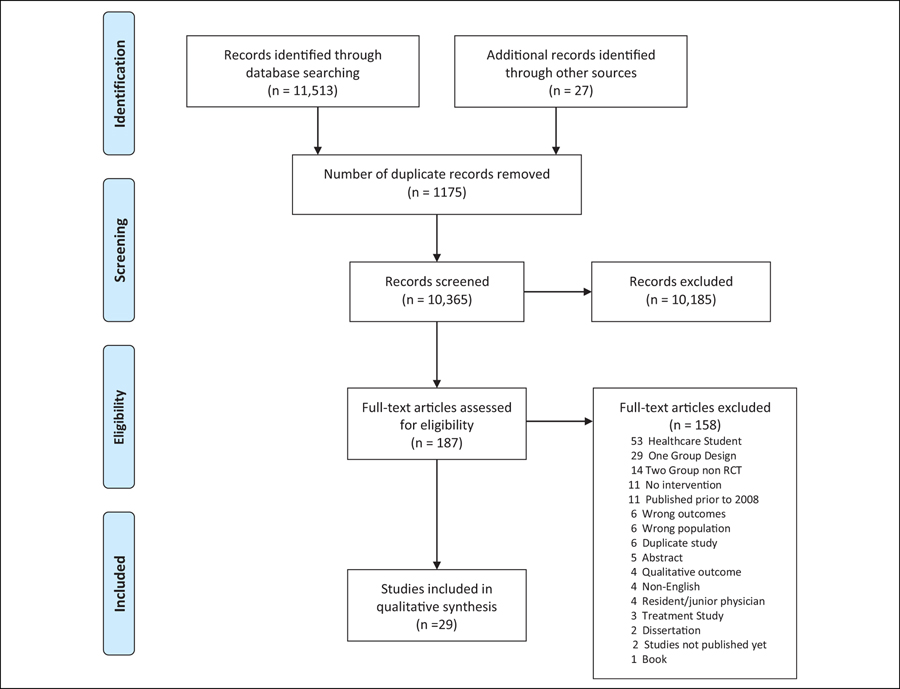
A systematic search of electronic databases from 2008 to May 2018 included PubMed, CINAHL, PsycINFO, SPORTDiscus, and the Cochrane Library.
Inclusion criteria included an RCT design, samples of physicians and/or nurses, and publication year 2008 or later with outcomes targeting mental health, well-being/resiliency, healthy lifestyle behaviors, and/or physical health. Exclusion criteria included studies with a focus on burnout without measures of mood, resiliency, mindfulness, or stress; primary focus on an area other than health promotion; and non-English papers.
Quantitative and qualitative data were extracted from each study by 2 independent researchers using a standardized template created in Covidence.
Although meta-analytic pooling across all studies was desired, a wide array of outcome measures made quantitative pooling unsuitable. Therefore, effect sizes were calculated and a mini meta-analysis was completed.
Twenty-nine studies (N = 2708 participants) met the inclusion criteria. Results indicated that mindfulness and cognitive-behavioral therapy-based interventions are effective in reducing stress, anxiety, and depression. Brief interventions that incorporate deep breathing and gratitude may be beneficial. Visual triggers, pedometers, and health coaching with texting increased physical activity.
Healthcare systems must promote the health and well-being of physicians and nurses with evidence-based interventions to improve population health and enhance the quality and safety of the care that is delivered.
本系统评价聚焦于针对医生和护士的随机对照试验(RCT),这些试验测试了旨在改善他们心理健康、幸福感、身体健康和生活方式行为的干预措施。
对2008年至2018年5月的电子数据库进行系统检索,包括PubMed、CINAHL、PsycINFO、SPORTDiscus和Cochrane图书馆。
纳入标准包括RCT设计、医生和/或护士样本,以及2008年或之后发表的、以心理健康、幸福感/恢复力、健康生活方式行为和/或身体健康为结局指标的研究。排除标准包括:重点关注职业倦怠但未测量情绪、恢复力、正念或压力的研究;主要关注健康促进以外领域的研究;以及非英文论文。
两名独立研究人员使用Covidence中创建的标准化模板从每项研究中提取定量和定性数据。
尽管希望对所有研究进行荟萃分析合并,但大量的结局指标使得定量合并不合适。因此,计算了效应量并完成了小型荟萃分析。
29项研究(N = 2708名参与者)符合纳入标准。结果表明,基于正念和认知行为疗法的干预措施在减轻压力、焦虑和抑郁方面有效。纳入深呼吸和感恩元素的简短干预可能有益。视觉提示、计步器以及通过短信进行的健康指导可增加身体活动。
医疗保健系统必须通过循证干预措施促进医生和护士的健康和幸福感,以改善人群健康,并提高所提供护理的质量和安全性。