Grupo de Aptámeros, Servicio de Bioquímica-Investigación, IRYCIS-Hospital Ramón y Cajal, Madrid, Ctra. Colmenar Km. 9100, 28034 Madrid, Spain.
Int J Mol Sci. 2020 Apr 23;21(8):2967. doi: 10.3390/ijms21082967.
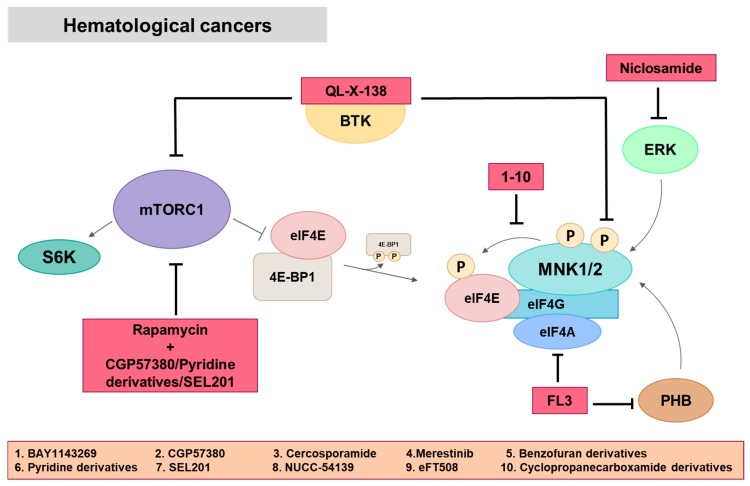
The mitogen-activated protein kinase (MAPK)-interacting kinases (MNKs) are involved in oncogenic transformation and can promote metastasis and tumor progression. In human cells, there are four MNKs isoforms (MNK1a/b and MNK2a/b), derived from two genes by alternative splicing. These kinases play an important role controlling the expression of specific proteins involved in cell cycle, cell survival and cell motility via eukaryotic initiation factor 4E (eIF4E) regulation, but also through other substrates such as heterogeneous nuclear ribonucleoprotein A1, polypyrimidine tract-binding protein-associated splicing factor and Sprouty 2. In this review, we provide an overview of the role of MNK in human cancers, describing the studies conducted to date to elucidate the mechanism involved in the action of MNKs, as well as the development of MNK inhibitors in different hematological cancers and solid tumors.
丝裂原活化蛋白激酶(MAPK)相互作用激酶(MNKs)参与致癌转化,可促进转移和肿瘤进展。在人类细胞中,有四种 MNK 同工型(MNK1a/b 和 MNK2a/b),由两个基因通过选择性剪接产生。这些激酶通过调节真核起始因子 4E(eIF4E)来控制参与细胞周期、细胞存活和细胞迁移的特定蛋白质的表达,此外还通过其他底物如异质核核糖核蛋白 A1、多嘧啶 tract 结合蛋白相关剪接因子和 Sprouty 2 发挥作用。在这篇综述中,我们概述了 MNK 在人类癌症中的作用,描述了迄今为阐明 MNKs 作用机制而进行的研究,以及在不同血液系统癌症和实体瘤中开发 MNK 抑制剂的情况。