Inserm UMR S-1124, Université de Paris, 75006 Paris, France.
HERACLES Research Center on the Exposome and Health, Aristotle University of Thessaloniki, Center for Interdisciplinary Research and Innovation, 57001 Thessaloniki, Greece.
Int J Mol Sci. 2020 Apr 23;21(8):2988. doi: 10.3390/ijms21082988.
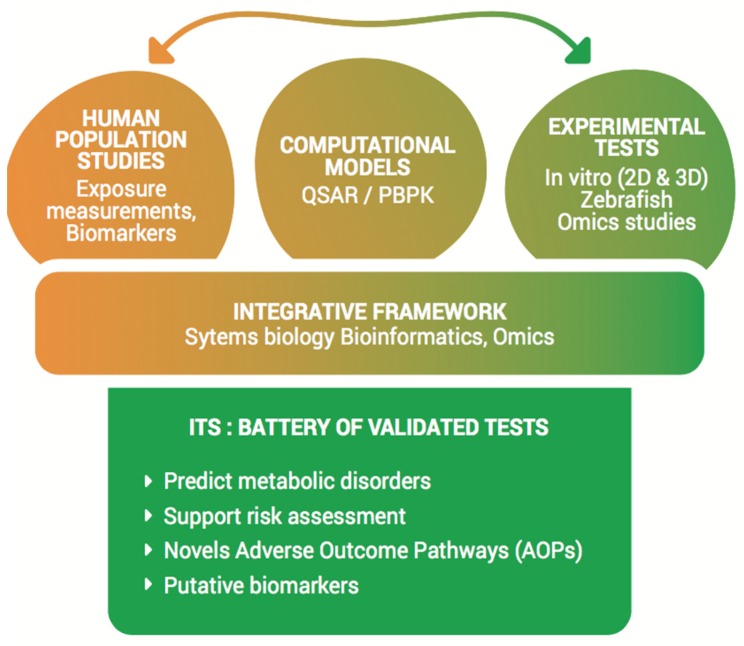
Exposure to chemical substances that can produce endocrine disrupting effects represents one of the most critical public health threats nowadays. In line with the regulatory framework implemented within the European Union (EU) to reduce the levels of endocrine disruptors (EDs) for consumers, new and effective methods for ED testing are needed. The OBERON project will build an integrated testing strategy (ITS) to detect ED-related metabolic disorders by developing, improving and validating a battery of test systems. It will be based on the concept of an integrated approach for testing and assessment (IATA). OBERON will combine (1) experimental methods (in vitro, e.g., using 2D and 3D human-derived cells and tissues, and in vivo, i.e., using zebrafish at different stages), (2) high throughput omics technologies, (3) epidemiology and human biomonitoring studies and (4) advanced computational models (in silico and systems biology) on functional endpoints related to metabolism. Such interdisciplinary framework will help in deciphering EDs based on a mechanistic understanding of toxicity by providing and making available more effective alternative test methods relevant for human health that are in line with regulatory needs. Data generated in OBERON will also allow the development of novel adverse outcome pathways (AOPs). The assays will be pre-validated in order to select the test systems that will show acceptable performance in terms of relevance for the second step of the validation process, i.e., the inter-laboratory validation as ring tests. Therefore, the aim of the OBERON project is to support the organization for economic co-operation and development (OECD) conceptual framework for testing and assessment of single and/or mixture of EDs by developing specific assays not covered by the current tests, and to propose an IATA for ED-related metabolic disorder detection, which will be submitted to the Joint Research Center (JRC) and OECD community.
接触到可能产生内分泌干扰效应的化学物质是当今最严重的公共健康威胁之一。为了降低消费者体内内分泌干扰物(EDs)的水平,符合欧盟(EU)实施的监管框架,需要开发新的有效的 ED 测试方法。OBERON 项目将通过开发、改进和验证一系列测试系统,构建一个用于检测与 ED 相关的代谢紊乱的综合测试策略(ITS)。该策略将基于测试和评估综合方法(IATA)的概念。OBERON 将结合(1)实验方法(例如,使用 2D 和 3D 人源细胞和组织的体外方法,以及使用不同阶段的斑马鱼的体内方法),(2)高通量组学技术,(3)流行病学和人体生物监测研究,(4)基于功能终点的先进计算模型(计算和系统生物学),这些终点与代谢有关。这种跨学科框架将有助于通过提供和利用更有效的替代方法来帮助破译基于毒性的机制理解的 EDs,这些替代方法与人类健康相关,并符合监管需求。在 OBERON 中生成的数据也将允许开发新的不良结局途径(AOPs)。将对测定法进行预验证,以选择在相关性方面具有可接受性能的测试系统,从而进入验证过程的第二步,即作为环试验的实验室间验证。因此,OBERON 项目的目标是通过开发当前测试未涵盖的特定测定法,支持经济合作与发展组织(OECD)对单一和/或混合物 ED 进行测试和评估的概念框架,并提出与 ED 相关的代谢紊乱检测的 IATA,该框架将提交给联合研究中心(JRC)和经合组织社区。