Angelopoulou Efthalia, Paudel Yam Nath, Villa Chiara, Shaikh Mohd Farooq, Piperi Christina
Department of Biological Chemistry, Medical School, National and Kapodistrian University of Athens, 11527 Athens, Greece.
Neuropharmacology Research Strength, Jeffrey Cheah School of Medicine and Health Sciences, Monash University Malaysia, Bandar Sunway 47500, Selangor, Malaysia.
Biology (Basel). 2020 Apr 23;9(4):86. doi: 10.3390/biology9040086.
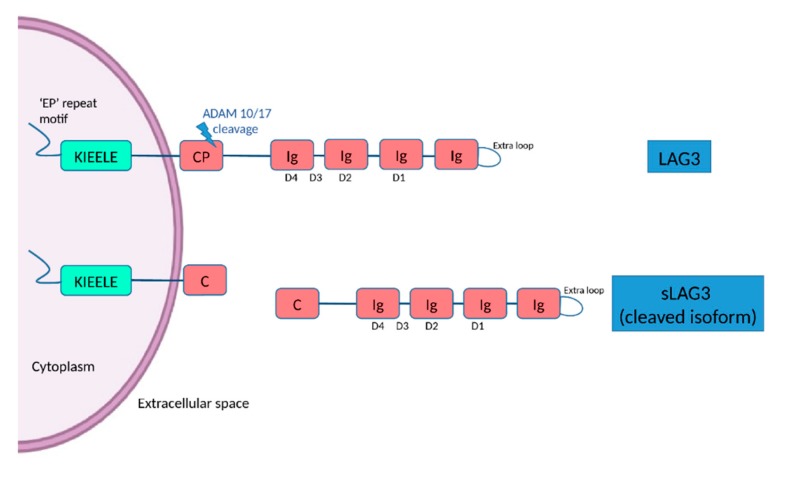
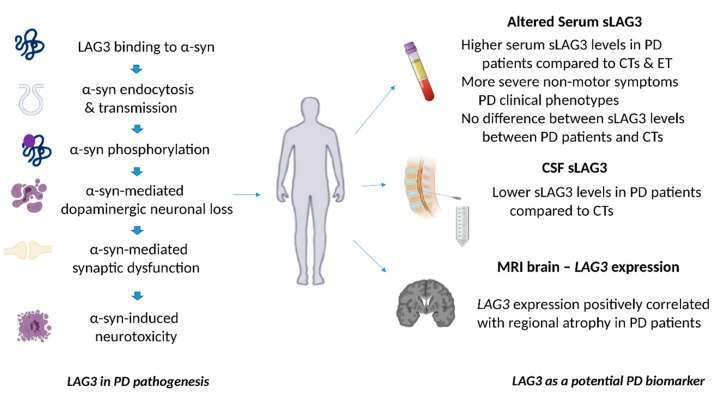
Parkinson's disease (PD) is the most common neurodegenerative movement disorder without any objective biomarker available to date. Increasing evidence highlights the critical role of neuroinflammation, including T cell responses, and spreading of aggregated α-synuclein in PD progression. Lymphocyte-activation gene 3 (LAG3) belongs to the immunoglobulin (Ig) superfamily expressed by peripheral immune cells, microglia and neurons and plays a key role in T cell regulation. The role of LAG3 has been extensively investigated in several human cancers, whereas until recently, the role of LAG3 in the central nervous system (CNS) has been largely unknown. Accumulating evidence highlights the potential role of LAG3 in PD pathogenesis, mainly by binding to α-synuclein fibrils and affecting its endocytosis and intercellular transmission, which sheds more light on the connection between immune dysregulation and α-synuclein spreading pathology. Serum and cerebrospinal fluid (CSF) soluble LAG3 (sLAG3) levels have been demonstrated to be potentially associated with PD development and clinical phenotype, suggesting that sLAG3 could represent an emerging PD biomarker. Specific single nucleotide polymorphisms (SNPs) of the LAG3 gene have been also related to PD occurrence especially in the female population, enlightening the pathophysiological background of gender-related PD clinical differences. Given also the ongoing clinical trials investigating various LAG3-targeting strategies in human diseases, new opportunities are being developed for PD treatment research. In this review, we discuss recent preclinical and clinical evidence on the role of LAG3 in PD pathogenesis and biomarker potential, aiming to elucidate its underlying molecular mechanisms.
帕金森病(PD)是最常见的神经退行性运动障碍,迄今为止尚无任何客观的生物标志物。越来越多的证据表明神经炎症在PD进展中起关键作用,包括T细胞反应以及聚集的α-突触核蛋白的传播。淋巴细胞激活基因3(LAG3)属于免疫球蛋白(Ig)超家族,由外周免疫细胞、小胶质细胞和神经元表达,在T细胞调节中起关键作用。LAG3在几种人类癌症中的作用已得到广泛研究,而直到最近,LAG3在中枢神经系统(CNS)中的作用在很大程度上仍不清楚。越来越多的证据凸显了LAG3在PD发病机制中的潜在作用,主要是通过与α-突触核蛋白原纤维结合并影响其胞吞作用和细胞间传递,这为免疫失调与α-突触核蛋白传播病理学之间的联系提供了更多线索。血清和脑脊液(CSF)可溶性LAG3(sLAG3)水平已被证明可能与PD的发生和临床表型相关,表明sLAG3可能是一种新兴的PD生物标志物。LAG3基因的特定单核苷酸多态性(SNP)也与PD的发生有关,尤其是在女性人群中,这揭示了与性别相关的PD临床差异的病理生理背景。鉴于目前正在进行针对人类疾病的各种LAG3靶向策略的临床试验,PD治疗研究也有了新的机遇。在这篇综述中,我们讨论了关于LAG3在PD发病机制中的作用和生物标志物潜力的最新临床前和临床证据,旨在阐明其潜在的分子机制。