Ma Xiaowan, Ning Ke, Jabbehdari Sayena, Prosseda Philipp P, Hu Yang, Shue Ann, Lambert Scott R, Sun Yang
Xiamen Changgung Hospital, Xiamen, China.
Department of Ophthalmology, School of Medicine, Stanford University, Palo Alto, CA, USA.
Eur J Ophthalmol. 2020 Sep;30(5):966-973. doi: 10.1177/1120672120920544. Epub 2020 Apr 27.
Lowe syndrome is a rare X-linked disease that is characterized by renal dysfunction, developmental delays, congenital cataracts and glaucoma. Mutations in the oculocerebral renal syndrome of Lowe () gene are found in Lowe syndrome patients. Although loss of vision is a major concern for families and physicians who take care of Lowe syndrome children, definitive cause of visual loss is still unclear. Children usually present with bilateral dense cataracts at birth and glaucoma, which occurs in more than half of cases, either concurrently or following cataract surgery.
A retrospective review was conducted on the prevalence and characteristics of ocular findings among families of patients with Lowe syndrome with 137 uniquely affected individuals.
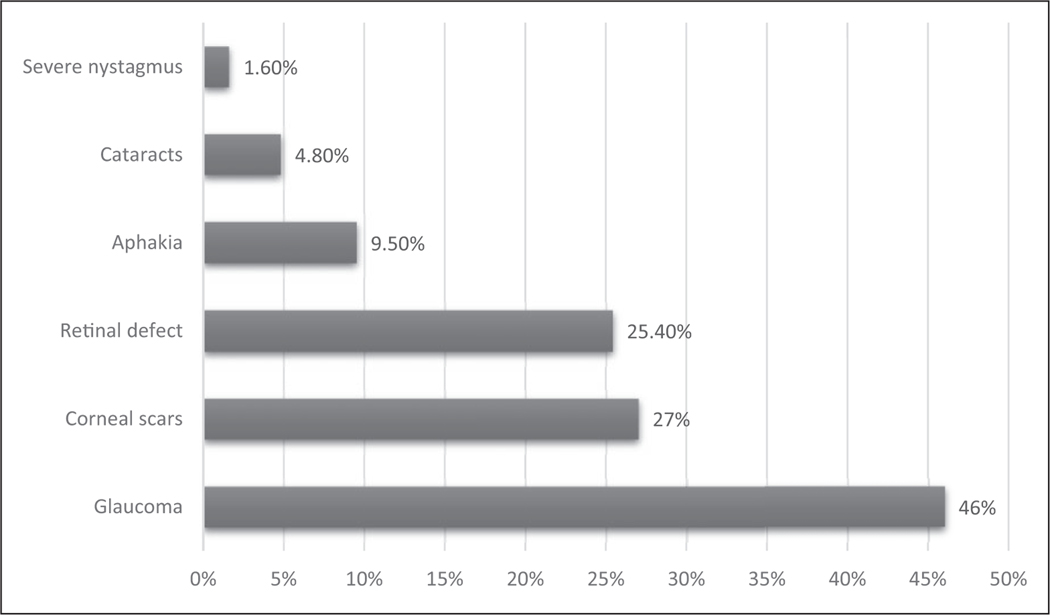
Of 137 patients, all had bilateral congenital cataracts. Nystagmus was reported in 69.3% of cases, glaucoma in 54.7%, strabismus in 35.0%, and corneal scar in 18.2% of patients. Glaucoma was reported as the most common cause of blindness (46%) followed by corneal scars (41%). Glaucoma occurred in 54.7% of patients and affected both eyes in the majority of cases. Of these patients, 55% underwent surgery for glaucoma, while the remaining patients used medications to control their eye pressure. Timolol and latanoprost were the most commonly used medications. Although trabeculectomy and goniotomy are commonly used for pressure management, aqueous tube shunts had the best outcomes.
Ocular manifestations in individuals with Lowe syndrome and carriers with mutation are reported which may help familiarize clinicians with the ocular manifestations and management of a rare and complex syndrome.
劳氏综合征是一种罕见的X连锁疾病,其特征为肾功能障碍、发育迟缓、先天性白内障和青光眼。劳氏综合征患者中发现了劳氏眼脑肾综合征(OCRL)基因的突变。尽管视力丧失是照顾劳氏综合征患儿的家庭和医生主要关注的问题,但视力丧失的确切原因仍不清楚。患儿通常在出生时即出现双侧致密性白内障,超过半数的患儿会并发青光眼,或在白内障手术后发生青光眼。
对137例受独特影响个体的劳氏综合征患者家庭的眼部检查结果的患病率和特征进行了回顾性研究。
137例患者均有双侧先天性白内障。69.3%的病例报告有眼球震颤,54.7%有青光眼,35.0%有斜视,18.2%有角膜瘢痕。青光眼被报告为最常见的失明原因(46%),其次是角膜瘢痕(41%)。54.7%的患者发生青光眼,大多数病例双眼受累。在这些患者中,55%接受了青光眼手术,其余患者使用药物控制眼压。噻吗洛尔和拉坦前列素是最常用的药物。尽管小梁切除术和前房角切开术常用于眼压管理,但房水引流管分流术效果最佳。
报告了劳氏综合征患者和携带OCRL突变的携带者的眼部表现,这可能有助于临床医生熟悉一种罕见复杂综合征的眼部表现及治疗。