Department of Chemistry and Biochemistry, University of Notre Dame, Notre Dame, Indiana 46556, United States.
Freimann Life Sciences Center, University of Notre Dame, Notre Dame, Indiana 46556, United States.
J Med Chem. 2020 May 28;63(10):5287-5296. doi: 10.1021/acs.jmedchem.0c00153. Epub 2020 May 8.
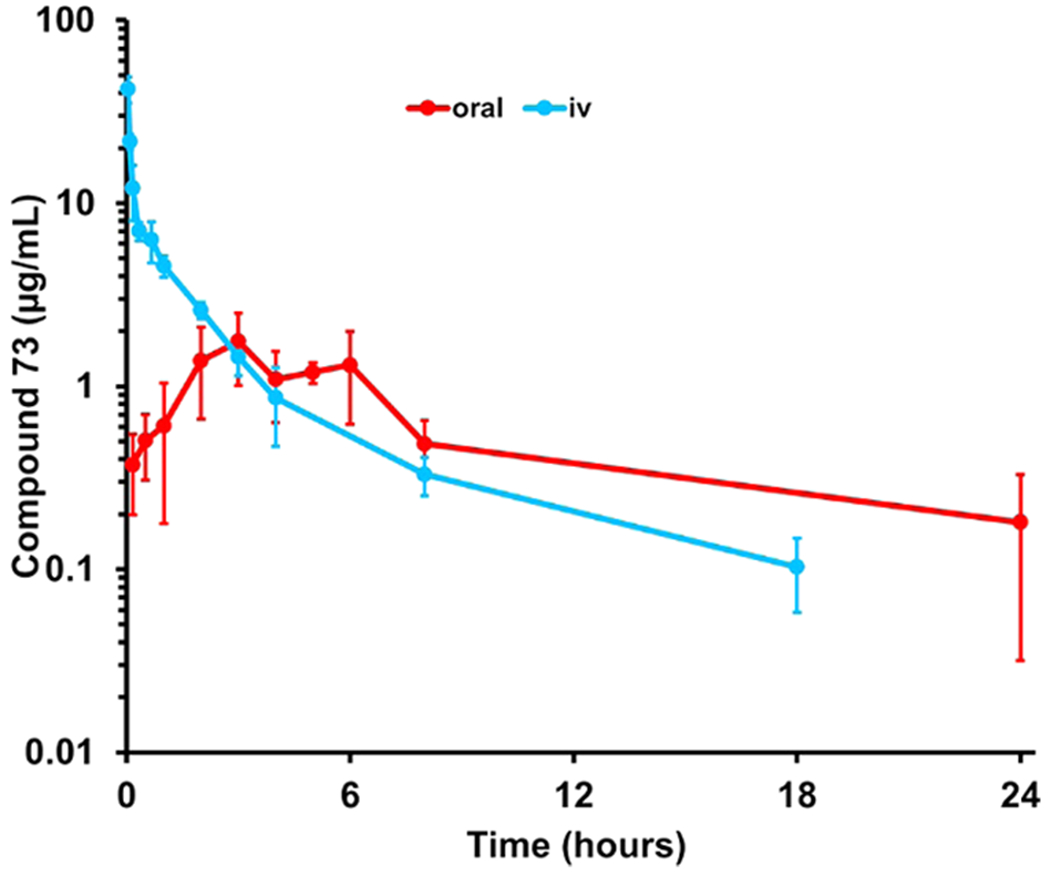
We report herein the syntheses of 79 derivatives of the 4(3)-quinazolinones and their structure-activity relationship (SAR) against methicillin-resistant (MRSA). Twenty one analogs were further evaluated in in vitro assays. Subsequent investigation of the pharmacokinetic properties singled out compound (()-3-(5-carboxy-2-fluorophenyl)-2-(4-cyanostyryl)quinazolin-4(3)-one) for further study. The compound synergized with piperacillin-tazobactam (TZP) both in vitro and in vivo in a clinically relevant mouse model of MRSA infection. The TZP combination lacks activity against MRSA, yet it synergized with compound to kill MRSA in a bactericidal manner. The synergy is rationalized by the ability of the quinazolinones to bind to the allosteric site of penicillin-binding protein (PBP)2a, resulting in opening of the active site, whereby the β-lactam antibiotic now is enabled to bind to the active site in its mechanism of action. The combination effectively treats MRSA infection, for which many antibiotics (including TZP) have faced clinical obsolescence.
我们在此报告了 79 种 4(3)-喹唑啉酮衍生物的合成及其对耐甲氧西林金黄色葡萄球菌(MRSA)的构效关系(SAR)。进一步对 21 种类似物进行了体外评估。随后对药代动力学性质的研究确定了化合物(()-3-(5-羧基-2-氟苯基)-2-(4-氰基苯乙烯基)喹唑啉-4(3)-酮)作为进一步研究的对象。该化合物在 MRSA 感染的临床相关小鼠模型中与哌拉西林-他唑巴坦(TZP)在体外和体内均具有协同作用。TZP 联合用药对 MRSA 没有活性,但与化合物协同作用以杀菌方式杀死 MRSA。这种协同作用是合理的,因为喹唑啉酮能够结合青霉素结合蛋白(PBP)2a 的变构位点,导致活性位点打开,从而使β-内酰胺抗生素现在能够在其作用机制中结合到活性位点。该联合用药有效地治疗了 MRSA 感染,因为许多抗生素(包括 TZP)已经面临临床淘汰。