Department of Psychology, Faculty of Health Sciences, UiT - The Arctic University of Norway, Tromsø, Norway.
Department of Health and Care Sciences, Faculty of Health Sciences, UiT - The Arctic University of Norway, Tromsø, Norway.
BMC Public Health. 2020 Apr 28;20(1):575. doi: 10.1186/s12889-020-08681-x.
The prevailing Western ideal of ageing in place, with the option to stay at home as one ages, has led to the development of physical activity guidelines for people of advanced age to increase their quality of life and promote their functional abilities. This study investigates the effect of self-reported health and physical activity on mortality and examines how levels of age-specific physical activity affect self-reported health trajectories in an ageing cohort.
The sample cohort of the population-based Tromsø Study consists of 24,309 participants aged 25-97 years at baseline. This study involved a survival analysis from 1994 to 2015 and included those who completed two or more surveys (n = 12,241) between 1994 and 2008. The purpose was to examine the relationship between physical activity and self-reported health throughout life using a random coefficient model analysis.
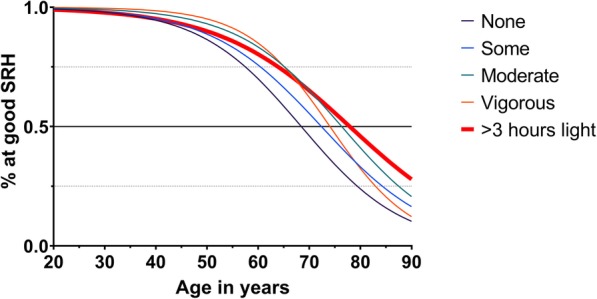
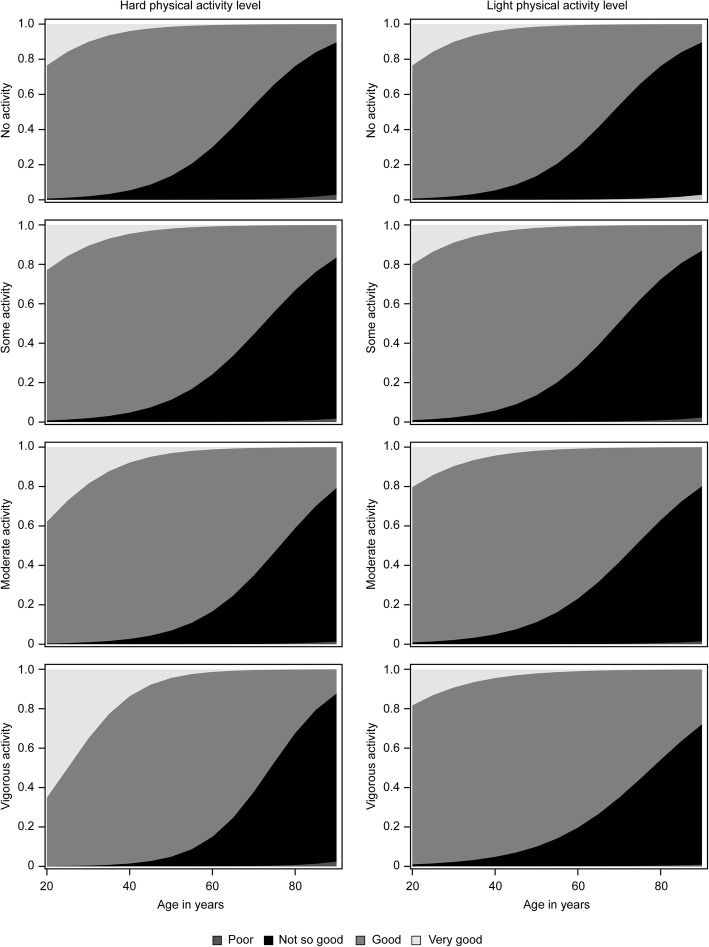
Being sedentary was associated with an increased risk of mortality in the ageing cohort. Subjects who reported neither light physical activity nor hard physical activity had a 57% (OR 1.57, 1.07-2.31) increased risk of all-cause death. Both hard (OR 2.77, 2.35-3.26) and light (OR 1.52, 1.32-1.76) physical activity were positively associated with self-reported health. The effect was age dependent. Vigorous physical activity was most beneficial for individuals younger than 40 years old, while moderate physical activity levels prolonged the period in which good self-reported health was likely.
Poor self-reported health and being sedentary were independently associated with an increased risk of mortality in the participants. Furthermore, physical activity prolonged the period of good self-reported health among older adults in two ways: physical activity habits from early adulthood and onwards were beneficial to self-reported health at an advanced age, and self-reported health was dependent on engagement in moderate intensity physical activity after approximately 65 years of age.
在原地养老的西方主流观念盛行,即随着年龄的增长,可以选择留在家里,这导致为高龄人群制定了身体活动指南,以提高他们的生活质量并促进他们的功能能力。本研究调查了自我报告的健康状况和身体活动对死亡率的影响,并研究了特定年龄段的身体活动水平如何影响老龄化队列中自我报告的健康轨迹。
基于人群的特罗姆瑟研究的样本队列由 24309 名年龄在 25-97 岁的参与者组成。本研究涉及从 1994 年到 2015 年的生存分析,包括在 1994 年至 2008 年间完成两次或两次以上调查的人(n=12241)。本研究旨在使用随机系数模型分析,终生检查身体活动与自我报告的健康之间的关系。
久坐不动与老龄化队列的死亡风险增加有关。既不进行轻度身体活动也不进行剧烈身体活动的受试者全因死亡的风险增加 57%(OR 1.57,1.07-2.31)。剧烈(OR 2.77,2.35-3.26)和轻度(OR 1.52,1.32-1.76)身体活动均与自我报告的健康状况呈正相关。这种影响与年龄有关。剧烈的身体活动对 40 岁以下的个体最有益,而适度的身体活动水平则延长了自我报告健康状况良好的时间。
较差的自我报告健康状况和久坐不动与参与者的死亡率增加独立相关。此外,身体活动以两种方式延长了老年人自我报告健康的时间:从成年早期开始并持续的身体活动习惯对高龄时的自我报告健康有益,并且自我报告的健康状况取决于 65 岁以后适度强度的身体活动。