Søvsø Morten Breinholt, Bech Bodil Hammer, Christensen Helle Collatz, Huibers Linda, Christensen Erika Frischknecht, Christensen Morten Bondo
Centre for Prehospital and Emergency Research, Aalborg University and Aalborg University Hospital, Aalborg, Denmark.
Research Unit for General Practice, Aarhus, Denmark.
Clin Epidemiol. 2020 Apr 15;12:393-401. doi: 10.2147/CLEP.S243531. eCollection 2020.
Out-of-hours (OOH) health care services are often divided into emergency medical services (EMS) and OOH primary care (OOH-PC). EMS and many OOH-PC use telephone triage, yet the patient still makes the initial choice of contacting a service and which service. Sociodemographic characteristics are associated with help-seeking. Yet, differences in characteristics for EMS and OOH-PC patients have not been investigated in any large-scale cohort studies. Such knowledge may contribute to organizing OOH services to match patient needs. Thus, in this study we aimed to explore which sociodemographic patient characteristics were associated with utilizing OOH health care and to explore which sociodemographic characteristics were associated with EMS or OOH-PC contact.
A population-based observational cohort study of inhabitants in two regions (North Denmark Region and Capital Region of Copenhagen) with or without contact to OOH services during 2016 was conducted. Associations between sociodemographic characteristics and OOH contacts (and EMS versus OOH-PC contact) were evaluated by regression analyses.
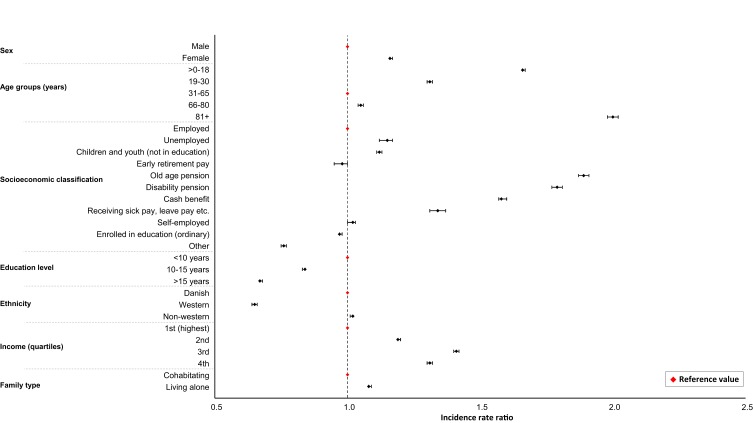
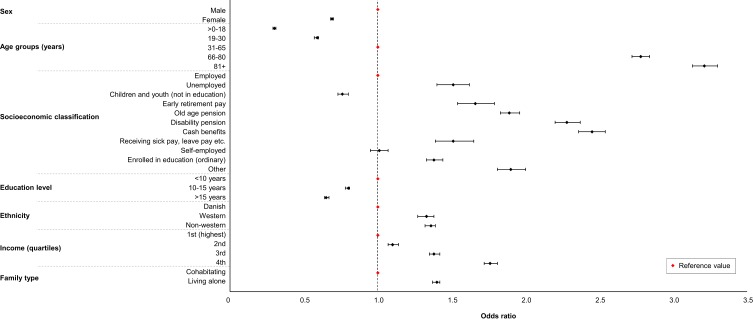
We identified 619,857 patients with OOH contact. Female sex (IRR=1.16 (95% CI: 1.16-1.17)), non-western ethnicity (IRR=1.02 (95% CI: 1.01-1.02)), living alone (IRR=1.08 (95% CI: 1.08-1.09)), age groups ≥81 years (IRR=2.00 (95% CI: 1.98-2.02)) and 0-18 years (IRR=1.66 (95% CI: 1.66-1.67)) and low income (IRR=1.41 (95% CI: 1.40-1.42)) were more likely to contact OOH health care compared to males, Danish ethnicity, citizens cohabitating, age 31-65 years and high income. Disability pensioners more often contacted OOH care (IRR=1.79 (95% CI: 1.77-1.81) compared to employees. Old age (≥81 years) (OR=3.21 (95% CI: 3.13-3.30)), receiving cash benefits (OR=2.45 (95% CI: 2.36-2.54)), low income (OR=1.76 (95% CI: 1.72-1.81)) and living alone (OR=1.40 (95% CI: 1.37-1.42)) were all associated with EMS contacts rather than OOH-PC contacts.
Several sociodemographic factors were associated with contacting a health care service outside office hours and with contacting EMS rather than OOH-PC. Old age, low income, low education and low socioeconomic status were of greatest importance.
非工作时间(OOH)医疗服务通常分为紧急医疗服务(EMS)和非工作时间初级医疗服务(OOH - PC)。EMS和许多OOH - PC都采用电话分诊,但患者仍然是联系服务机构以及选择联系何种服务的最初决策者。社会人口学特征与寻求帮助相关。然而,在任何大规模队列研究中,尚未对EMS患者和OOH - PC患者的特征差异进行调查。此类知识可能有助于组织OOH服务以满足患者需求。因此,在本研究中,我们旨在探索哪些社会人口学患者特征与使用OOH医疗服务相关,并探索哪些社会人口学特征与联系EMS或OOH - PC相关。
对丹麦北部地区和哥本哈根首都地区两个地区在2016年有或没有联系OOH服务的居民进行了一项基于人群的观察性队列研究。通过回归分析评估社会人口学特征与OOH联系(以及EMS与OOH - PC联系)之间的关联。
我们确定了619,857名有OOH联系的患者。与男性、丹麦族裔、同居公民、31 - 65岁年龄组和高收入相比,女性(IRR = 1.16(95% CI:1.16 - 1.17))、非西方族裔(IRR = 1.02(95% CI:1.01 - 1.02))、独居(IRR = 1.08(95% CI:1.08 - 1.09))、81岁及以上年龄组(IRR = 2.00(95% CI:1.98 - 2.02))和0 - 18岁年龄组(IRR = 1.66(95% CI:1.66 - 1.67))以及低收入(IRR = 1.41(95% CI:1.40 - 1.42))更有可能联系OOH医疗服务。与雇员相比,残疾养老金领取者更常联系OOH护理(IRR = 1.79(95% CI:1.77 - 1.81))。老年(≥81岁)(OR = 3.21(95% CI:3.13 - 3.30))接受现金福利(OR = 2.45(95% CI:2.36 - 2.54))、低收入(OR = 1.76(95% CI:1.72 - 1.81))和独居(OR =