Ebert J F, Huibers L, Christensen B, Lippert F K, Christensen M B
a Section for General Medical Practice, Department of Public Health , Aarhus University , Aarhus C , Denmark.
b Research Unit for General Practice , Aarhus C , Denmark.
Scand J Prim Health Care. 2019 Mar;37(1):120-127. doi: 10.1080/02813432.2019.1569427. Epub 2019 Feb 2.
Acute out-of-hours (OOH) healthcare is challenged by potentially long waiting time for callers in acute need of medical aid. OOH callers must usually wait in line, even when contacting for highly urgent or life-threatening conditions. We tested an emergency access button (EAB), which allowed OOH callers to bypass the waiting line if they perceived their health problem as severe. We aimed to investigate EAB use and patient characteristics associated with this use.
Comparative intervention study.
OOH services in two major Danish healthcare regions.
Giving callers the option to bypass the telephone waiting line by introducing an EAB.
OOH service callers contacting during end of October to mid-December 2017.
Proportions of EAB use, waiting time and background information on participants in two settings differing on organisation structure, waiting time and triage personnel.
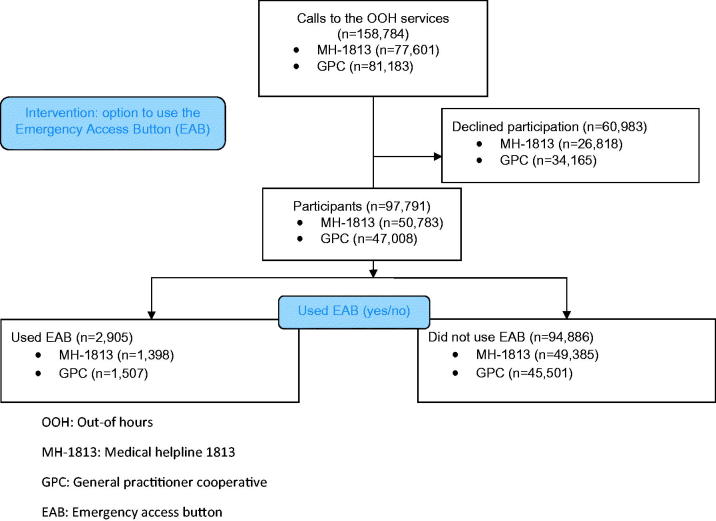
In total, 97,791 out of 158,784 callers (61.6%) chose to participate. The EAB was used 2905 times out of 97,791 (2.97%, 95%CI 2.86; 3.08). Patient characteristics associated with increased EAB use were male gender, higher age, low education, being retired, and increasing announced estimated waiting time. In one region, immigrants used the EAB more often than native Danish callers.
Only about 3% of all callers chose to bypass the waiting line in the OOH service when given the option. This study suggests that the EAB could serve as a new and simple tool to reduce the waiting time for severely ill patients in an OOH service telephone triage setting. Key Points Acute out-of-hours healthcare is challenged by overcrowding and increasing demand for services. This study shows that only approximately 3% of callers chose to bypass the telephone waiting queue when given the opportunity through an emergency access button. An emergency access button may serve as a new tool to help reduce the triage waiting time for severely ill patients in out-of-hours medical facilities.
非工作时间(OOH)的急性医疗保健面临着紧急需要医疗救助的呼叫者可能长时间等待的挑战。OOH呼叫者通常必须排队等候,即使是在联系处理高度紧急或危及生命的情况时也是如此。我们测试了一种紧急接入按钮(EAB),如果OOH呼叫者认为自己的健康问题严重,该按钮可让他们跳过等候队列。我们旨在调查EAB的使用情况以及与此使用相关的患者特征。
比较性干预研究。
丹麦两个主要医疗保健地区的OOH服务。
通过引入EAB,让呼叫者可以选择跳过电话等候队列。
2017年10月底至12月中旬联系OOH服务的呼叫者。
在组织结构、等待时间和分诊人员方面存在差异的两种情况下,EAB的使用比例、等待时间以及参与者的背景信息。
在158,784名呼叫者中,共有97,791名(61.6%)选择参与。在97,791次呼叫中,EAB被使用了2905次(2.97%,95%CI 2.86;3.08)。与EAB使用增加相关的患者特征包括男性、年龄较大、教育程度低、退休以及宣布的预计等待时间增加。在一个地区,移民使用EAB的频率高于丹麦本地呼叫者。
在有选择的情况下,所有呼叫者中只有约3%选择在OOH服务中跳过等候队列。这项研究表明,EAB可以作为一种新的简单工具,减少OOH服务电话分诊环境中重症患者的等待时间。要点非工作时间的急性医疗保健面临着过度拥挤和服务需求增加的挑战。这项研究表明,当通过紧急接入按钮有机会时,只有约3%的呼叫者选择跳过电话等候队列。紧急接入按钮可作为一种新工具,帮助减少非工作时间医疗设施中重症患者的分诊等待时间。