Matsuoka Hiroshi, Ogata Yutaka, Nakamura Michio, Shibata Yoshihisa, Munemoto Yoshinori, Bando Hiroyuki, Nishijima Koji, Okuda Hiroyuki, Terada Itsuro, Shiroiwa Takeru, Kishimoto Junji, Maeda Kotaro
Department of Surgery, Fujita Health University, Toyoake, Japan.
Department of Surgery, Kurume University, Kurume, Japan.
J Anus Rectum Colon. 2020 Apr 28;4(2):79-84. doi: 10.23922/jarc.2019-020. eCollection 2020.
In recent years, CapeOX therapy for patients with colorectal cancer is widely used. We previously reported that a multidisciplinary approach decreases the worsening of adverse events and increases patient satisfaction. In this study, we conducted a multicenter, prospective, observational study to evaluate the incidence of adverse events, health-related quality of life (HRQOL) of the patient, and efficacy of a management (intervention) according to the support system (SMILE study).
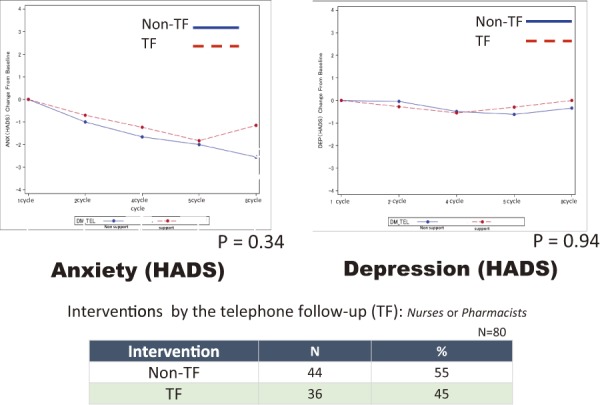
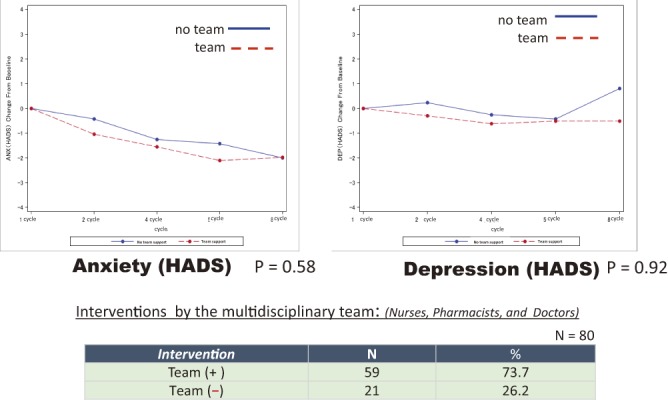
As the interventional method, the following more than one method was carried out in each institute, 1: support with telephone, 2: dosing instruction by a pharmacist, 3: skin care instruction by a nurse, and 4: patient instruction by a doctor. The primary endpoint was the incidence of hand-foot syndrome (HFS) of more than grade 2. The secondary endpoint was the HRQOL evaluation and efficacy. The questionnaire (HADS) was administered before the start of the chemotherapy and in 1, 2, 4, 5, and 8 courses to evaluate quality of life (QOL).
From April 2011 to September 2012, 80 patients were enrolled from 14 sites, and all patients were the subjects of analysis. The demographic background was as follows: man/woman: 46/34, age median: 63 (36-75), and management interventional method 1/2/3/4: 36/68/73/78. The overall percentage of HFS that exceeded grade 2 within 6 months was 16.3%. It was 11.1% with the telephone support group and 20.5% without the telephone support group (p = 0.26).
A multi-professional telephone support may reduce the deterioration of HFS. Further study which includes larger cohort is needed in the future.
近年来, CapeOX方案在结直肠癌患者中广泛应用。我们之前报道多学科方法可减少不良事件的恶化并提高患者满意度。在本研究中,我们进行了一项多中心、前瞻性观察研究,以评估不良事件的发生率、患者的健康相关生活质量(HRQOL)以及根据支持系统进行管理(干预)的效果(SMILE研究)。
作为干预方法,各机构采用以下一种以上方法:1:电话支持;2:药剂师进行剂量指导;3:护士进行皮肤护理指导;4:医生进行患者指导。主要终点是2级以上手足综合征(HFS)的发生率。次要终点是HRQOL评估和效果。在化疗开始前以及第1、2、4、5和8疗程时进行问卷调查(HADS)以评估生活质量(QOL)。
2011年4月至2012年9月,从14个地点招募了80例患者,所有患者均为分析对象。人口统计学背景如下:男/女:46/34,年龄中位数:63(36 - 75),管理干预方法1/2/3/4:36/68/73/78。6个月内HFS超过2级的总体百分比为16.3%。电话支持组为11.1%,无电话支持组为20.5%(p = 0.26)。
多专业电话支持可能会减少HFS的恶化。未来需要纳入更大队列的进一步研究。