Microbiology Department, Hospital Universitari Bellvitge, IDIBELL-UB, L'Hospitalet de LLobregat, Spain.
Research Network for Respiratory Diseases (CIBERES), ISCIII, Madrid, Spain.
Euro Surveill. 2020 Apr;25(16). doi: 10.2807/1560-7917.ES.2020.25.16.1900457.
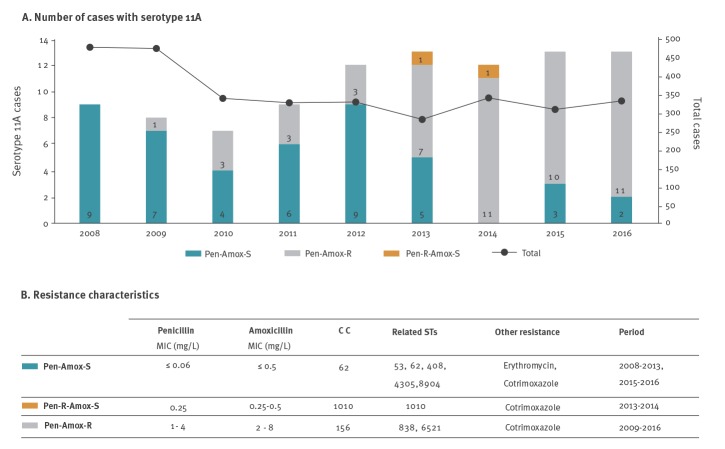
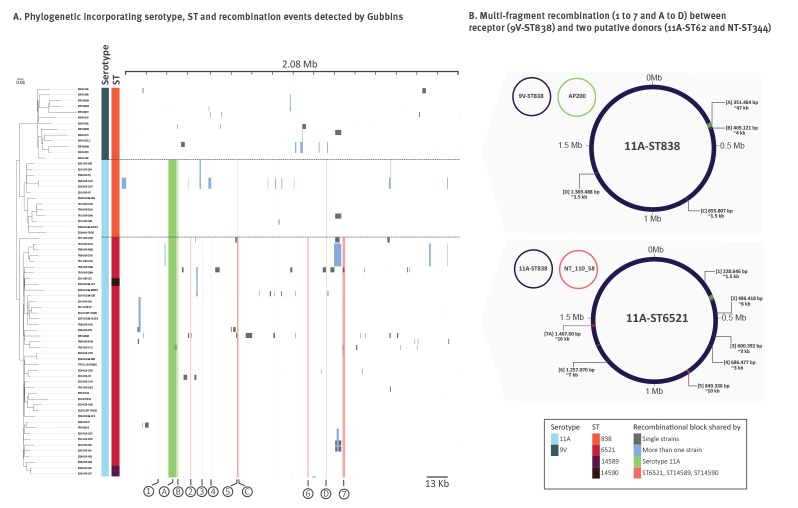
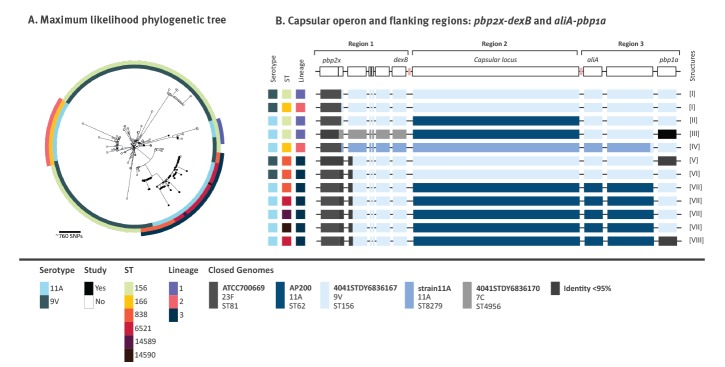
BackgroundThe successful pneumococcal clone Spain9V-ST156 (PMEN3) is usually associated with vaccine serotypes 9V and 14.AimOur objective was to analyse the increase of a serotype 11A variant of PMEN3 as cause of invasive pneumococcal disease (IPD) in Spain and its spread in south-western Europe.MethodsWe conducted a prospective multicentre study of adult IPD in Spain (2008-16). Furthermore, a subset of 61 penicillin-resistant serotype 11A isolates from France, Italy, Portugal and Spain were subjected to whole genome sequencing (WGS) and compared with 238 genomes from the European Nucleotide Archive (ENA).ResultsAlthough the incidence of serotype 11A in IPD was stable, a clonal shift was detected from CC62 (penicillin-susceptible) to CC156 (penicillin-resistant). By WGS, three major 11A-CC156 lineages were identified, linked to ST156 (n = 5 isolates; France, Italy and Portugal), ST166 (n = 4 isolates; France and Portugal) and ST838/6521 (n = 52 isolates; France, Portugal and Spain). Acquisition of the 11A capsule allowed to escape vaccine effect. AP200 (11A-ST62) was the donor for ST156 and ST838/6521 but not for ST166. In-depth analysis of ST838/6521 lineage showed two multi-fragment recombination events including four and seven fragments from an 11A-ST62 and an NT-ST344 representative, respectively.ConclusionThe increase in penicillin-resistant serotype 11A IPD in Spain was linked to the spread of a vaccine escape PMEN3 recombinant clone. Several recombination events were observed in PMEN3 acquiring an 11A capsule. The most successful 11A-PMEN3 lineage spreading in south-western Europe appeared after two multi-fragment recombination events with representatives of two major pneumococcal clones (11A-ST62 and NT-ST344).
背景
成功的肺炎球菌克隆 Spain9V-ST156(Pmen3)通常与疫苗血清型 9V 和 14 相关。
目的
我们的目的是分析作为西班牙侵袭性肺炎球菌病(IPD)病因的血清型 11A 变体 PMEN3 的增加及其在西南欧的传播。
方法
我们进行了一项西班牙成人 IPD 的前瞻性多中心研究(2008-16 年)。此外,对来自法国、意大利、葡萄牙和西班牙的 61 株耐青霉素血清型 11A 分离株进行了全基因组测序(WGS),并与欧洲核苷酸档案(ENA)中的 238 个基因组进行了比较。
结果
虽然血清型 11A 在 IPD 中的发病率保持稳定,但检测到从 CC62(青霉素敏感)到 CC156(青霉素耐药)的克隆转移。通过 WGS,确定了三个主要的 11A-CC156 谱系,与 ST156(n=5 株;法国、意大利和葡萄牙)、ST166(n=4 株;法国和葡萄牙)和 ST838/6521(n=52 株;法国、葡萄牙和西班牙)相关联。获得 11A 荚膜可逃避疫苗效果。AP200(11A-ST62)是 ST156 和 ST838/6521 的供体,但不是 ST166 的供体。对 ST838/6521 谱系的深入分析显示,有两个多片段重组事件,分别包含来自 11A-ST62 和 NT-ST344 代表的四个和七个片段。
结论
西班牙青霉素耐药血清型 11A IPD 的增加与一种逃避疫苗的 PMEN3 重组克隆的传播有关。在获得 11A 荚膜的 PMEN3 中观察到几个重组事件。在西南欧传播最成功的 11A-PMEN3 谱系出现在两个多片段重组事件之后,涉及两个主要肺炎球菌克隆(11A-ST62 和 NT-ST344)的代表。