Neuroscience Research Program, St. Michael's Hospital, Toronto, Canada.
Keenan Research Centre for Biomedical Science of St. Michael's Hospital, Toronto, Canada.
Hum Brain Mapp. 2020 Jul;41(10):2567-2582. doi: 10.1002/hbm.24962. Epub 2020 Apr 29.
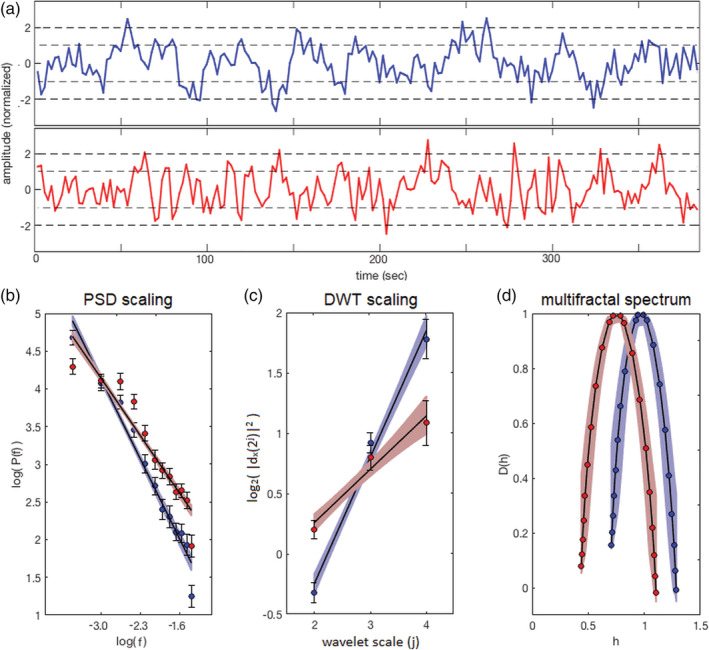
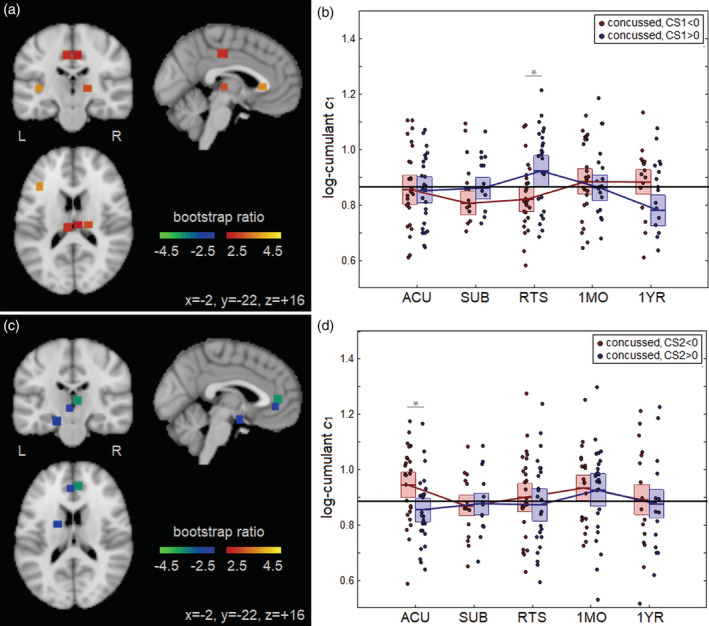
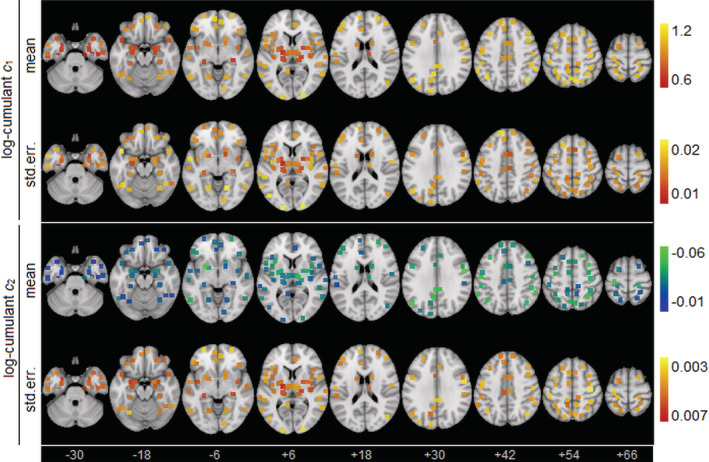
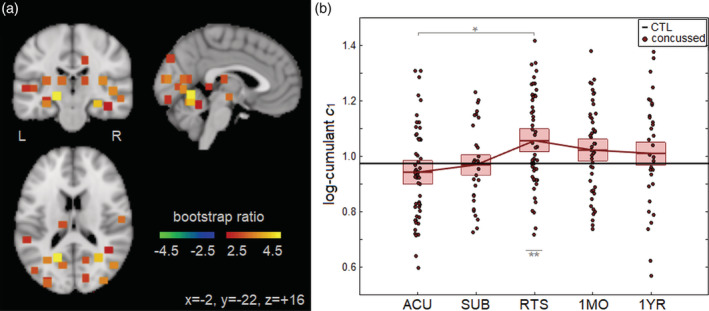
Studies using blood-oxygenation-level-dependent functional magnetic resonance imaging (BOLD fMRI) have characterized how the resting brain is affected by concussion. The literature to date, however, has largely focused on measuring changes in the spatial organization of functional brain networks. In the present study, changes in the temporal dynamics of BOLD signals are examined throughout concussion recovery using scaling (or fractal) analysis. Imaging data were collected for 228 university-level athletes, 61 with concussion and 167 athletic controls. Concussed athletes were scanned at the acute phase of injury (1-7 days postinjury), the subacute phase (8-14 days postinjury), medical clearance to return to sport (RTS), 1 month post-RTS and 1 year post-RTS. The wavelet leader multifractal approach was used to assess scaling ( c ) and multifractal ( c ) behavior. Significant longitudinal changes were identified for c , which was lowest at acute injury, became significantly elevated at RTS, and returned near control levels by 1 year post-RTS. No longitudinal changes were identified for c . Secondary analyses showed that clinical measures of acute symptom severity and time to RTP were related to longitudinal changes in c . Athletes with both higher symptoms and prolonged recovery had elevated c values at RTS, while athletes with higher symptoms but rapid recovery had reduced c at acute injury. This study provides the first evidence for long-term recovery of BOLD scale-free brain dynamics after a concussion.
使用血氧水平依赖功能磁共振成像(BOLD fMRI)的研究已经描述了静息大脑如何受到脑震荡的影响。然而,迄今为止,文献主要集中在测量功能脑网络的空间组织变化。在本研究中,使用标度(或分形)分析检查了 BOLD 信号在脑震荡恢复过程中的时间动态变化。对 228 名大学生运动员(61 名患有脑震荡,167 名运动对照组)进行了成像数据采集。脑震荡运动员在受伤的急性期(受伤后 1-7 天)、亚急性期(受伤后 8-14 天)、恢复运动医学许可(RTS)、RTS 后 1 个月和 RTS 后 1 年进行扫描。使用小波领先多重分形方法评估标度(c)和多重分形(c)行为。c 存在显著的纵向变化,在急性期最低,在 RTS 时显著升高,并在 RTS 后 1 年接近对照组水平。c 没有纵向变化。二次分析表明,急性症状严重程度和 RTP 时间的临床测量与 c 的纵向变化有关。急性症状较高且恢复期较长的运动员在 RTS 时 c 值较高,而急性症状较高但恢复较快的运动员在急性损伤时 c 值较低。这项研究首次提供了脑震荡后 BOLD 无标度大脑动力学长期恢复的证据。