Department of Psychology, King's College London, Institute of Psychiatry, Psychology and Neuroscience (IoPPN), De Crespigny Park, London, SE5 8AF, UK.
Department of Psychology, University of Bath, Bath, BA2 7AY, UK.
BMC Psychiatry. 2020 Apr 29;20(1):193. doi: 10.1186/s12888-020-02608-x.
Inpatient psychiatric care is a scarce and expensive resource in the National Health Service (NHS), with chronic bed shortages being partly driven by high re-admission rates. Brief inpatient talking therapies for psychosis could help reduce re-admission rates. The primary aim was to assess feasibility and acceptability of a novel, brief, mindfulness-based intervention for inpatients with psychosis. The secondary aim was to collect pilot outcome data on readmission rate, at 6 and 12 months (m) post discharge, and self-report symptom measures at 6 m.
The amBITION study (BrIef Talking therapIes ON wards) was a parallel group, feasibility randomised controlled trial (RCT). In addition to treatment as usual (TAU), eligible inpatients with psychotic symptoms were randomly allocated to receive either (Mindfulness-Based Crisis Intervention; MBCI) or a control intervention (Social Activity Therapy; SAT), for 1-5 sessions.
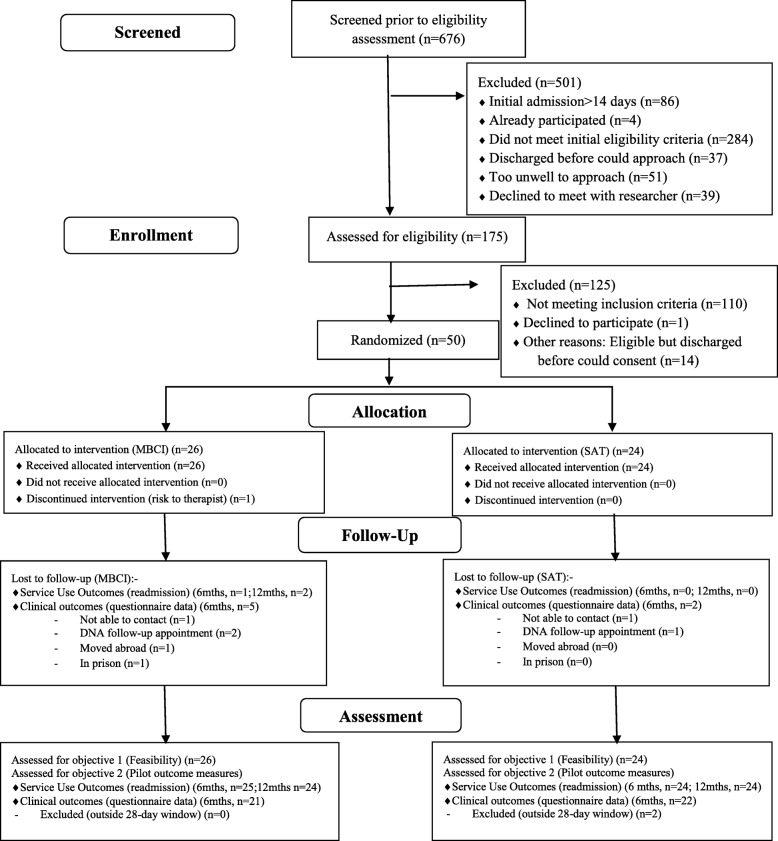
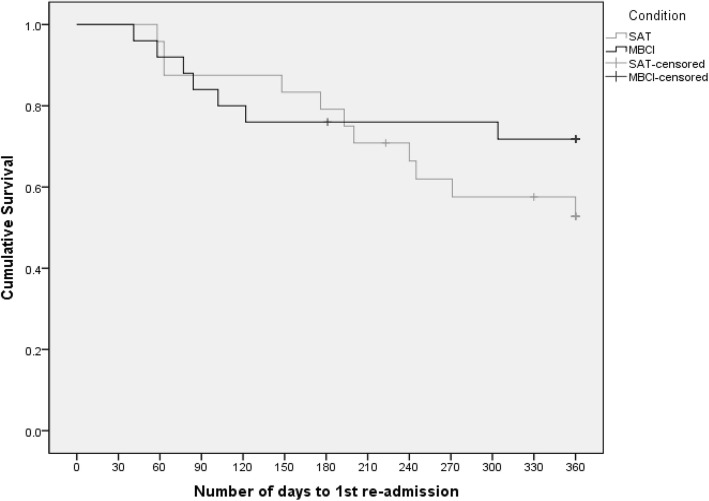
Fifty participants were recruited (26 MBCI; 24 SAT); all received at least 1 therapy session (mean = 3). Follow-up rates were 98% at 6 m and 96% at 12 m for service use data extracted from clinical notes, and 86% for self-report measures. At 6 m follow-up, re-admission rates were similar across groups (MBCI = 6, SAT = 5; odds ratio = 1.20, 95% CI: 0.312-4.61). At 12 m follow-up, re-admissions were lower in the MBCI group (MBCI = 7, SAT = 11; odds ratio = 0.46, 95% CI: 0.14-1.51). Three participants experienced adverse events; none was related to trial participation.
Delivering a brief mindfulness-based inpatient intervention for psychosis is feasible and acceptable, and may reduce risk of short-term readmission. These promising findings warrant progression to a larger clinical effectiveness trial.
ISRCTN37625384.
在国民保健制度(NHS)中,住院精神病治疗是一种稀缺且昂贵的资源,慢性床位短缺部分是由于高再入院率造成的。针对精神病的短期住院谈话疗法可能有助于降低再入院率。主要目的是评估一种新颖的、简短的基于正念的干预措施在精神病住院患者中的可行性和可接受性。次要目的是收集 6 个月和 12 个月(m)出院后再入院率以及 6m 时自我报告症状测量的初步结果。
amBITION 研究(BrIef Talking therapIes ON wards)是一项平行组可行性随机对照试验(RCT)。除了常规治疗(TAU)外,符合条件的有精神病症状的住院患者被随机分配接受正念危机干预(MBCI)或对照干预(社交活动治疗;SAT),共 1-5 次。
共招募了 50 名参与者(MBCI 26 名;SAT 24 名);所有人都接受了至少 1 次治疗(平均=3)。从临床记录中提取的服务使用数据的随访率为 6m 时为 98%,12m 时为 96%,自我报告测量的随访率为 86%。在 6m 随访时,两组的再入院率相似(MBCI=6,SAT=5;优势比=1.20,95%CI:0.312-4.61)。在 12m 随访时,MBCI 组的再入院率较低(MBCI=7,SAT=11;优势比=0.46,95%CI:0.14-1.51)。有 3 名参与者出现不良事件;无一人与试验参与有关。
为精神病患者提供简短的基于正念的住院干预是可行且可接受的,并且可能降低短期再入院的风险。这些有希望的发现证明了向更大规模的临床有效性试验推进的合理性。
ISRCTN37625384。