Turcsán Borbála, Tátrai Kitti, Petró Eszter, Topál József, Balogh Lajos, Egyed Balázs, Kubinyi Eniko
Department of Ethology, ELTE Eötvös Loránd University, Budapest, Hungary.
Research Centre for Natural Sciences, Institute of Cognitive Neuroscience and Psychology, Hungarian Academy of Sciences, Budapest, Hungary.
Front Vet Sci. 2020 Apr 15;7:183. doi: 10.3389/fvets.2020.00183. eCollection 2020.
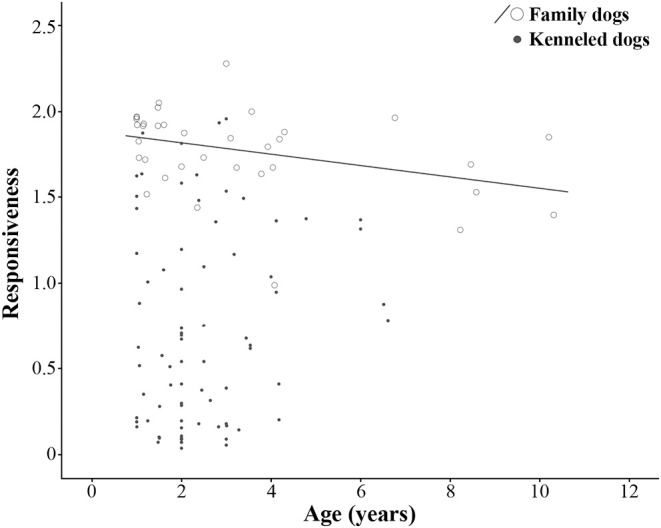
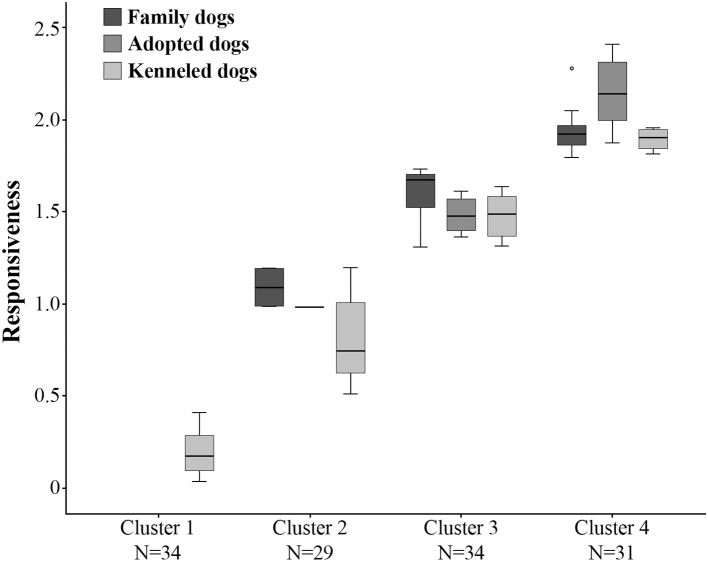
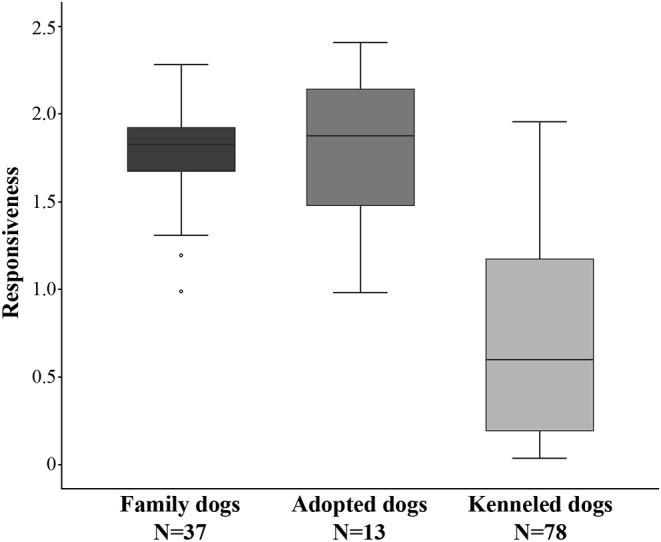
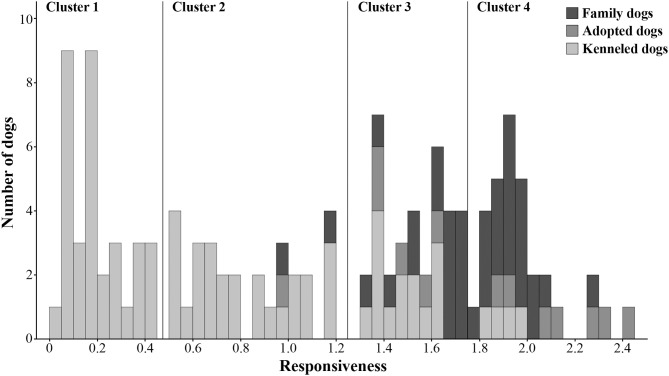
In dogs, the social and spatial restriction associated with living in a kennel environment could lead to chronic stress and the development of abnormal behaviors ("kennel-dog syndrome"). However, little is known about how kenneled dogs differ from their conspecifics living as pets in human families. In the current study, using a test battery exposing the dogs to novel stimuli, we compared the behavior of three groups of beagles: (1) kenneled dogs living in a restricted environment with limited human contact ( = 78), (2) family dogs living in human families as pets ( = 37), and (3) adopted dogs born in the kenneled population but raised in human families ( = 13). We found one factor comprising most of the test behaviors, labeled as Responsiveness. Family dogs and adopted dogs scored higher in Responsiveness than kenneled dogs. However, 23% of the kenneled dogs were comparable to family and adopted dogs based on a cluster analysis, indicating a similar (positive) reaction to novel stimuli, while 77% of the kenneled dogs were unresponsive (mostly immobile) in at least part of the test. To assess if the behavioral difference between the family and kenneled dogs could be due to genetic divergence of these two populations and/or to lower genetic diversity of the kenneled dogs, we analyzed their genetic structure using 11 microsatellite markers. We found no significant difference between the populations in their genetic diversity (i.e., heterozygosity, level of inbreeding), nor any evidence that the family and kenneled populations originated from different genetic pools. Thus, the behavior difference between the groups more likely reflects a G × E interaction, that is, the influence of specific genetic variants manifesting under specific environmental conditions (kennel life). Nevertheless, some kenneled individuals were (genetically) more resistant to social and environmental deprivation. Selecting for such animals could strongly improve the welfare of kenneled dog populations. Moreover, exploring the genetic background of their higher resilience could also help to better understand the genetics behind stress- and fear-related behaviors.
在犬类中,与生活在犬舍环境相关的社交和空间限制可能会导致慢性应激以及异常行为的发展(“犬舍犬综合征”)。然而,对于生活在犬舍中的犬与作为宠物生活在人类家庭中的同类犬有何不同,我们知之甚少。在当前的研究中,我们使用一组让犬接触新刺激的测试,比较了三组比格犬的行为:(1) 生活在限制环境中且与人接触有限的犬舍犬(n = 78),(2) 作为宠物生活在人类家庭中的家庭犬(n = 37),以及 (3) 出生在犬舍群体但在人类家庭中饲养的领养犬(n = 13)。我们发现一个包含大多数测试行为的因素,标记为反应性。家庭犬和领养犬在反应性方面的得分高于犬舍犬。然而,根据聚类分析,23% 的犬舍犬与家庭犬和领养犬相当,表明对新刺激有类似的(积极)反应,而 77% 的犬舍犬在至少部分测试中无反应(大多不动)。为了评估家庭犬和犬舍犬之间的行为差异是否可能是由于这两个群体的遗传差异和 / 或犬舍犬较低的遗传多样性,我们使用 11 个微卫星标记分析了它们的遗传结构。我们发现这些群体在遗传多样性(即杂合性、近亲繁殖水平)方面没有显著差异,也没有任何证据表明家庭犬群体和犬舍犬群体起源于不同的基因库。因此,各组之间的行为差异更可能反映了基因与环境的相互作用,也就是说,特定基因变异在特定环境条件(犬舍生活)下的表现。然而,一些犬舍犬个体(在基因上)对社交和环境剥夺更具抵抗力。选择这样的动物可以极大地改善犬舍犬群体的福利。此外,探索它们更高恢复力的遗传背景也有助于更好地理解与应激和恐惧相关行为背后的遗传学。