Department of Obstetrics and Gynecology, Zhujiang Hospital of Southern Medical University, Guangzhou, Guangdong, China.
Department of Obstetrics and Gynecology, Guangdong Provincial People's Hospital, Guangdong Academy of Medical Sciences, Guangzhou, Guangdong, China.
J Immunol Res. 2020 Apr 13;2020:3582648. doi: 10.1155/2020/3582648. eCollection 2020.
Premature ovarian insufficiency (POI) represents the hypergonadotropic hypoestrogenic symptoms that result in the loss of ovarian follicles. 5-30% POI cases are suggested to be involved in autoimmune etiology. MicroRNA-21 (miR-21) plays a vital role in ovarian folliculogenesis via regulating and interacting with multiple target genes. Here, we conduct the target prediction of miR-21, identify the expression and correlation of miR-21 and its putative target Pellino-1 (Peli1), and confirm their relationship with clinical characteristics in autoimmune POI.
Bioinformatic analysis was conducted to screen the miR-21 putative target gene. Autoimmune POI mouse models were established by ZP3 immunization. Serum miR-21, Peli1 mRNA of peripheral blood mononuclear cells (PBMCs) and regulatory T cells (Tregs), general status, spleen Tregs ratio, inflammatory factors, ovarian endocrine function, and ovarian structure were evaluated. For autoimmune POI patients, serum miR-21, PBMCs Peli1 mRNA levels, general data, immune parameters, hormone levels, and ultrasound examinations were obtained. The correlations of miR-21 with Peli1 and clinical characteristics in patients were analyzed.
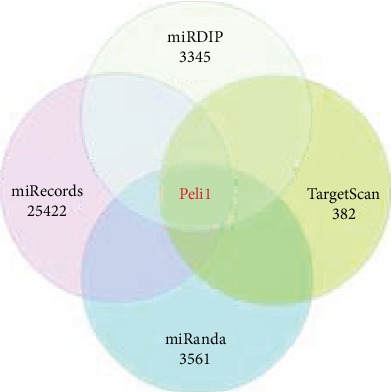
Peli1 was selected based on four microRNA prediction databases and literature retrieval. In mouse models, serum miR-21 level, PBMCs and Tregs Peli1 mRNA, and spleen Tregs ratio were 0.61 ± 0.09, 0.12 ± 0.12, 0.27±0.23 and 4.82 ± 0.58, respectively, lower than those in the control group. In patients, miR-21 level (0.60 ± 0.14) and Peli1 mRNA (0.30 ± 0.14) were lower than those in the control group (1.01 ± 0.07 and 1.63 ± 0.54); miR-21 was positively related with Peli1, AMH, E, the size of the uterus, and ovarian volume and negatively related with FSH, LH, and the number of positive immune parameters (AOAb, EMAb, ACL, ANA, ds-DNA, ACA, IgG, IgA, IgM, IgE, C3, and C4).
Low expressions of miR-21 and Peli1 were detected in autoimmune POI mice and patients. Positive correlation between miR-21 and Peli1 was observed in autoimmune POI patients, suggesting that miR-21 and Peli1 might be associated with the pathogenesis of autoimmune POI.
卵巢早衰(POI)表现为促性腺激素升高、雌激素降低的症状,导致卵泡耗竭。5-30%的 POI 病例被认为与自身免疫病因有关。微小 RNA-21(miR-21)通过调节和与多个靶基因相互作用,在卵泡发生中发挥重要作用。在这里,我们进行了 miR-21 的靶基因预测,鉴定了 miR-21 及其假定靶基因 Pellino-1(Peli1)的表达和相关性,并证实了它们与自身免疫性 POI 的临床特征的关系。
生物信息学分析筛选 miR-21 的假定靶基因。通过 ZP3 免疫建立自身免疫性 POI 小鼠模型。评估血清 miR-21、外周血单个核细胞(PBMCs)和调节性 T 细胞(Tregs)中的 Peli1 mRNA、一般情况、脾脏 Tregs 比值、炎症因子、卵巢内分泌功能和卵巢结构。对于自身免疫性 POI 患者,检测血清 miR-21、PBMCs Peli1 mRNA 水平、一般资料、免疫参数、激素水平和超声检查。分析 miR-21 与 Peli1 及患者临床特征的相关性。
基于四个 microRNA 预测数据库和文献检索,选择了 Peli1。在小鼠模型中,血清 miR-21 水平、PBMCs 和 Tregs Peli1 mRNA 以及脾脏 Tregs 比值分别为 0.61 ± 0.09、0.12 ± 0.12、0.27±0.23 和 0.27±0.23,均低于对照组。在患者中,miR-21 水平(0.60 ± 0.14)和 Peli1 mRNA(0.30 ± 0.14)均低于对照组(1.01 ± 0.07 和 1.63 ± 0.54);miR-21 与 Peli1、AMH、E、子宫大小和卵巢体积呈正相关,与 FSH、LH 和阳性免疫参数的数量(AOAb、EMAb、ACL、ANA、ds-DNA、ACA、IgG、IgA、IgM、IgE、C3 和 C4)呈负相关。
在自身免疫性 POI 小鼠和患者中检测到 miR-21 和 Peli1 的低表达。在自身免疫性 POI 患者中观察到 miR-21 与 Peli1 之间的正相关,提示 miR-21 和 Peli1 可能与自身免疫性 POI 的发病机制有关。