Department of Biomedical Sciences, Seoul National University College of Medicine, Seoul, Republic of Korea.
Department of Psychology, Duksung Women's University, Ssangmun-Dong, Dobong-Gu, Republic of Korea.
JMIR Mhealth Uhealth. 2020 Apr 30;8(4):e14817. doi: 10.2196/14817.
Developing effective, widely useful, weight management programs is a priority in health care because obesity is a major health problem.
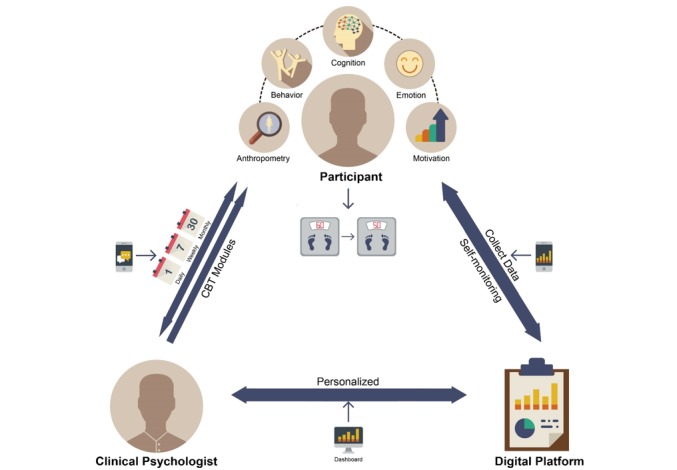
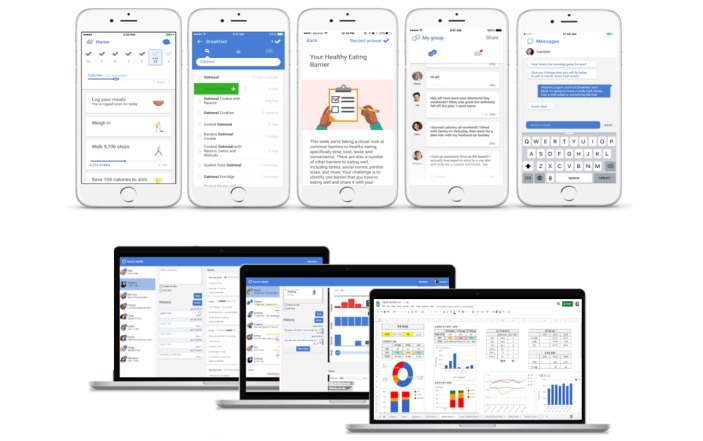
This study developed and investigated a new, comprehensive, multifactorial, daily, intensive, psychologist coaching program based on cognitive behavioral therapy (CBT) modules. The program was delivered via the digital health care mobile services Noom Coach and InBody.
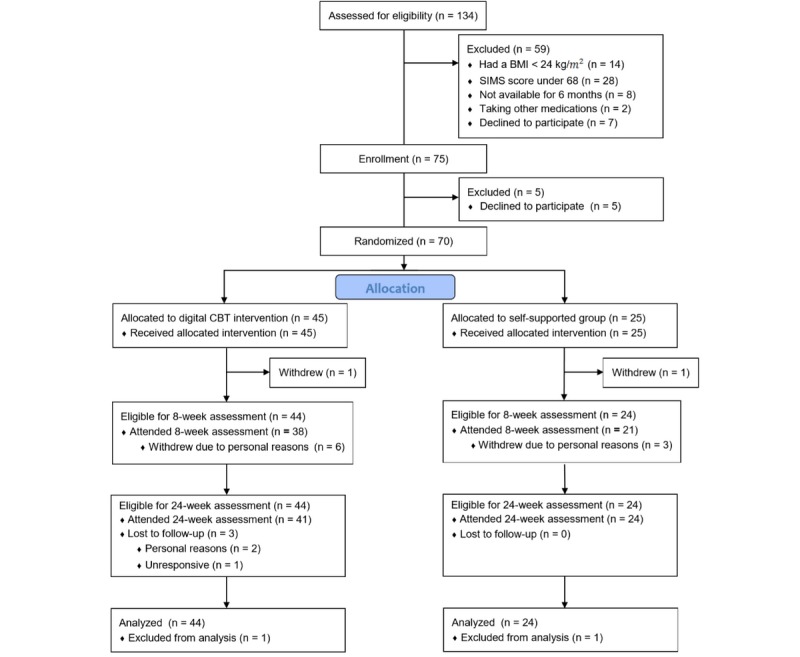
This was an open-label, active-comparator, randomized controlled trial. A total of 70 female participants with BMI scores above 24 kg/m and no clinical problems besides obesity were randomized into experimental and control groups. The experimental (ie, digital CBT) group (n=45) was connected with a therapist intervention using a digital health care service that provided daily feedback and assignments for 8 weeks. The control group (n=25) also used the digital health care service, but practiced self-care without therapist intervention. The main outcomes of this study were measured objectively at baseline, 8 weeks, and 24 weeks and included weight (kg) as well as other body compositions. Differences between groups were evaluated using independent t tests and a per-protocol framework.
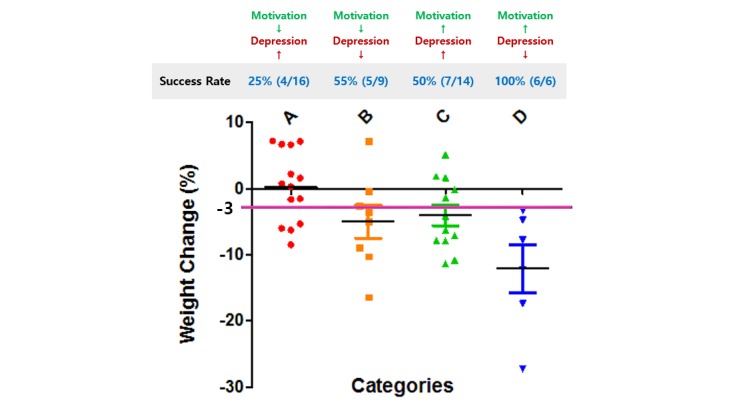
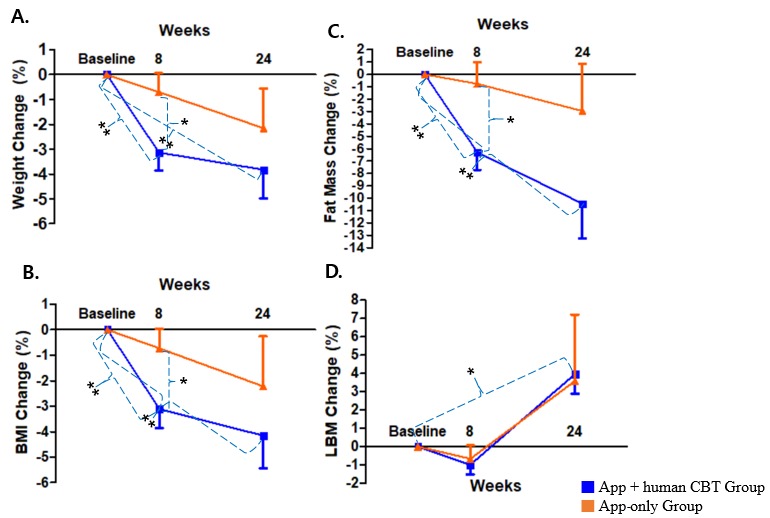
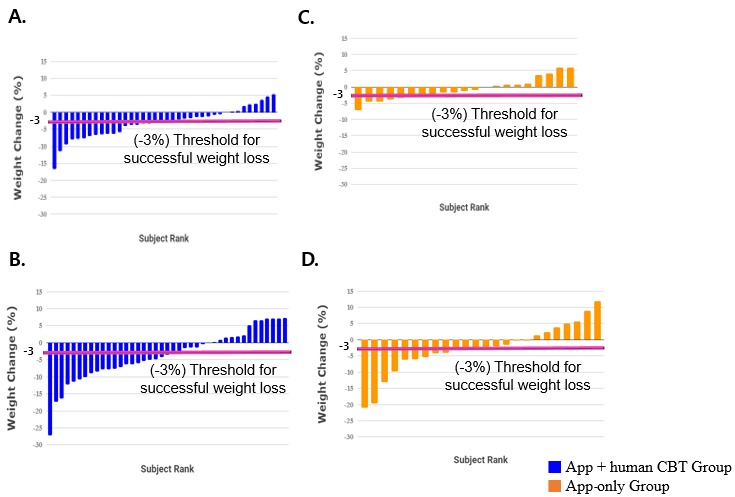
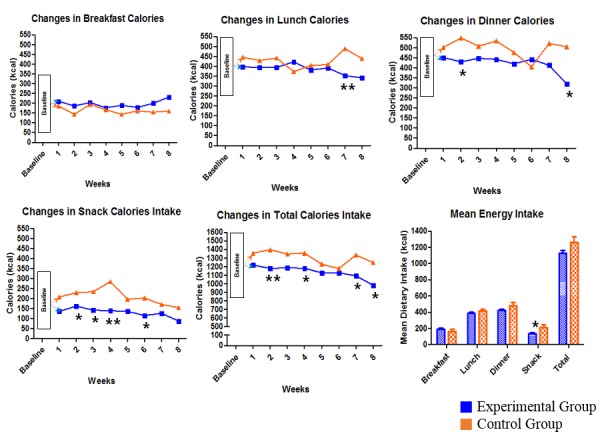
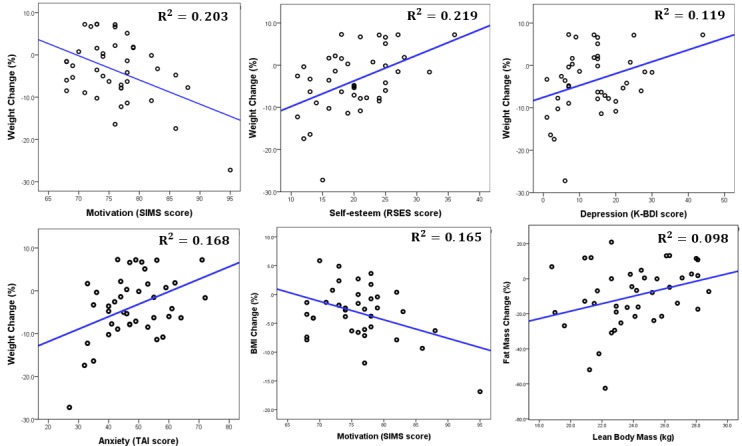
Mean weight loss at 8 weeks in the digital CBT group was significantly higher than in the control group (-3.1%, SD 4.5, vs -0.7%, SD 3.4, P=.04). Additionally, the proportion of subjects who attained conventional 5% weight loss from baseline in the digital CBT group was significantly higher than in the control group at 8 weeks (32% [12/38] vs 4% [1/21], P=.02) but not at 24 weeks. Mean fat mass reduction in the digital CBT group at 8 weeks was also significantly greater than in the control group (-6.3%, SD 8.8, vs -0.8%, SD 8.1, P=.02). Mean leptin and insulin resistance in the digital CBT group at 8 weeks was significantly reduced compared to the control group (-15.8%, SD 29.9, vs 7.2%, SD 35.9, P=.01; and -7.1%, SD 35.1, vs 14.4%, SD 41.2, P=.04). Emotional eating behavior (ie, mean score) measured by questionnaire (ie, the Dutch Eating Behavior Questionnaire) at 8 weeks was significantly improved compared to the control group (-2.8%, SD 34.4, vs 21.6%, SD 56.9, P=.048). Mean snack calorie intake in the digital CBT group during the intervention period was significantly lower than in the control group (135.9 kcal, SD 86.4, vs 208.2 kcal, SD 166.3, P=.02). Lastly, baseline depression, anxiety, and self-esteem levels significantly predicted long-term clinical outcomes (24 weeks), while baseline motivation significantly predicted both short-term (8 weeks) and long-term clinical outcomes.
These findings confirm that technology-based interventions should be multidimensional and are most effective with human feedback and support. This study is innovative in successfully developing and verifying the effects of a new CBT approach with a multidisciplinary team based on digital technologies rather than standalone technology-based interventions.
ClinicalTrials.gov NCT03465306; https://clinicaltrials.gov/ct2/show/NCT03465306.
开发有效且广泛适用的体重管理方案是医疗保健的重点,因为肥胖是一个主要的健康问题。
本研究开发并调查了一种基于认知行为疗法(CBT)模块的新的、全面的、多因素的、日常的、强化的、心理学家指导的方案。该方案通过数字医疗服务 Noom Coach 和 InBody 提供。
这是一项开放标签、活性对照、随机对照试验。共有 70 名女性参与者,BMI 评分高于 24kg/m2,除肥胖外无临床问题,随机分为实验组和对照组。实验组(即数字 CBT 组)(n=45)通过数字医疗服务与治疗师干预连接,该服务提供每日反馈和 8 周的作业。对照组(n=25)也使用数字医疗服务,但在没有治疗师干预的情况下进行自我护理。本研究的主要结果在基线、8 周和 24 周时通过客观测量获得,包括体重(kg)和其他身体成分。使用独立 t 检验和协议框架评估组间差异。
数字 CBT 组在 8 周时的体重减轻量明显高于对照组(-3.1%,SD 4.5,vs -0.7%,SD 3.4,P=.04)。此外,数字 CBT 组在 8 周时达到常规 5%体重减轻的患者比例明显高于对照组(32%[12/38] vs 4%[1/21],P=.02),但在 24 周时没有差异。数字 CBT 组在 8 周时的脂肪量减少量也明显大于对照组(-6.3%,SD 8.8,vs -0.8%,SD 8.1,P=.02)。数字 CBT 组在 8 周时的瘦素和胰岛素抵抗也明显低于对照组(-15.8%,SD 29.9,vs 7.2%,SD 35.9,P=.01;-7.1%,SD 35.1,vs 14.4%,SD 41.2,P=.04)。通过问卷(即荷兰饮食行为问卷)测量的 8 周时的情绪性饮食行为(即平均得分)与对照组相比明显改善(-2.8%,SD 34.4,vs 21.6%,SD 56.9,P=.048)。数字 CBT 组在干预期间的零食卡路里摄入量明显低于对照组(135.9kcal,SD 86.4,vs 208.2kcal,SD 166.3,P=.02)。基线时的抑郁、焦虑和自尊水平显著预测长期临床结局(24 周),而基线时的动机显著预测短期(8 周)和长期临床结局。
这些发现证实,基于技术的干预措施应该是多维度的,并且在提供人类反馈和支持时最有效。本研究通过多学科团队基于数字技术成功开发和验证了一种新的 CBT 方法的效果,这是创新的,而不是基于单独的技术干预。
ClinicalTrials.gov NCT03465306;https://clinicaltrials.gov/ct2/show/NCT03465306。