MMWR Morb Mortal Wkly Rep. 2020 May 1;69(17):515-520. doi: 10.15585/mmwr.mm6917a2.
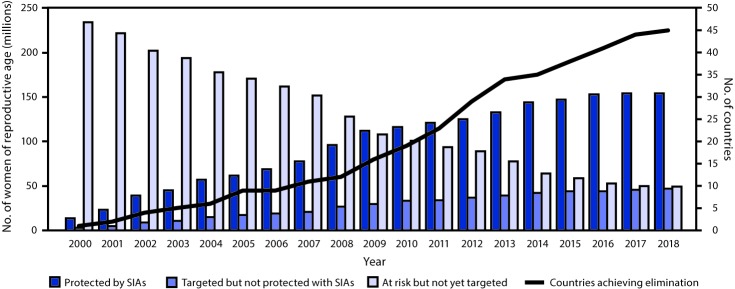
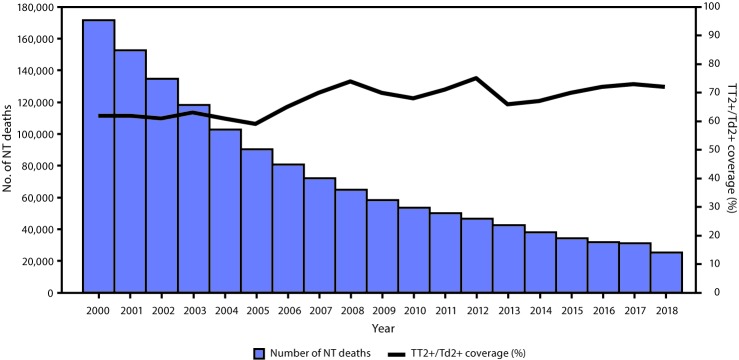
Maternal and neonatal tetanus* (MNT) remains a major public health problem, with an 80%-100% case-fatality rate among neonates, especially in areas with poor immunization coverage and limited access to clean deliveries (i.e., delivery in a health facility or assisted by medically trained attendants in sanitary conditions) and umbilical cord care (1). In 1989, the World Health Assembly endorsed the elimination of neonatal tetanus (NT), and in 1999, the initiative was relaunched and renamed the MNT elimination initiative, targeting 59 priority countries (1). Elimination strategies include 1) achieving ≥80% coverage with ≥2 doses of tetanus toxoid-containing vaccine (TTCV) among women of reproductive age through routine immunization of pregnant women and supplementary immunization activities (SIAs)** in high-risk areas and districts; 2) achieving care at ≥70% of deliveries by a skilled birth attendant (SBA); and 3) enhancing surveillance for NT cases (1). This report summarizes progress toward achieving MNT elimination during 2000-2018. Coverage with ≥2 doses of TTCV (2 doses of tetanus toxoid [TT2+] or 2 doses of tetanus-diphtheria toxoid [Td2+]) among women of reproductive age increased by 16%, from 62% in 2000 to 72% in 2018. By December 2018, 52 (88%) of 59 priority countries had conducted TTCV SIAs, vaccinating 154 million (77%) of 201 million targeted women of reproductive age with TT2+/Td2+. Globally, the percentage of deliveries assisted by SBAs increased from 62% during 2000-2005 to 81% during 2013-2018, and estimated neonatal tetanus deaths decreased by 85%, from 170,829 in 2000 to 25,000 in 2018. By December 2018, 45 (76%) of 59 priority countries were validated by WHO as having achieved MNT elimination. To achieve elimination in the remaining 14 countries and sustain elimination in countries that have achieved it, implementation of MNT elimination strategies needs to be maintained and strengthened, and TTCV booster doses need to be included in country immunization schedules as recommended by the World Health Organization (WHO) (2). In addition, integration of maternal, newborn, and child health services with vaccination services is needed, as well as innovative approaches to target hard-to-reach areas for tetanus vaccination and community engagement to strengthen surveillance.
孕产妇和新生儿破伤风(MNT)仍然是一个主要的公共卫生问题,新生儿的病死率为 80%-100%,尤其是在免疫覆盖率低、清洁分娩(即在卫生机构分娩或由医疗培训人员在卫生条件下助产)和脐带护理有限的地区(1)。1989 年,世界卫生大会批准消除新生儿破伤风(NT),1999 年,该倡议重新启动并更名为孕产妇和新生儿破伤风消除倡议,目标是 59 个重点国家(1)。消除策略包括 1)通过对孕妇进行常规免疫接种和在高危地区和地区开展补充免疫活动(SIA)**,使育龄妇女破伤风类毒素疫苗(TTCV)的覆盖率达到 80%以上,至少接种 2 剂;2)使 70%以上的分娩由熟练的接生员(SBA)提供护理;3)加强对 NT 病例的监测(1)。本报告总结了 2000-2018 年期间在实现 MNT 消除方面取得的进展。育龄妇女 TTCV 至少接种 2 剂(TT2+或 Td2+)的覆盖率提高了 16%,从 2000 年的 62%提高到 2018 年的 72%。截至 2018 年 12 月,59 个重点国家中有 52 个(88%)国家开展了 TTCV SIA,为 20100 万目标育龄妇女中的 15400 万人(77%)接种了 TT2+/Td2+。全球范围内,SBA 辅助分娩的比例从 2000-2005 年的 62%增加到 2013-2018 年的 81%,估计新生儿破伤风死亡人数减少了 85%,从 2000 年的 170829 人减少到 2018 年的 25000 人。截至 2018 年 12 月,59 个重点国家中有 45 个(76%)经世界卫生组织(世卫组织)确认已实现 MNT 消除。为了在其余 14 个国家实现消除,并在已实现消除的国家保持消除,需要维持和加强 MNT 消除策略的实施,并按照世卫组织的建议将 TTCV 加强剂纳入国家免疫规划(2)。此外,还需要将孕产妇、新生儿和儿童保健服务与疫苗接种服务相结合,采取创新方法,为破伤风疫苗接种的目标人群和社区参与提供服务,以加强监测。