Department of Innovative Technologies, University of Applied Sciences and Arts of Southern Switzerland, Galleria 2, Via Cantonale 2c, CH-6928 Manno, Switzerland.
Department of Organic Chemistry, Weizmann Institute of Science, Rehovot 76100, Israel.
J Am Chem Soc. 2020 May 27;142(21):9792-9802. doi: 10.1021/jacs.0c03444. Epub 2020 May 14.
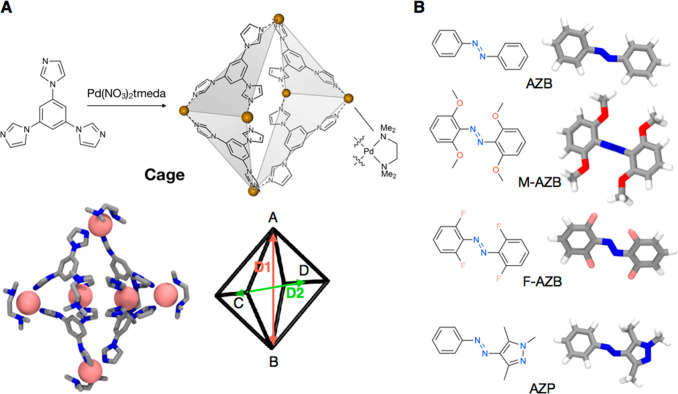
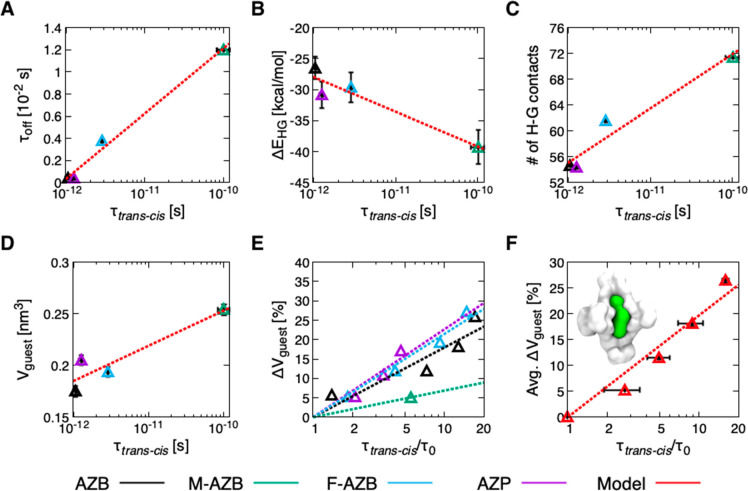
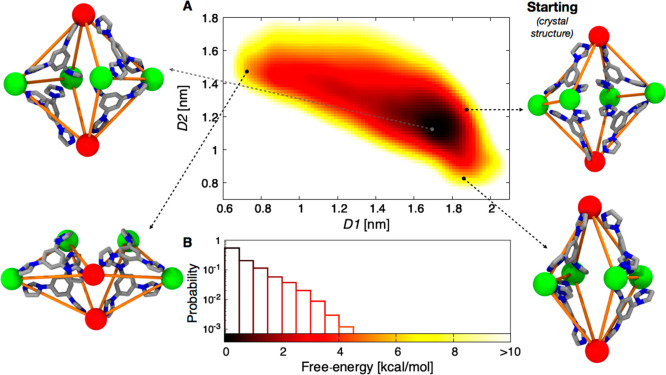
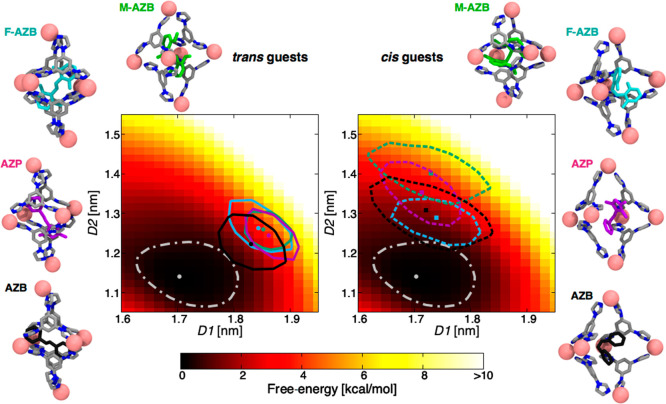
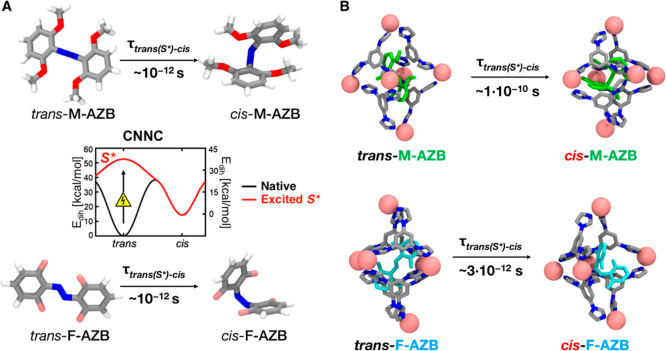
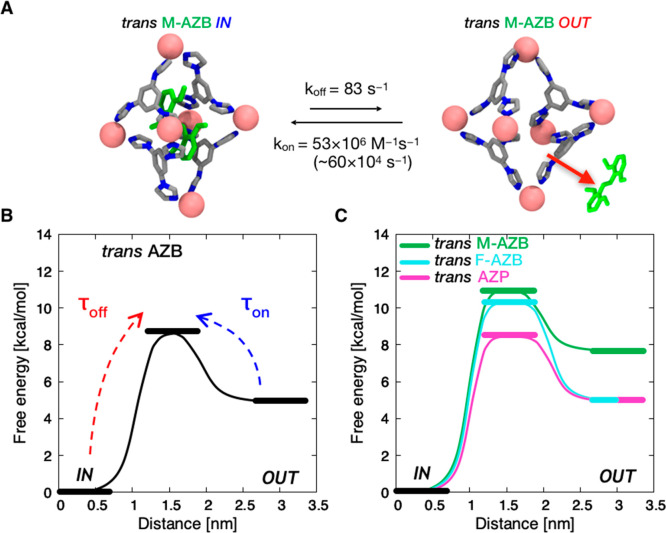
Photoswitchable molecules are employed for many applications, from the development of active materials to the design of stimuli-responsive molecular systems and light-powered molecular machines. To fully exploit their potential, we must learn ways to control the mechanism and kinetics of their photoinduced isomerization. One possible strategy involves confinement of photoresponsive switches such as azobenzenes or spiropyrans within crowded molecular environments, which may allow control over their light-induced conversion. However, the molecular factors that influence and control the switching process under realistic conditions and within dynamic molecular regimes often remain difficult to ascertain. As a case study, here we have employed molecular models to probe the isomerization of azobenzene guests within a Pd(II)-based coordination cage host in water. Atomistic molecular dynamics and metadynamics simulations allow us to characterize the flexibility of the cage in the solvent, the (rare) guest encapsulation and release events, and the relative probability/kinetics of light-induced isomerization of azobenzene analogues in these host-guest systems. In this way, we can reconstruct the mechanism of azobenzene switching inside the cage cavity and explore key molecular factors that may control this event. We obtain a molecular-level insight on the effects of crowding and host-guest interactions on azobenzene isomerization. The detailed picture elucidated by this study may enable the rational design of photoswitchable systems whose reactivity can be controlled via host-guest interactions.
光致变色分子在许多应用中都有使用,从活性材料的开发到刺激响应分子体系和光动力分子机器的设计。为了充分发挥它们的潜力,我们必须学习控制其光诱导异构化的机制和动力学的方法。一种可能的策略是将光响应开关(如偶氮苯或螺吡喃)限制在拥挤的分子环境中,这可能允许控制它们的光诱导转化。然而,在实际条件下和动态分子环境中影响和控制开关过程的分子因素通常仍然难以确定。作为一个案例研究,在这里我们使用分子模型来探测水中钯(II)基配位笼主体中偶氮苯客体的异构化。原子分子动力学和元动力学模拟使我们能够描述溶剂中笼的灵活性、(罕见的)客体封装和释放事件,以及这些主客体体系中光诱导偶氮苯类似物异构化的相对概率/动力学。通过这种方式,我们可以重建笼腔内部偶氮苯开关的机制,并探索可能控制这一事件的关键分子因素。我们获得了关于拥挤和主客体相互作用对偶氮苯异构化影响的分子水平的见解。这项研究阐明的详细情况可能使能够通过主客体相互作用控制反应性的光致变色系统的合理设计成为可能。