Riza Elena, Kalkman Shona, Coritsidis Alexandra, Koubardas Sotirios, Vassiliu Sofia, Lazarou Despoina, Karnaki Panagiota, Zota Dina, Kantzanou Maria, Psaltopoulou Theodora, Linos Athena
Department of Hygiene, Epidemiology and Medical Statistics, Medical School, National and Kapodistrian University of Athens, 115 27 Athens, Greece.
Julius Center for Health Sciences and Primary Care, University Medical Center Utrecht, Utrecht University, 3584 CG Utrecht, The Netherlands.
Healthcare (Basel). 2020 Apr 28;8(2):115. doi: 10.3390/healthcare8020115.
Strengthening community-based healthcare is a valuable strategy to reduce health inequalities and improve the integration of migrants and refugees into local communities in the European Union. However, little is known about how to effectively develop and run community-based healthcare models for migrants and refugees. Aiming at identifying the most-promising best practices, we performed a scoping review of the international academic literature into effective community-based healthcare models and interventions for migrants and refugees as part of the Mig-HealthCare project.
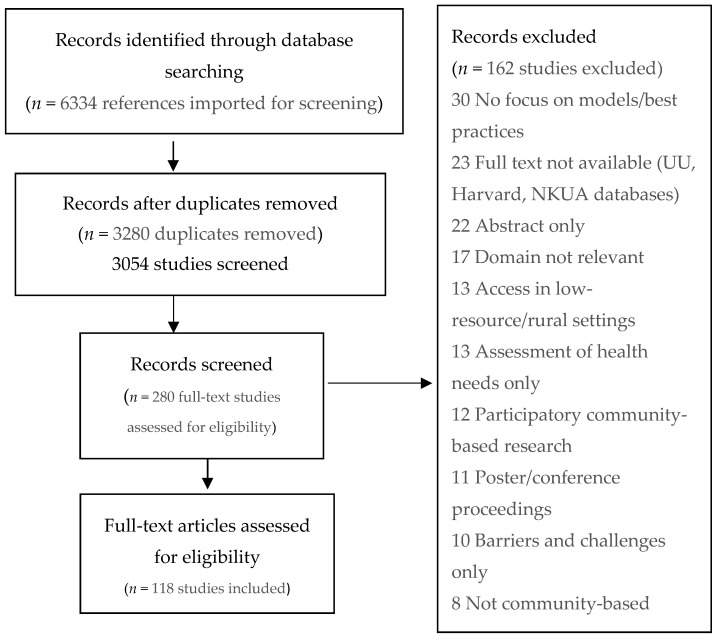
A systematic search in PubMed, EMBASE, and Scopus databases was conducted in March 2018 following the PRISMA methodology. Data extraction from eligible publications included information on general study characteristics, a brief description of the intervention/model, and reported outcomes in terms of effectiveness and challenges. Subsequently, we critically assessed the available evidence per type of healthcare service according to specific criteria to establish a shortlist of the most promising best practices.
In total, 118 academic publications were critically reviewed and categorized in the thematic areas of mental health ( = 53), general health services ( = 36), noncommunicable diseases ( = 13), primary healthcare ( = 9), and women's maternal and child health ( = 7).
A set of 15 of the most-promising best practices and tools in community-based healthcare for migrants and refugees were identified that include several intervention approaches per thematic category. The elements of good communication, the linguistic barriers and the cultural differences, played crucial roles in the effective application of the interventions. The close collaboration of the various stakeholders, the local communities, the migrant/refugee communities, and the partnerships is a key element in the successful implementation of primary healthcare provision.
加强基于社区的医疗保健是一项有价值的战略,有助于减少健康不平等现象,并促进移民和难民融入欧盟当地社区。然而,对于如何有效地为移民和难民开发并运行基于社区的医疗保健模式,我们知之甚少。作为“移民医疗保健”项目的一部分,为了确定最具前景的最佳实践,我们对有关针对移民和难民的有效基于社区的医疗保健模式及干预措施的国际学术文献进行了范围综述。
2018年3月,按照PRISMA方法在PubMed、EMBASE和Scopus数据库中进行了系统检索。从符合条件的出版物中提取的数据包括一般研究特征、干预措施/模式的简要描述,以及在有效性和挑战方面报告的结果。随后,我们根据特定标准对每种医疗服务类型的现有证据进行了严格评估,以确定最具前景的最佳实践的入围名单。
总共对118篇学术出版物进行了严格审查,并将其归类于心理健康(n = 53)、一般健康服务(n = 36)、非传染性疾病(n = 13)、初级医疗保健(n = 9)以及妇女母婴健康(n = 7)等主题领域。
确定了一套针对移民和难民的基于社区的医疗保健中最具前景的15种最佳实践和工具,每个主题类别包括几种干预方法。良好沟通的要素、语言障碍和文化差异在干预措施有效应用中发挥了关键作用。各利益相关者、当地社区、移民/难民社区以及伙伴关系之间的密切合作是成功提供初级医疗保健的关键要素。