Marsh-Wakefield Felix, Ashhurst Thomas, Trend Stephanie, McGuire Helen M, Juillard Pierre, Zinger Anna, Jones Anderson P, Kermode Allan G, Hawke Simon, Grau Georges E, Hart Prue H, Byrne Scott N
School of Medical Sciences Faculty of Medicine and Health The University of Sydney Sydney NSW Australia.
Vascular Immunology Unit Department of Pathology The University of Sydney Sydney NSW Australia.
Clin Transl Immunology. 2020 Apr 29;9(5):e01133. doi: 10.1002/cti2.1133. eCollection 2020 May.
Disease-modifying therapies (DMTs) targeting B cells are amongst the most effective for preventing multiple sclerosis (MS) progression. IgG antibodies and their uncharacterised B-cell clones are predicted to play a pathogenic role in MS. Identifying subsets of IgG B cells involved in MS progression could improve diagnosis, could inform timely disease intervention and may lead to new DMTs that target B cells more specifically.
We designed a 31-parameter B-cell-focused mass cytometry panel to interrogate the role of peripheral blood IgG B cells in MS progression of two different patient cohorts: one to investigate the B-cell subsets involved in conversion from clinically isolated syndrome (CIS) to MS; and another to compare MS patients with inactive or active stages of disease. Each independent cohort included a group of non-MS controls.
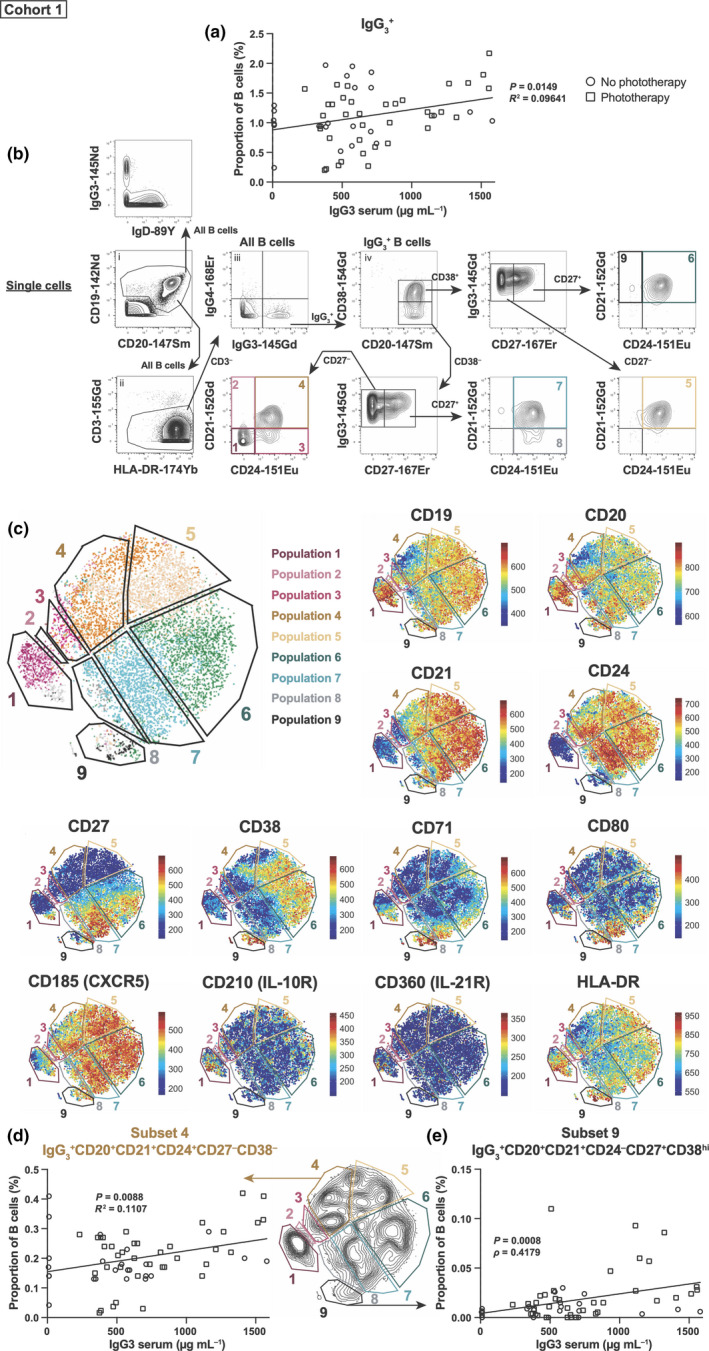
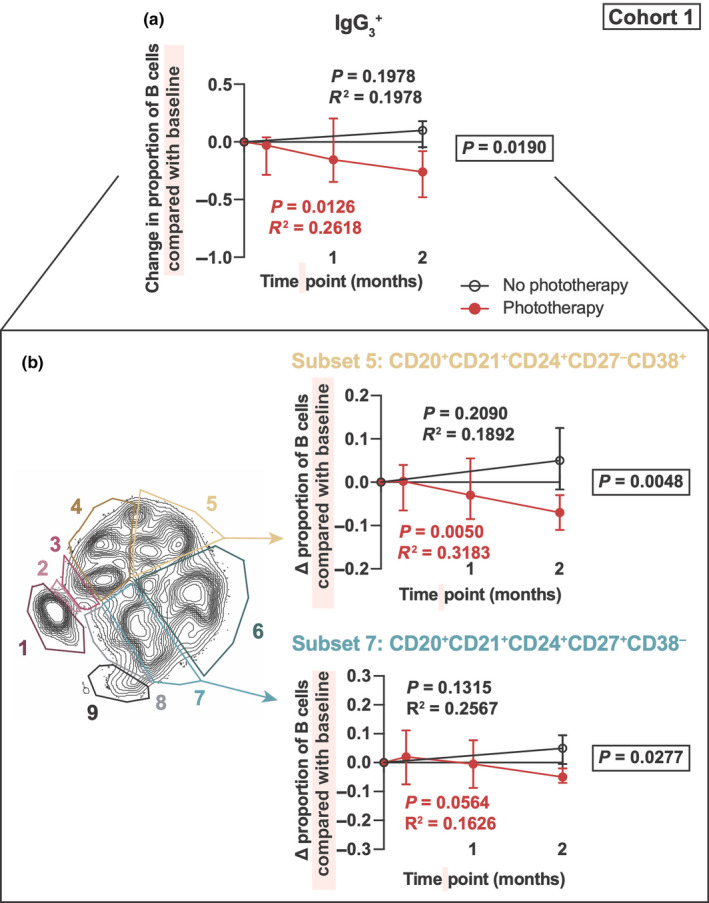
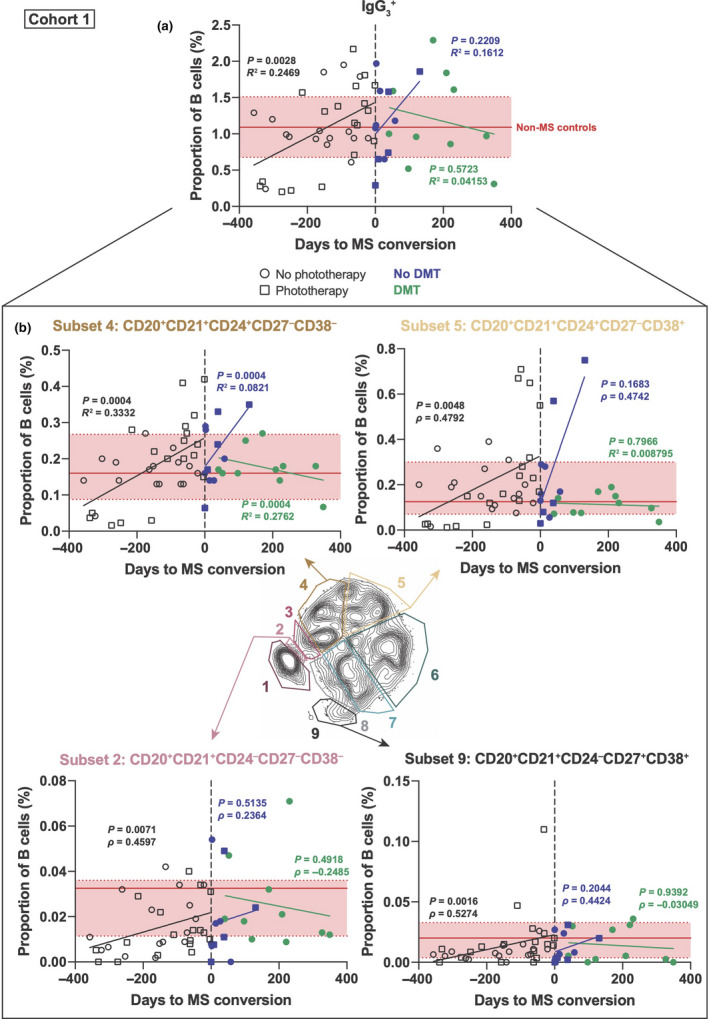
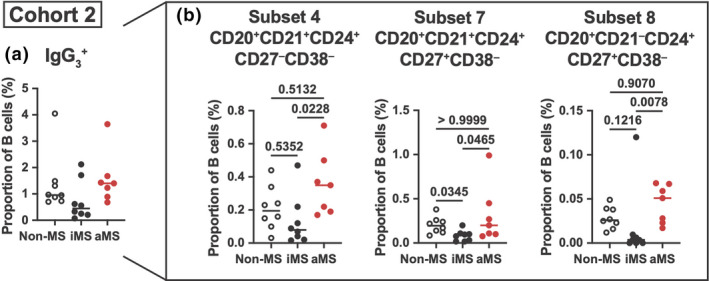
Nine distinct CD20IgDIgG B-cell subsets were identified. Significant changes in the proportion of CD21CD24CD27CD38 and CD27CD38CD71 memory B-cell subsets correlated with changes in serum IgG levels and time to conversion from CIS to MS. The same CD38 double-negative B-cell subset was significantly elevated in MS patients with active forms of the disease. A third CD21CD24CD27CD38 subset was elevated in patients with active MS, whilst narrowband UVB significantly reduced the proportion of this switched-memory B-cell subset.
We have identified previously uncharacterised subsets of IgG B cells and shown them to correlate with autoimmune attacks on the central nervous system (CNS). These results highlight the potential for therapies that specifically target IgG B cells to impact MS progression.
针对B细胞的疾病修饰疗法(DMTs)是预防多发性硬化症(MS)进展最有效的疗法之一。IgG抗体及其未定性的B细胞克隆预计在MS中发挥致病作用。识别参与MS进展的IgG B细胞亚群可改善诊断、为及时的疾病干预提供依据,并可能带来更具特异性地靶向B细胞的新型DMTs。
我们设计了一个聚焦于31个参数的B细胞质谱流式细胞术检测板,以探究外周血IgG B细胞在两个不同患者队列的MS进展中的作用:一个队列用于研究参与从临床孤立综合征(CIS)转化为MS的B细胞亚群;另一个队列用于比较处于疾病非活动期或活动期的MS患者。每个独立队列都包括一组非MS对照。
识别出九个不同的CD20IgDIgG B细胞亚群。CD21CD24CD27CD38和CD27CD38CD71记忆B细胞亚群比例的显著变化与血清IgG水平的变化以及从CIS转化为MS的时间相关。在患有活动性疾病的MS患者中,相同的CD38双阴性B细胞亚群显著升高。在活动性MS患者中,第三个CD21CD24CD27CD38亚群升高,而窄谱中波紫外线(UVB)显著降低了这个转换记忆B细胞亚群的比例。
我们识别出了先前未定性的IgG B细胞亚群,并表明它们与对中枢神经系统(CNS)的自身免疫攻击相关。这些结果突出了特异性靶向IgG B细胞的疗法影响MS进展的潜力。