Department of Radiology & Nuclear Medicine, Erasmus MC University Medical Center, 's-Gravendijkwal 230, P.O. Box 2040, 3000 CA, Rotterdam, The Netherlands.
Department of Radiology, Netherlands Cancer Institute, Amsterdam, The Netherlands.
Abdom Radiol (NY). 2020 Dec;45(12):4012-4022. doi: 10.1007/s00261-020-02547-x.
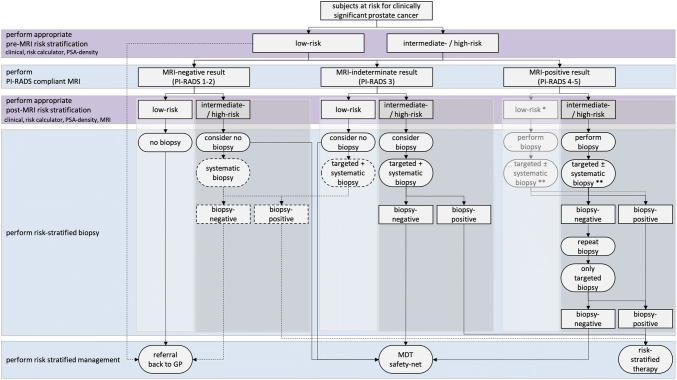
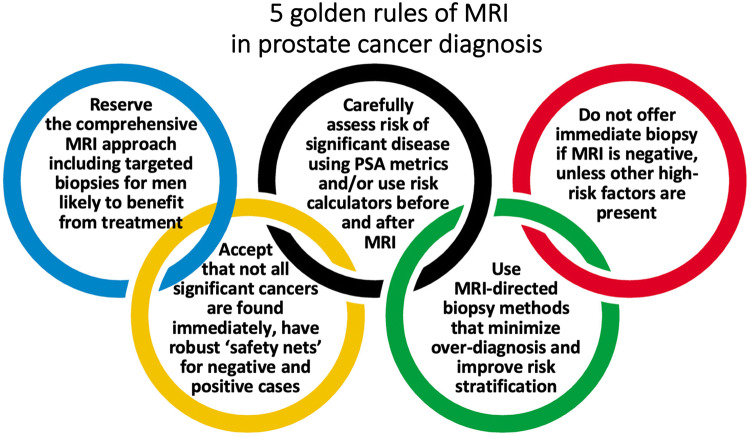
Pre-biopsy multiparametric MRI is now recommended by multiple guidelines, not only for men with persistent suspicion of prostate cancer after prior negative systematic biopsy, but also at initial screening before the first biopsy. The major benefit of pre-biopsy MRI in the diagnostic work-up is to promote individualized risk-adapted approaches for biopsy-decision management. Multiple MRI-directed diagnostic pathways can be conceived, with each approach having net-benefit trade-offs between benefits and harms, based on improved diagnostic yields of significant cancers and reduced biopsy testing and reduced detection of indolent prostate cancer. In this paper, we illustrate how clinical benefits can be maximized in men with MRI-negative and MRI-positive results, using the PI-RADS Multiparametric MRI and MRI-directed biopsy pathway. From a practice perspective, we emphasize five golden rules: (1) that multiparametric MRI approach including targeted biopsies be reserved for men likely to benefit from early detection and treatment of prostate cancer; (2) that there is a need to carefully assess risk of significant disease using PSA and clinical parameters before and after MRI; (3) do not offer immediate biopsy if the MRI is negative, unless other high-risk factors are present; (4) accept that not all significant cancers are found immediately and have robust 'safety nets' for men with negative MRI scans who avoid immediate biopsy and for positive MRI patients with negative or non-explanatory histology; and (5) use MRI-directed biopsy methods that minimize overdiagnosis and improve risk stratification.
多参数 MRI 引导下的前列腺穿刺活检术(简称 MRI 引导下穿刺)在当前的临床实践中已被广泛应用。它可以提高穿刺活检的诊断效能,识别出真正具有临床意义的前列腺癌,减少过度诊断。
在过去,MRI 引导下穿刺活检术主要应用于前列腺癌根治术后或前列腺放疗后局部复发、经直肠超声(简称 TRUS)引导下系统性穿刺活检后仍高度怀疑前列腺癌或 PSA 持续升高的患者。而近年来,越来越多的临床研究表明,在初次接受前列腺穿刺活检前进行 MRI 检查,也可以提高诊断效能,筛选出真正需要接受治疗的患者。
MRI 引导下穿刺活检术的主要优势在于能够帮助医生根据患者的具体情况制定个体化的治疗方案。目前,已经有多种 MRI 引导下的穿刺活检方法,每种方法都有其优缺点和适用范围。医生需要根据患者的具体情况,权衡利弊,选择最合适的方法。
在本文中,我们将介绍如何根据 PI-RADS 评分系统,利用 MRI 引导下穿刺活检术来优化患者的临床获益。我们将从临床实践的角度出发,强调以下五个要点:
只有当患者从早期诊断和治疗中获益的可能性较大时,才考虑进行 MRI 引导下穿刺活检术。
在进行 MRI 检查前后,需要仔细评估患者的 PSA 水平和临床参数,以评估患者患前列腺癌的风险。
如果 MRI 检查结果为阴性,除非存在其他高危因素,否则不应立即进行穿刺活检。
接受并非所有具有临床意义的前列腺癌都能立即被发现的事实,并为那些 MRI 检查结果为阴性但仍有较高患癌风险的患者,以及那些 MRI 检查结果为阳性但组织学检查结果为阴性或非特异性的患者,建立有效的“安全网”。
选择合适的 MRI 引导下穿刺活检方法,以减少过度诊断,提高风险分层的准确性。
总之,MRI 引导下穿刺活检术是一种非常有价值的诊断工具,可以帮助医生提高前列腺癌的诊断效能,为患者制定更加个体化的治疗方案。在临床实践中,医生需要根据患者的具体情况,权衡利弊,选择最合适的方法。