Gelding Rebecca W, Harrison Peter M C, Silas Sebastian, Johnson Blake W, Thompson William F, Müllensiefen Daniel
Department of Cognitive Science, Macquarie University, Sydney, Australia.
School of Electronic Engineering and Computer Science, Queen Mary, University Of London, London, UK.
Psychol Res. 2021 Apr;85(3):1201-1220. doi: 10.1007/s00426-020-01322-3. Epub 2020 Apr 30.
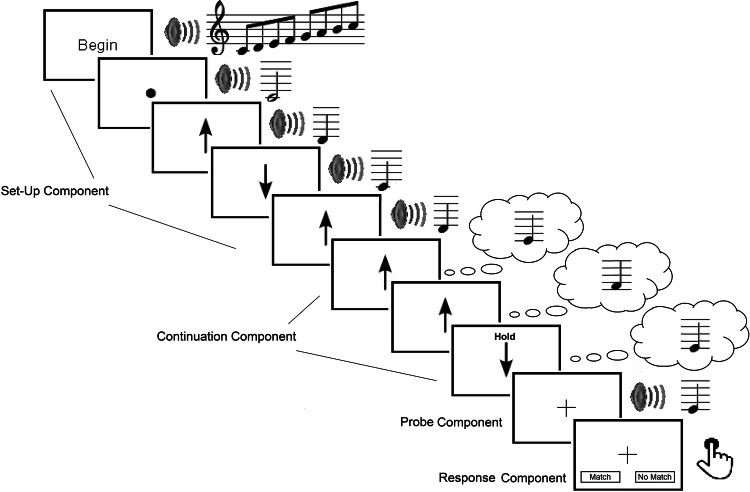
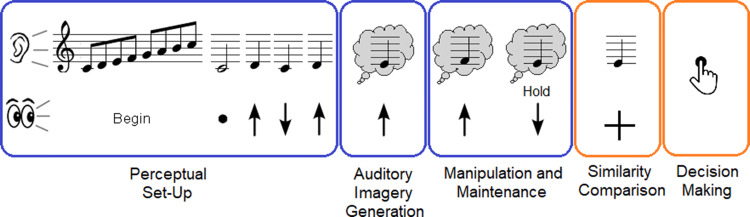
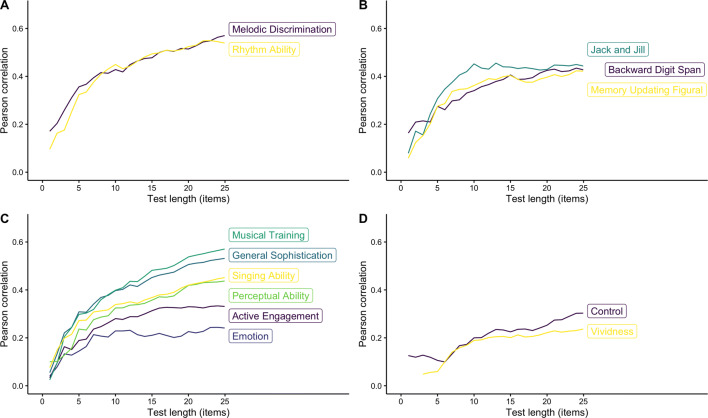
The ability to silently hear music in the mind has been argued to be fundamental to musicality. Objective measurements of this subjective imagery experience are needed if this link between imagery ability and musicality is to be investigated. However, previous tests of musical imagery either rely on self-report, rely on melodic memory, or do not cater in range of abilities. The Pitch Imagery Arrow Task (PIAT) was designed to address these shortcomings; however, it is impractically long. In this paper, we shorten the PIAT using adaptive testing and automatic item generation. We interrogate the cognitive processes underlying the PIAT through item response modelling. The result is an efficient online test of auditory mental imagery ability (adaptive Pitch Imagery Arrow Task: aPIAT) that takes 8 min to complete, is adaptive to participant's individual ability, and so can be used to test participants with a range of musical backgrounds. Performance on the aPIAT showed positive moderate-to-strong correlations with measures of non-musical and musical working memory, self-reported musical training, and general musical sophistication. Ability on the task was best predicted by the ability to maintain and manipulate tones in mental imagery, as well as to resist perceptual biases that can lead to incorrect responses. As such, the aPIAT is the ideal tool in which to investigate the relationship between pitch imagery ability and musicality.
在脑海中默默聆听音乐的能力被认为是音乐素养的基础。如果要研究意象能力与音乐素养之间的这种联系,就需要对这种主观意象体验进行客观测量。然而,以往对音乐意象的测试要么依赖自我报告,要么依赖旋律记忆,要么无法涵盖各种能力范围。音高意象箭头任务(PIAT)旨在解决这些缺点;然而,它过长,不切实际。在本文中,我们通过自适应测试和自动项目生成来缩短PIAT。我们通过项目反应建模来探究PIAT背后的认知过程。结果是一个高效的听觉心理意象能力在线测试(自适应音高意象箭头任务:aPIAT),该测试需要8分钟完成,能适应参与者的个人能力,因此可用于测试具有不同音乐背景的参与者。aPIAT上的表现与非音乐和音乐工作记忆的测量、自我报告的音乐训练以及一般音乐素养呈中度到强的正相关。任务能力最好由在心理意象中保持和操纵音调的能力以及抵抗可能导致错误反应的感知偏差的能力来预测。因此,aPIAT是研究音高意象能力与音乐素养之间关系的理想工具。