Department of Biology and Biological Engineering, Chalmers University of Technology, SE-41296, Gothenburg, Sweden.
Novo Nordisk Foundation Center for Biosustainability, Chalmers University of Technology, SE-41296, Gothenburg, Sweden.
Nat Commun. 2020 May 1;11(1):2144. doi: 10.1038/s41467-020-16073-3.
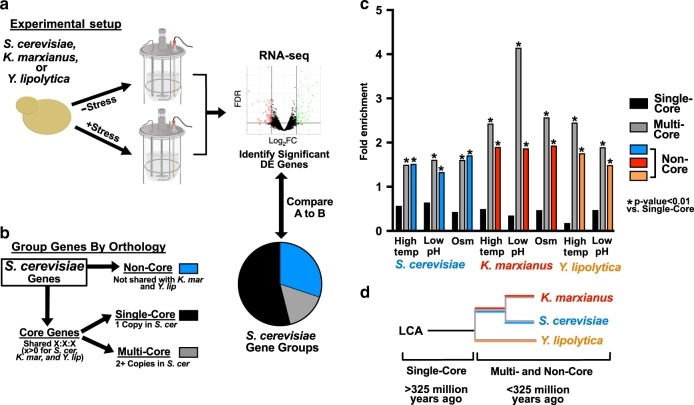
The Saccharomycotina subphylum (budding yeasts) spans 400 million years of evolution and includes species that thrive in diverse environments. To study niche-adaptation, we identify changes in gene expression in three divergent yeasts grown in the presence of various stressors. Duplicated and non-conserved genes are significantly more likely to respond to stress than genes that are conserved as single-copy orthologs. Next, we develop a sorting method that considers evolutionary origin and duplication timing to assign an evolutionary age to each gene. Subsequent analysis reveals that genes that emerged in recent evolutionary time are enriched amongst stress-responsive genes for each species. This gene expression pattern suggests that budding yeasts share a stress adaptation mechanism, whereby selective pressure leads to functionalization of young genes to improve growth in adverse conditions. Further characterization of young genes from species that thrive in harsh environments can inform the design of more robust strains for biotechnology.
子囊菌亚门(出芽酵母)的进化跨越了 4 亿年,包含了在各种环境中茁壮成长的物种。为了研究生态位适应,我们在三种不同的酵母中鉴定了在各种胁迫下生长时基因表达的变化。与保守的单拷贝直系同源基因相比,复制和非保守基因更有可能对胁迫产生反应。接下来,我们开发了一种排序方法,该方法考虑了进化起源和复制时间,为每个基因分配了一个进化年龄。随后的分析表明,在每个物种中,最近进化时间出现的基因在应激反应基因中富集。这种基因表达模式表明,出芽酵母共享一种应激适应机制,即选择压力导致年轻基因的功能化,以改善在不利条件下的生长。对在恶劣环境中茁壮成长的物种的年轻基因进行进一步的特征描述,可以为生物技术设计更健壮的菌株提供信息。