Dieter John Ni, Engel Scot D
Intrepid Spirit Center, Carl R. Darnall Army Medical Center, U.S. Army, Fort Hood, TX, USA.
Neurosci Insights. 2019 Dec 31;14:1179069519892933. doi: 10.1177/1179069519892933. eCollection 2019.
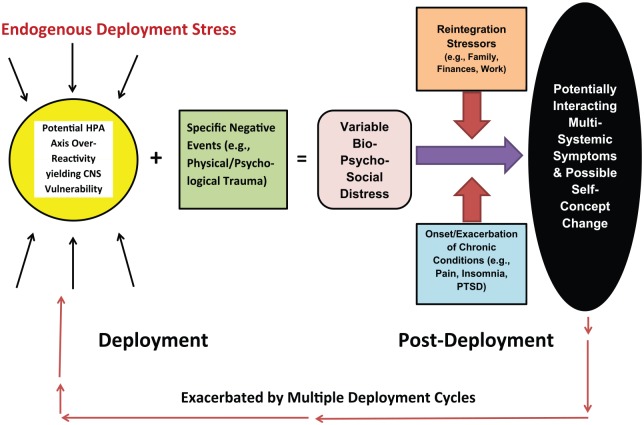
Scientific literature is reviewed supporting a "consequence of war syndrome (CWS)" in Operation Enduring Freedom/Operation Iraqi Freedom/Operation New Dawn soldiers. CWS constituents include chronic pain and insomnia, other physical complaints, posttraumatic stress disorder (PTSD), anxiety, depression, and neuropsychological deficits. The foundation of CWS lies with the chronic stressors inherent to deployment and the cascade of biological events mediated and maintained by hypothalamic-pituitary-adrenal (HPA) axis dysregulation. Such dysregulation is modified by the individual's specific experiences at war, difficulty reintegrating to post-deployment life, and the onset or exacerbation of the chronic and comorbid physical, emotional, and cognitive disorders. The circuit network between the prefrontal cortex (PFC), amygdala, and hippocampus is particularly sensitive to the consequences of war. The review's specific conclusions are as follows: HPA axis dysregulation contributes to the chronic insomnia and hyperarousal seen in soldiers. There is considerable symptom overlap between PTSD and blast-related head injury, and it is difficult to determine the relative contributions of the two disorders to abnormal imaging studies. In some cases, traumatic brain injury (TBI) may directly precipitate PTSD symptoms. While not intuitive, the relationship between TBI and postconcussion syndrome appears indirect and mediated through PTSD. Blast-related or conventional head injury may have little long-term impact on neuropsychological functioning; contrarily, PTSD particularly accounts for current cognitive deficits. The psychological experience of CWS includes a "war-within" where soldiers continue to battle an internalized enemy. Successful treatment of CWS entails transdisciplinary care that addresses each of the constituent disorders.
对科学文献进行了综述,这些文献支持持久自由行动/伊拉克自由行动/新黎明行动中的士兵存在“战争综合征后果(CWS)”。CWS的构成要素包括慢性疼痛、失眠、其他身体不适、创伤后应激障碍(PTSD)、焦虑、抑郁和神经心理缺陷。CWS的根源在于部署所固有的慢性应激源以及由下丘脑-垂体-肾上腺(HPA)轴失调介导和维持的一系列生物事件。这种失调会因个体在战争中的具体经历、重新融入部署后生活的困难以及慢性和共病的身体、情感和认知障碍的发作或加重而有所改变。前额叶皮质(PFC)、杏仁核和海马体之间的回路网络对战争后果特别敏感。该综述的具体结论如下:HPA轴失调导致士兵出现慢性失眠和过度觉醒。PTSD与爆炸相关的头部损伤之间存在相当多的症状重叠,很难确定这两种疾病对异常影像学研究的相对影响。在某些情况下,创伤性脑损伤(TBI)可能直接引发PTSD症状。虽然不直观,但TBI与脑震荡后综合征之间的关系似乎是间接的,且通过PTSD介导。爆炸相关或传统的头部损伤可能对神经心理功能几乎没有长期影响;相反,PTSD尤其导致了目前的认知缺陷。CWS的心理体验包括一种“内心的战争”,即士兵们继续与一个内化的敌人战斗。成功治疗CWS需要跨学科护理,以解决每个构成性疾病。