Weller Dominic, Franklin Samantha, Shea Glenn, White Peter, Fenner Kate, Wilson Bethany, Wilkins Cristina, McGreevy Paul
Sydney School of Veterinary Science, Faculty of Science, University of Sydney, Sydney, NSW 2006, Australia.
School of Animal and Veterinary Sciences, University of Adelaide, Roseworthy Campus, Roseworthy, SA 5371, Australia.
Animals (Basel). 2020 Apr 30;10(5):776. doi: 10.3390/ani10050776.
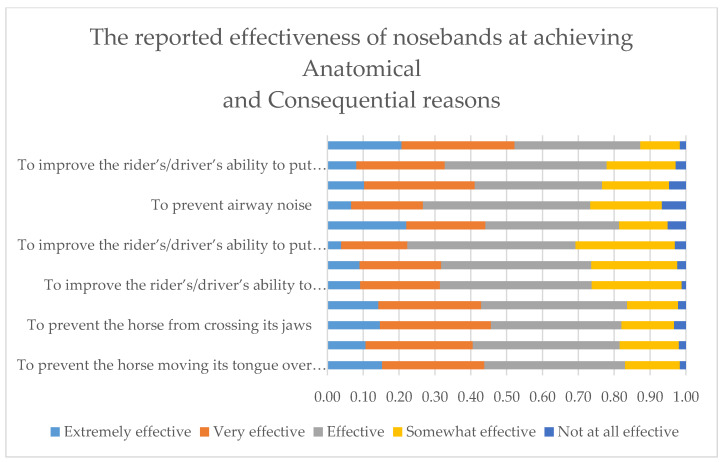
This article reports on the results of a survey designed to explore the types of nosebands that owners, riders and trainers use in training and competition, their reasons for using nosebands, the design preferences in different disciplines and approaches to noseband tightness and monitoring, as well as the incidence of negative impacts related to noseband usage. Respondents ( = 3040) were asked to specify the type of noseband they were currently using and to rate how effective they were in achieving these stated reasons. Respondents who used nosebands ( = 2332) most commonly used Plain Cavesson (46.6%, = 1087) and Hanoverian (24.8%, = 579) nosebands. The reasons provided in the survey for noseband usage were grouped into three broad, mutually exclusive categories: Anatomical; Consequential and Passive. Responses across these categories were fairly evenly distributed overall: Anatomical (29.5%, = 1501), Consequential (30.6%, = 1560), Passive (32.9%, = 1673) and other reasons (7.0%, = 358). Across all respondents ( = 2332), the most common Anatomical reason given was to (20.8%, = 485), the most common Consequential reason was to (20.4%, = 476), with (30.2%, = 705) the most popular Passive reason. Of the respondents who answered the question of checking noseband tightness ( = 2295), most reported checking noseband tightness at the bridge of the nose (62.1%, = 1426), some (10.4%, = 238) reported checking for tightness on the side of the face and others under the chin (21.5%, = 496). This survey also revealed some of the potential issues associated with noseband use, with 18.6% ( = 434) reporting at least one physical or behavioural complication. The most common complication was hair loss under the noseband (39.9%, n = 173). Crank systems were reported to be used by 28.9% (n = 665) of respondents. This is of concern as these devices can be excessively tightened, minimising jaw and tongue movement and may compromise horse welfare. Indeed, the current data in our study show that these devices are associated with an increased risk of complications being reported. Against the backdrop of potential harm to horse welfare associated with restrictive nosebands, this report may serve as a guide for future regulations and research. It helps improve our understanding of noseband preferences and their use in different disciplines.
本文报告了一项调查结果,该调查旨在探究马主、骑手和驯马师在训练和比赛中使用的鼻革类型、使用鼻革的原因、不同项目中的设计偏好以及鼻革松紧度和监测方法,同时也涉及与鼻革使用相关的负面影响发生率。受访者(n = 3040)被要求指明他们当前使用的鼻革类型,并对这些鼻革在实现所述目的方面的有效性进行评分。使用鼻革的受访者(n = 2332)最常使用的是普通卡韦松鼻革(46.6%,n = 1087)和汉诺威鼻革(24.8%,n = 579)。调查中给出的使用鼻革的原因被归为三大类,且相互排斥:解剖学原因;间接原因和被动原因。总体而言,这些类别中的回答分布较为均匀:解剖学原因(29.5%,n = 1501)、间接原因(30.6%,n = 1560)、被动原因(32.9%,n = 1673)以及其他原因(7.0%,n = 358)。在所有受访者(n = 2332)中,给出的最常见解剖学原因是[具体内容缺失](20.8%,n = 485),最常见间接原因是[具体内容缺失](20.4%,n = 476),而[具体内容缺失](30.2%,n = 705)是最受欢迎的被动原因。在回答了检查鼻革松紧度问题的受访者(n = 2295)中,大多数人报告在鼻梁处检查鼻革松紧度(62.1%,n = 1426),一些人(10.4%,n = 238)报告在脸颊一侧检查松紧度,还有一些人在下巴下方检查(21.5%,n = 496)。这项调查还揭示了一些与鼻革使用相关的潜在问题,18.6%(n = 434)的受访者报告至少出现一种身体或行为上的并发症。最常见的并发症是鼻革下方毛发脱落(39.9%,n = 173)。据报告,28.9%(n = 665)的受访者使用曲柄系统。这令人担忧,因为这些装置可能会被过度收紧,减少颌部和舌头的活动,可能会损害马匹福利。事实上,我们研究中的当前数据表明,这些装置与报告的并发症风险增加有关。在与限制性鼻革对马匹福利潜在危害的背景下,本报告可作为未来法规和研究的指南。它有助于增进我们对鼻革偏好及其在不同项目中使用情况的理解。