Alahmadi Yaser M, Alharbi Raed H, Aljabri Ahmad K, Alofi Fadwa S, Alshaalani Omimah A, Alssdi Baiaan H
Clinical and Hospital Pharmacy Department, College of Pharmacy, Taibah University, Almadinah Almunawwarah, KSA.
Pharmacy Department, Almadinah Almunawwarah General Hospital, Almadinah Almunawwarah, KSA.
J Taibah Univ Med Sci. 2020 Mar 5;15(2):136-141. doi: 10.1016/j.jtumed.2020.01.005. eCollection 2020 Apr.
The study evaluated the adherence to the guidelines for surgical antimicrobial prophylaxis in a Saudi tertiary care hospital.
The medical records of 707 patients from the surgical units over a selected 3-month period were selected. The data were reviewed and statistically analysed.
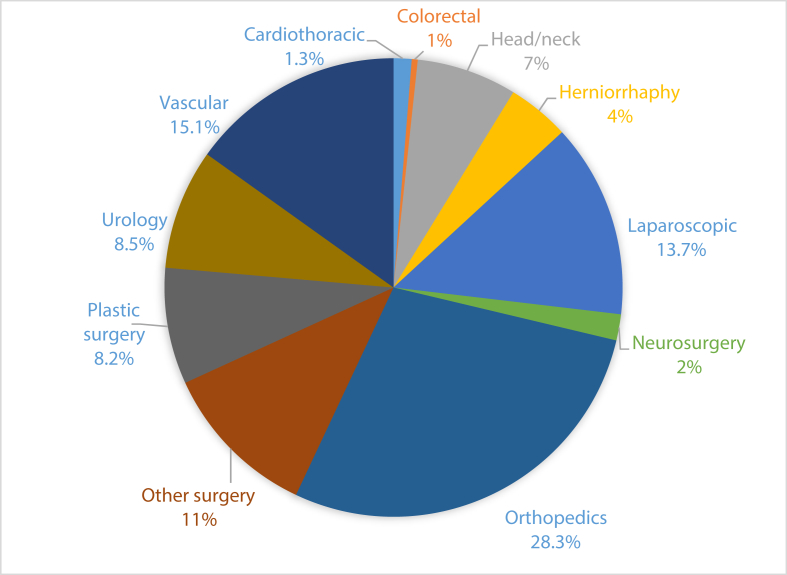
Of the 707 respondents, 51.2% were women and most were older than 50 years. The most common surgical procedures involved orthopaedics (28.3%), followed by vascular surgery (15.1%). One hundred and thirty-eight (19.5%) patients received antibiotics according to the guidelines for surgical prophylaxis. More than half of the patients (399/56.4%) received antibiotics for more than 24 h and 129 (18.2%) received antibiotics for less than 24 h. Single dose antibiotic therapy was used in 179 (25.3%) patients. Two hundred and ninety-seven (42%) patients underwent clean surgery, 284 (40%) clean-contaminated and 128 (18%) contaminated surgery. A significant difference was evident between the antibiotics administered according to the recommended guidelines and the duration of antibiotic therapy ( = 0.001), duration ( = 0.001) and the type of surgical procedure ( = 0.00).
The findings of this study suggest that healthcare professionals do not strictly adhere to the guidelines for surgical antibiotic prophylaxis. Physicians are therefore encouraged to follow the recommendations appropriately and to regularly implement surgical antimicrobial prophylaxis for patient safety.
本研究评估了沙特一家三级护理医院对手术抗菌预防指南的遵循情况。
选取了选定的3个月期间外科病房707例患者的病历。对数据进行了审查和统计分析。
在707名受访者中,51.2%为女性,大多数年龄超过50岁。最常见的外科手术涉及骨科(28.3%),其次是血管外科(15.1%)。138例(19.5%)患者按照手术预防指南接受了抗生素治疗。超过一半的患者(399/56.4%)接受抗生素治疗超过24小时,129例(18.2%)接受抗生素治疗少于24小时。179例(25.3%)患者采用了单剂量抗生素治疗。297例(42%)患者接受了清洁手术,284例(40%)接受了清洁-污染手术,128例(18%)接受了污染手术。根据推荐指南使用的抗生素与抗生素治疗持续时间(P = 0.001)、持续时间(P = 0.001)和手术类型(P = 0.00)之间存在显著差异。
本研究结果表明,医护人员并未严格遵循手术抗生素预防指南。因此,鼓励医生适当遵循建议,并定期实施手术抗菌预防以确保患者安全。