Dwivedi Poushpi, Mishra P K, Mondal Manoj Kumar, Srivastava Neha
Department of Chemistry, Indian Institute of Technology (Banaras Hindu University), Varanasi, UP, India.
Department of Chemical Engineering and Technology, Indian Institute of Technology (Banaras Hindu University), Varanasi, UP, India.
Heliyon. 2019 Aug 29;5(8):e02198. doi: 10.1016/j.heliyon.2019.e02198. eCollection 2019 Aug.
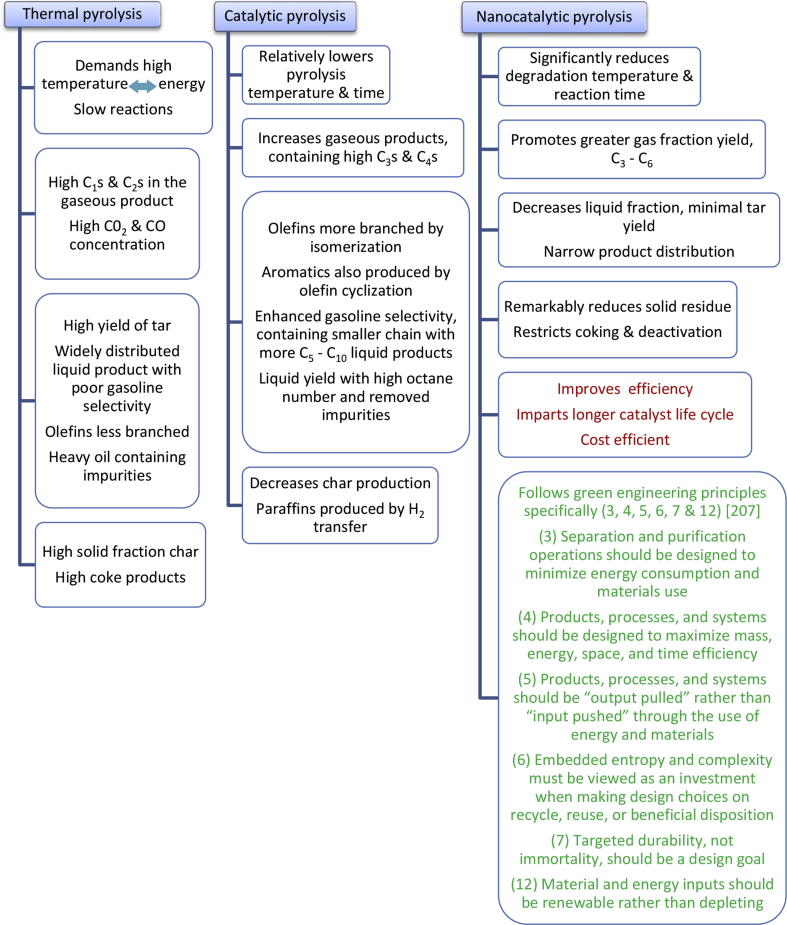
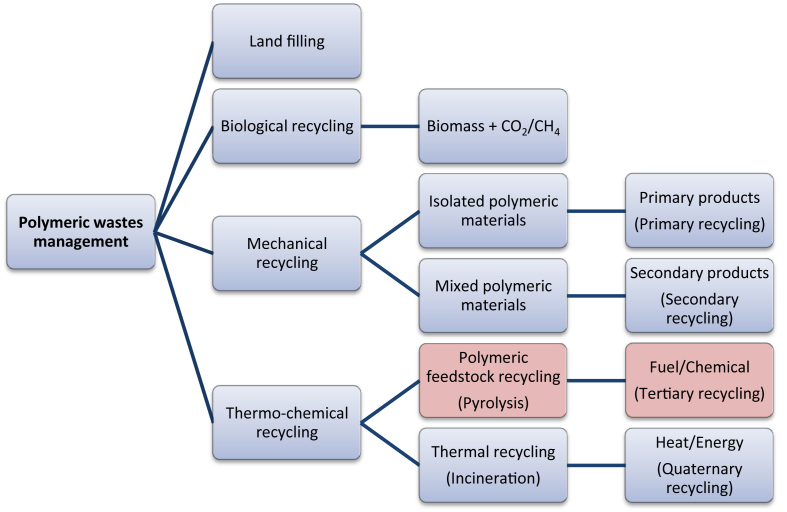
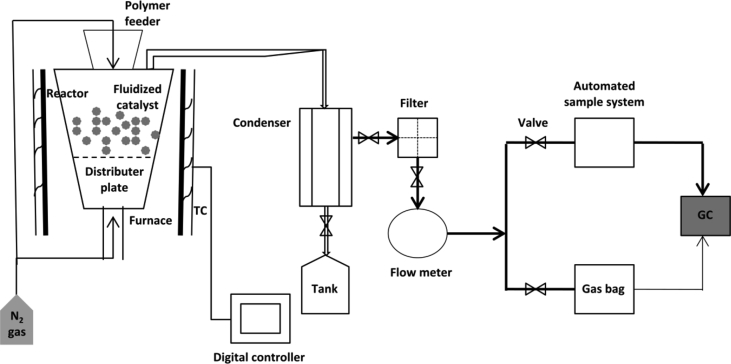
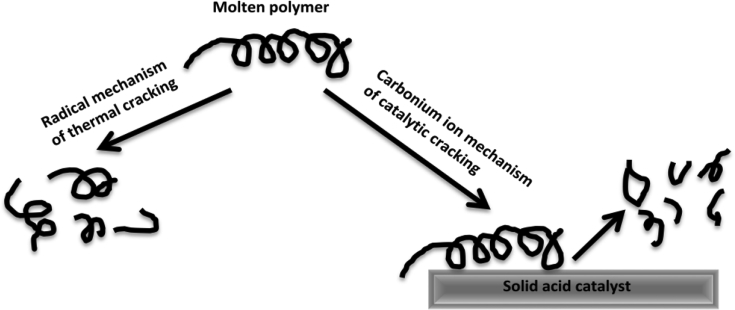
Nowadays, increasing population, widespread urbanization, rise in living standards together with versatile use of polymers have caused non-biodegradable polymeric wastes affecting the environment a chronic global problem, simultaneously, the existing high energy demand in our society is a matter of great concern. Hence forth, this review article provides an insight into the technological approach of pyrolysis emphasizing catalytic pyrolysis for conversion of polymeric wastes into energy products and presents an alternative waste management technique which is a leap towards developing sustainable environment. Pyrolysis of waste non-biodegradable polymer materials involves controlled thermal decomposition in the absence of oxygen, cracking their macromolecules into lower molecular weight ones, resulting into the formation of a wide range of products from hydrogen, hydrocarbons to coke. Nanocatalyzed pyrolysis is a recommended solution to the low thermal conductivity of polymers, promoting faster reactions in breaking the C-C bonds at lower temperatures, denoting less energy consumption and enabling enhancement in the process selectivity, whereby higher value added products are generated with increased yield. Nanotechnology plays an indispensable role in academic research as well as in industrial applications. Existing reviews illustrate that one of the oldest application field of nanotechnology is in the arena of nanocatalysis. Nanocatalysis closes the gap between homo and heterogeneous catalyses while combines their advantageous characteristics and positive aspects, reducing the respective drawbacks. During the current nanohype, nanostructured catalysts are esteemed materials and their exploration provide promising solutions for challenges from the perspective of cost and factors influencing catalytic activity, due to their featured high surface area to volume ratio which render enhanced properties with respect to the bulk catalyst.
如今,人口增长、城市化进程的广泛推进、生活水平的提高以及聚合物的广泛使用,已导致不可生物降解的聚合物废物对环境造成影响,这成为一个全球性的长期问题。与此同时,我们社会目前对高能源的需求也备受关注。因此,这篇综述文章深入探讨了热解技术方法,重点强调催化热解,即将聚合物废物转化为能源产品,并提出了一种替代性的废物管理技术,这是朝着发展可持续环境迈出的一大步。不可生物降解的废弃聚合物材料的热解涉及在无氧条件下的受控热分解,将其大分子裂解为较低分子量的分子,从而形成从氢气、碳氢化合物到焦炭等多种产物。纳米催化热解是解决聚合物低导热性的推荐方案,可促进在较低温度下更快地断裂碳 - 碳键的反应,意味着能耗更低,并能提高过程选择性,从而以更高的产率生成附加值更高的产品。纳米技术在学术研究和工业应用中都发挥着不可或缺的作用。现有综述表明,纳米技术最古老的应用领域之一是在纳米催化领域。纳米催化缩小了均相催化和多相催化之间的差距,同时结合了它们的优势特性和积极方面,减少了各自的缺点。在当前的纳米热潮中,纳米结构催化剂是备受推崇的材料,由于其具有高的表面积与体积比这一特性,相对于块状催化剂具有增强的性能,从成本和影响催化活性的因素角度来看,对它们的探索为应对挑战提供了有前景的解决方案。