Royal National Orthopaedic Hospital, Stanmore, UK.
Department of Biomedical Engineering, School of Biomedical Engineering and Imaging Sciences, King's College London, London, UK.
Med Phys. 2020 Aug;47(8):3356-3362. doi: 10.1002/mp.14218. Epub 2020 Jun 1.
To introduce a method that allows the generation of ultra high-resolution (submillimeter) heterogeneous digital PET brain phantoms and to provide a new publicly available [ ]FDG phantom as an example.
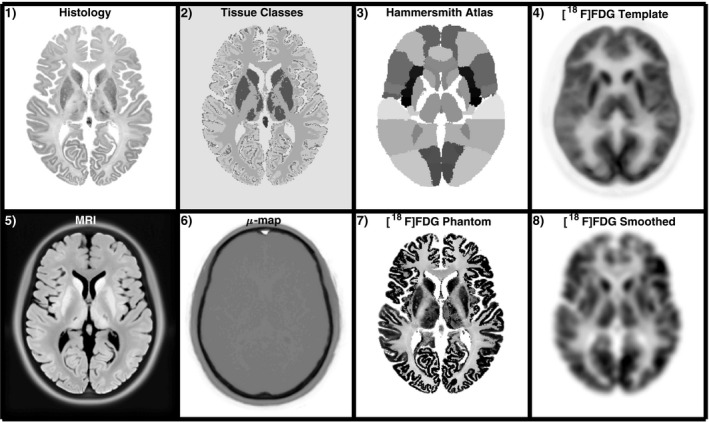
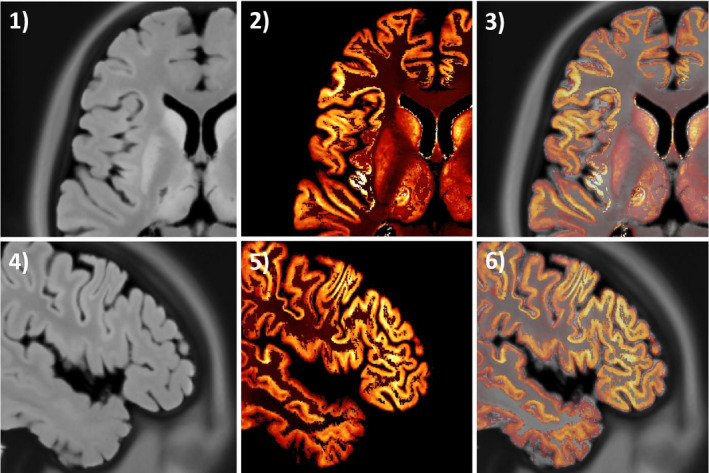
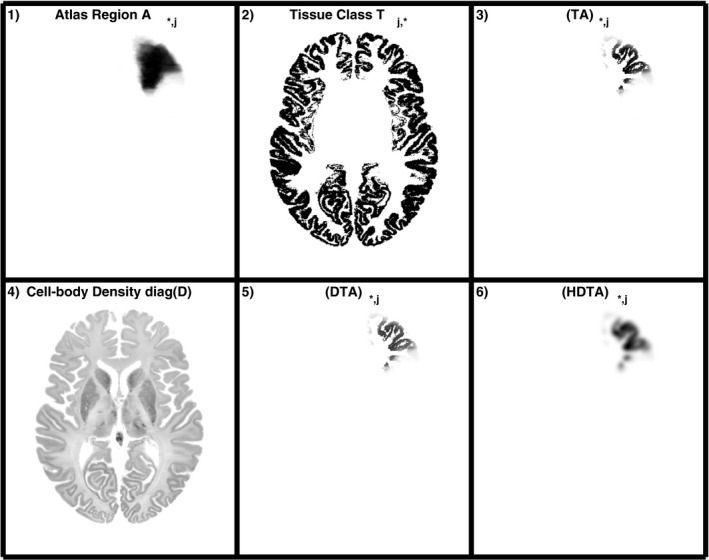
The radiotracer distribution of the phantom is estimated by minimizing the Kullback-Leibler distance between the parameterized unknown phantom distribution and a radiotracer-specific template used as a reference. The phantom is modelled using the histological and tissue classified volumes of the BigBrain atlas to provide both high resolution and heterogeneity. The Hammersmith brain atlas is also included to allow the estimation of different activity values in different anatomical regions of the brain. Using this method, a realistic [ ]FDG phantom was produced, where a single real [ ]FDG scan was used as the reference to match. An MRI T1-weighted image, obtained from the BigBrain atlas, and a pseudo-CT are included to complete the dataset. A full PET-MRI dataset was simulated and reconstructed with MR-guided methods for the new [ ]FDG phantom.
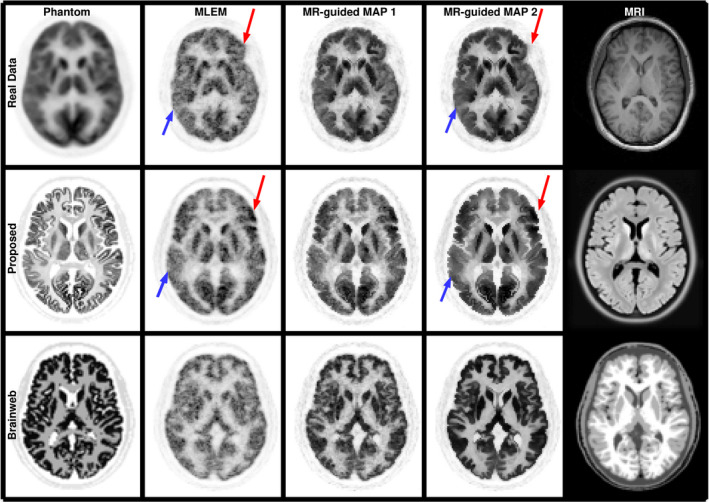
An ultra high-resolution (400 μm voxel size) and heterogeneous phantom for [ ]FDG was obtained. The radiotracer activity follows the patterns observed in the scan used as a reference. The simulated PET-MRI dataset provided a realistic simulation that was able to be reconstructed with MR-guided methods. By visual inspection, the reconstructed images showed similar patterns to the real data and the improvements in contrast and noise with respect to the standard MLEM reconstruction were more modest compared to simulations done with a simpler phantom, which was created from the same MRI image used to assist the reconstruction.
A method to create high-resolution heterogeneous digital brain phantoms for different PET radiotracers has been presented and successfully employed to create a new publicly available [ ]FDG phantom. The generated phantom is of high resolution, is heterogeneous, and simulates the uptake of the radiotracer in the different regions of the brain.
介绍一种能够生成超高分辨率(亚毫米级)异质数字 PET 脑体模的方法,并以新的[ ]FDG 体模为例。
通过最小化参数化未知体模分布与作为参考的放射性示踪剂特定模板之间的 Kullback-Leibler 距离来估计体模中的放射性示踪剂分布。该体模使用 BigBrain 图谱的组织学和组织分类体积进行建模,以提供高分辨率和异质性。还包括 Hammersmith 脑图谱,以允许在大脑的不同解剖区域估计不同的活动值。使用这种方法,生成了一个逼真的[ ]FDG 体模,其中单个真实的[ ]FDG 扫描被用作参考来匹配。包括来自 BigBrain 图谱的 MRI T1 加权图像和伪 CT 以完成数据集。使用 MR 引导方法对新的[ ]FDG 体模进行了全 PET-MRI 数据集的模拟和重建。
获得了超高分辨率(400μm 体素大小)和异质的[ ]FDG 体模。放射性示踪剂的活性遵循作为参考的扫描中观察到的模式。模拟的 PET-MRI 数据集提供了逼真的模拟,可以使用 MR 引导方法进行重建。通过目视检查,重建图像显示出与真实数据相似的模式,与使用更简单的体模进行的模拟相比,对比度和噪声的改善幅度较小,而该更简单的体模是使用用于辅助重建的相同 MRI 图像创建的。
提出了一种用于不同 PET 放射性示踪剂的高分辨率异质数字脑体模的创建方法,并成功用于创建新的公开可用的[ ]FDG 体模。生成的体模具有高分辨率、异质性,并模拟放射性示踪剂在大脑不同区域的摄取。