Université de Tours, Tours, France.
CHRU de Tours, Tours, France.
Cancer Med. 2020 Jul;9(13):4736-4742. doi: 10.1002/cam4.3067. Epub 2020 May 5.
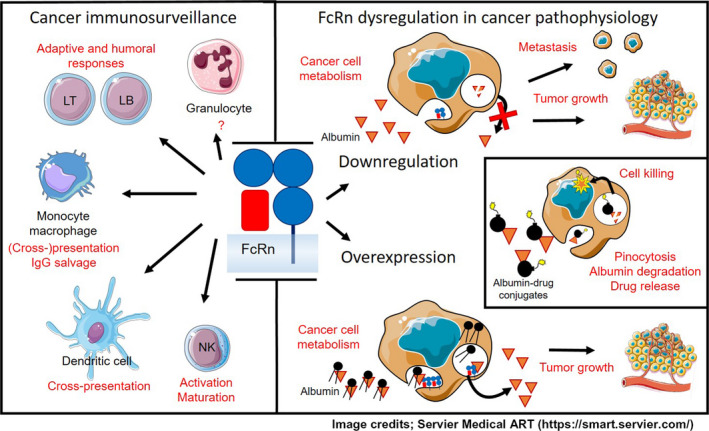
Since the neonatal IgG Fc receptor (FcRn) was discovered, it was found to be involved in immunoglobulin recycling and biodistribution, immune complexes routing, antigen presentation, humoral immune response, and cancer immunosurveillance. The latest data show that FcRn plays a part in cancer pathophysiology. In various types of cancers, such as lung and colorectal cancer, FcRn has been described as an early marker for prognosis. Dysregulation of FcRn expression by cancer cells allows them to increase their metabolism, and this process could be exploited for passive targeting of cytotoxic drugs. However, the roles of this receptor depend on whether the studied cell population is the tumor tissue or the infiltrating cells, bringing forward the need for further studies.
自从新生儿 IgG Fc 受体 (FcRn) 被发现以来,人们发现它参与了免疫球蛋白的再循环和分布、免疫复合物的路由、抗原呈递、体液免疫反应和癌症免疫监视。最新数据表明,FcRn 在癌症病理生理学中发挥作用。在各种类型的癌症中,如肺癌和结直肠癌,FcRn 已被描述为预后的早期标志物。癌细胞中 FcRn 表达的失调使它们能够增加新陈代谢,这个过程可以被用于细胞毒性药物的被动靶向。然而,该受体的作用取决于所研究的细胞群体是肿瘤组织还是浸润细胞,这就需要进一步的研究。