Institute of Cancer Sciences, University of Glasgow, Glasgow G61 1BD, U.K.
Chakri Naruebodindra Medical Institute, Mahidol University, Samut Prakan 10540, Thailand.
Biochem Soc Trans. 2020 Jun 30;48(3):765-773. doi: 10.1042/BST20190109.
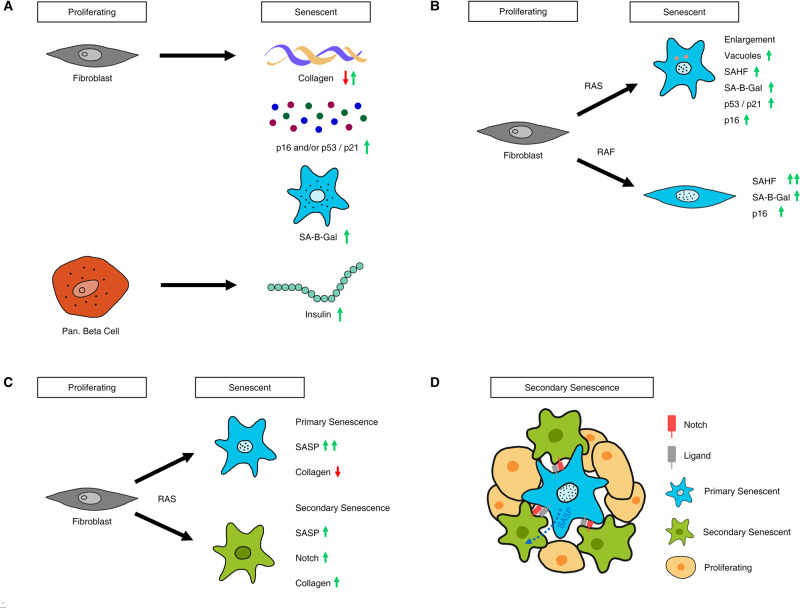
Senescence is a tumour suppressor mechanism which is cell-intrinsically activated in the context of cellular stress. Senescence can further be propagated to neighbouring cells, a process called secondary senescence induction. Secondary senescence was initially shown as a paracrine response to the secretion of cytokines from primary senescent cells. More recently, juxtacrine Notch signalling has been implicated in mediating secondary senescence induction. Primary and secondary senescent induction results in distinct transcriptional outcomes. In addition, cell type and the stimulus in which senescence is induced can lead to variations in the phenotype of the senescence response. It is unclear whether heterogeneous senescent end-points are associated with distinct cellular function in situ, presenting functional heterogeneity. Thus, understanding senescence heterogeneity could prove to be important when devising ways of targeting senescent cells by senolytics, senostatics or senogenics. In this review, we discuss a role for functional heterogeneity in senescence in tissue- and cell-type specific manners, highlighting potential differences in senescence outcomes of primary and secondary senescence.
衰老(Senescence)是一种肿瘤抑制机制,在细胞应激的情况下,这种机制会在细胞内部被激活。衰老可以进一步传播到邻近的细胞,这一过程被称为次级衰老诱导(Secondary Senescence Induction)。最初,次级衰老诱导被认为是初级衰老细胞分泌细胞因子的旁分泌反应。最近,旁分泌 Notch 信号通路被认为在介导次级衰老诱导中发挥作用。初级和次级衰老诱导会导致不同的转录结果。此外,细胞类型和诱导衰老的刺激因素会导致衰老反应表型的变化。目前尚不清楚不同的衰老终点是否与原位细胞功能的不同有关,是否存在功能异质性。因此,在通过 Senolytics、Senostatics 或 Senogenics 靶向衰老细胞的方法中,了解衰老异质性可能非常重要。在这篇综述中,我们讨论了衰老的功能异质性在组织和细胞类型特异性方面的作用,强调了初级和次级衰老的衰老结果的潜在差异。