Australian Centre for Blood Diseases, Monash University, Melbourne, VIC, Australia.
Department of Pharmacology and Therapeutics, Rady Faculty of Health Sciences, University of Manitoba, Winnipeg, MB, Canada.
Blood. 2020 Aug 20;136(8):957-973. doi: 10.1182/blood.2019002548.
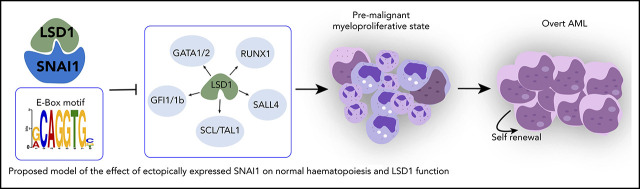
Modulators of epithelial-to-mesenchymal transition (EMT) have recently emerged as novel players in the field of leukemia biology. The mechanisms by which EMT modulators contribute to leukemia pathogenesis, however, remain to be elucidated. Here we show that overexpression of SNAI1, a key modulator of EMT, is a pathologically relevant event in human acute myeloid leukemia (AML) that contributes to impaired differentiation, enhanced self-renewal, and proliferation of immature myeloid cells. We demonstrate that ectopic expression of Snai1 in hematopoietic cells predisposes mice to AML development. This effect is mediated by interaction with the histone demethylase KDM1A/LSD1. Our data shed new light on the role of SNAI1 in leukemia development and identify a novel mechanism of LSD1 corruption in cancer. This is particularly pertinent given the current interest surrounding the use of LSD1 inhibitors in the treatment of multiple different malignancies, including AML.
上皮-间质转化(EMT)调节剂最近成为白血病生物学领域的新角色。然而,EMT 调节剂促进白血病发病机制的机制仍有待阐明。在这里,我们表明,上皮-间质转化(EMT)关键调节剂 SNAI1 的过表达是人类急性髓细胞白血病(AML)中的一个与病理相关的事件,导致不成熟髓细胞分化受损、自我更新增强和增殖。我们证明,造血细胞中 Sna1 的异位表达使小鼠易患 AML 的发展。这种效应是通过与组蛋白去甲基化酶 KDM1A/LSD1 的相互作用介导的。我们的数据为 SNAI1 在白血病发生中的作用提供了新的见解,并确定了 LSD1 在癌症中腐败的新机制。鉴于目前围绕 LSD1 抑制剂在治疗多种不同恶性肿瘤(包括 AML)中的应用的兴趣,这一点尤其重要。