Byeon Haewon
Department of Speech Language Pathology, School of Public Health, Honam University, 417, Eodeung-daero, Gwangsan-gu, Gwangju 62399, Korea.
Healthcare (Basel). 2020 May 1;8(2):121. doi: 10.3390/healthcare8020121.
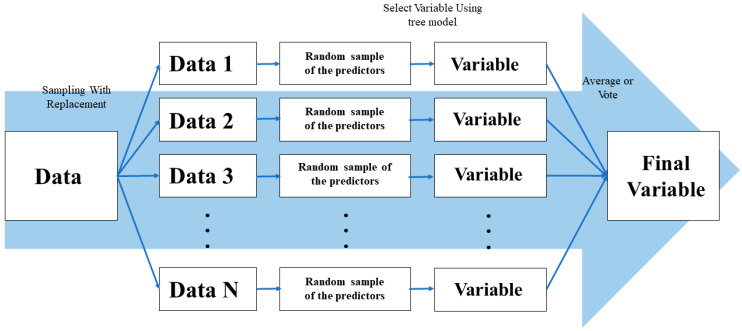
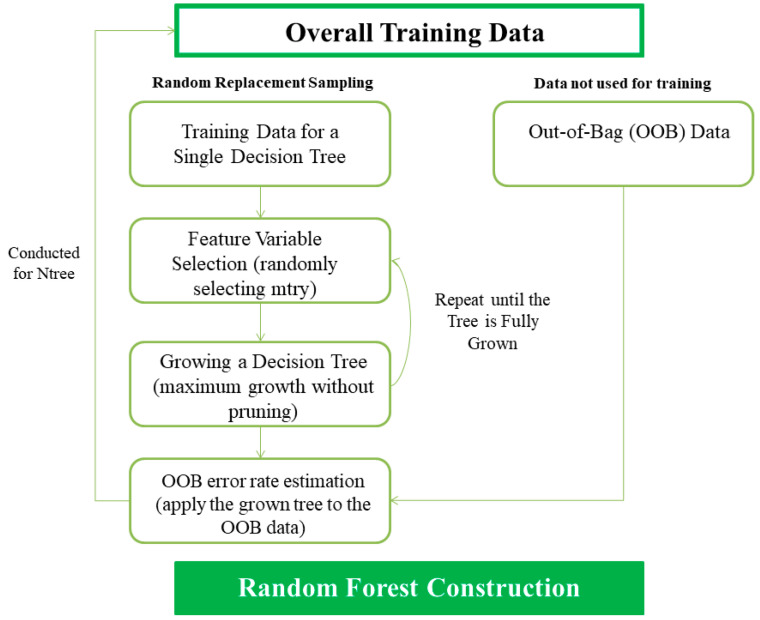
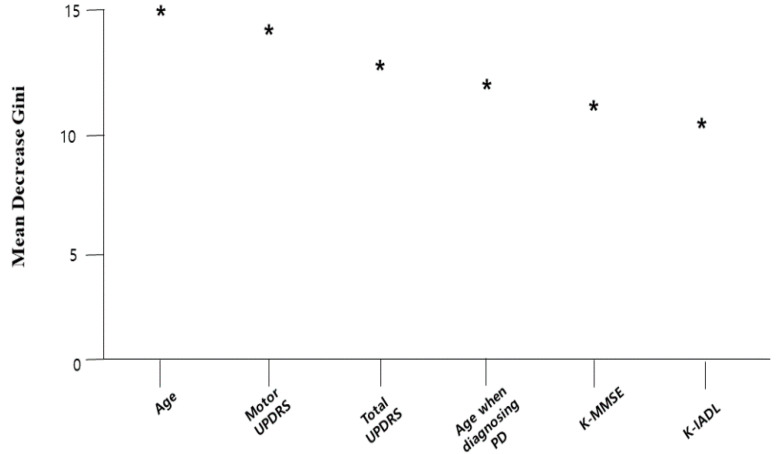
The rapid eye movement sleep behavior disorder (RBD) of Parkinson's disease (PD) patients can be improved with medications such as donepezil as long as it is diagnosed with a thorough medical examination, since identifying a high-risk group of RBD is a critical issue to treat PD. This study develops a model for predicting the high-risk groups of RBD using random forest (RF) and provides baseline information for selecting subjects for polysomnography. Subjects consisted of 350 PD patients (Parkinson's disease with normal cognition (PD-NC) = 48; Parkinson's disease with mild cognitive impairment (PD-MCI) = 199; Parkinson's disease dementia (PDD) = 103) aged 60 years and older. This study compares the prediction performance of RF, discriminant analysis, classification and regression tree (CART), radial basis function (RBF) neural network, and logistic regression model to select a final model with the best model performance and presents the variable importance of the final model's variable. As a result of analysis, the sensitivity of RF (79%) was superior to other models (discriminant analysis = 14%, CART = 32%, RBF neural network = 25%, and logistic regression = 51%). It was confirmed that age, the motor score of Untitled Parkinson's Disease Rating (UPDRS), the total score of UPDRS, the age when a subject was diagnosed with PD first time, the Korean Mini Mental State Examination, and Korean Instrumental Activities of Daily Living, were major variables with high weight for predicting RBD. Among them, age was the most important factor. The model for predicting Parkinson's disease RBD developed in this study will contribute to the screening of patients who should receive a video-polysomnography.
只要通过全面的医学检查确诊,帕金森病(PD)患者的快速眼动睡眠行为障碍(RBD)就可以使用多奈哌齐等药物进行改善,因为识别RBD高危人群是治疗PD的关键问题。本研究开发了一种使用随机森林(RF)预测RBD高危人群的模型,并为选择多导睡眠图检查的受试者提供基线信息。受试者包括350名60岁及以上的PD患者(认知正常的帕金森病(PD-NC)=48例;轻度认知障碍的帕金森病(PD-MCI)=199例;帕金森病痴呆(PDD)=103例)。本研究比较了RF、判别分析、分类与回归树(CART)、径向基函数(RBF)神经网络和逻辑回归模型的预测性能,以选择具有最佳模型性能的最终模型,并呈现最终模型变量的变量重要性。分析结果显示,RF的敏感性(79%)优于其他模型(判别分析=14%,CART=32%,RBF神经网络=25%,逻辑回归=51%)。经证实,年龄、帕金森病统一评分量表(UPDRS)的运动评分、UPDRS总分、首次诊断为PD的年龄、韩国简易精神状态检查表以及韩国日常生活活动能力量表是预测RBD的主要高权重变量。其中,年龄是最重要的因素。本研究开发的预测帕金森病RBD的模型将有助于筛选应接受视频多导睡眠图检查的患者。