Department of Ageing and Life Course, World Health Organization, 20 Avenue Appia, 1221 Geneva, Switzerland.
Ethox Centre, Nuffield Department of Population Health, University of Oxford, Oxford OX3 7LF, UK.
Int J Environ Res Public Health. 2020 May 1;17(9):3159. doi: 10.3390/ijerph17093159.
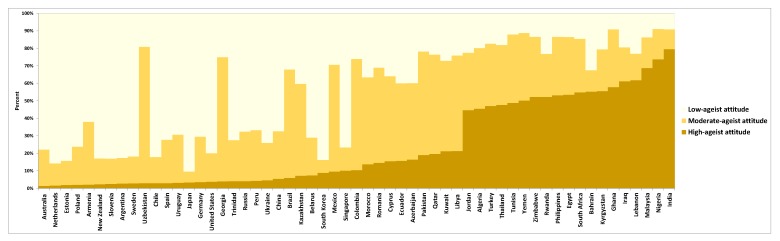
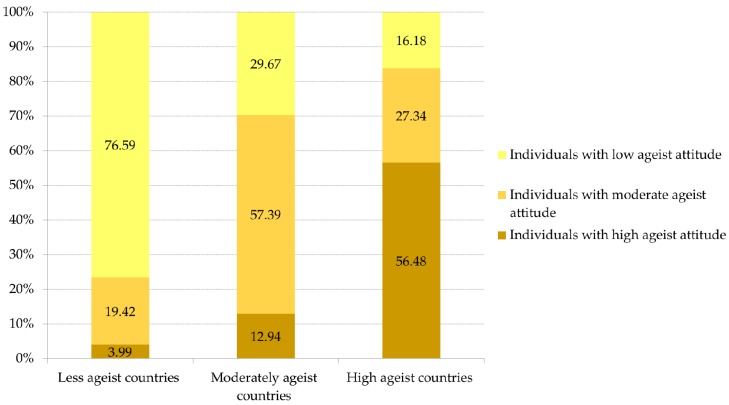
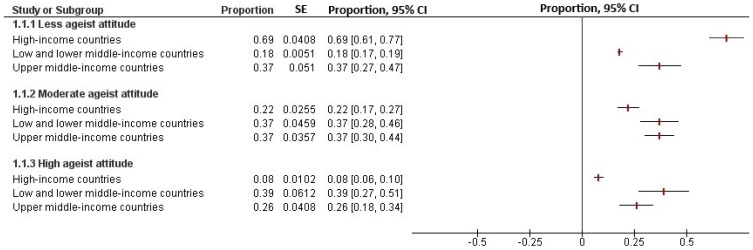
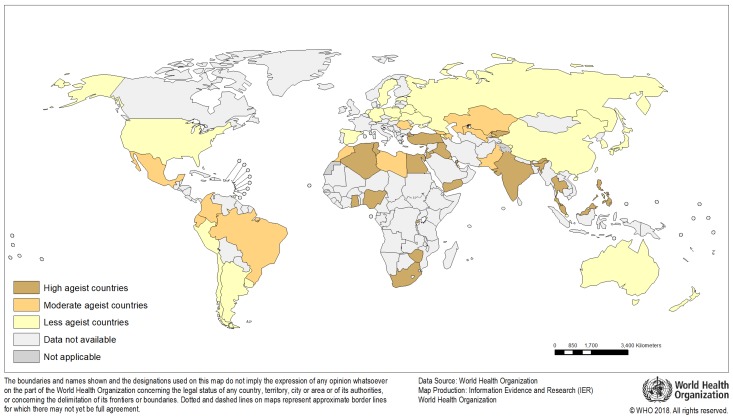
Evidence shows that ageism negatively impacts the health of older adults. However, estimates of its prevalence are lacking. This study aimed to estimate the global prevalence of ageism towards older adults and to explore possible explanatory factors. Data were included from 57 countries that took part in Wave 6 of the World Values Survey. Multilevel Latent Class Analysis was performed to identify distinct classes of individuals and countries. Individuals were classified as having high, moderate or low ageist attitudes; and countries as being highly, moderately or minimally ageist, by aggregating individual responses. Individual-level (age, sex, education and wealth) and contextual-level factors (healthy life expectancy, population health status and proportion of the population aged over 60 years) were examined as potential explanatory factors in multinomial logistic regression. From the 83,034 participants included, 44%, 32% and 24% were classified as having low, moderate and high ageist attitudes, respectively. From the 57 countries, 34 were classified as moderately or highly ageist. The likelihood of an individual or a country being ageist was significantly reduced by increases in healthy life expectancy and the proportion of older people within a country. Certain personal characteristics-younger age, being male and having lower education-were significantly associated with an increased probability of an individual having high ageist attitudes. At least one in every two people included in this study had moderate or high ageist attitudes. Despite the issue's magnitude and negative health impacts, ageism remains a neglected global health issue.
证据表明,年龄歧视会对老年人的健康产生负面影响。然而,目前缺乏对其流行程度的估计。本研究旨在估计全球对老年人的年龄歧视程度,并探讨可能的解释因素。数据来自参与世界价值观调查第六波的 57 个国家。采用多层次潜在类别分析来识别不同个体和国家的类别。通过汇总个体的反应,将个体分为高度、中度或低度年龄歧视态度;将国家分为高度、中度或低度年龄歧视。个体层面(年龄、性别、教育和财富)和背景层面(健康预期寿命、人口健康状况和 60 岁以上人口比例)的因素被检查为多变量逻辑回归的潜在解释因素。在纳入的 83034 名参与者中,分别有 44%、32%和 24%被归类为低度、中度和高度年龄歧视态度。在 57 个国家中,有 34 个被归类为中度或高度年龄歧视。健康预期寿命和一个国家内老年人的比例的增加显著降低了个人或国家年龄歧视的可能性。某些个人特征——年龄较小、男性和受教育程度较低——与个人高度年龄歧视态度的可能性增加显著相关。在这项研究中,至少每两个人中就有一个人有中度或高度的年龄歧视态度。尽管这一问题的规模和对健康的负面影响很大,但年龄歧视仍然是一个被忽视的全球健康问题。