School of Public Health and Preventive Medicine, 553 St Kilda Road Melbourne, 3004 VIC, Australia.
Usher Institute, The University of Edinburgh, 5 Little France Rd, Edinburgh EH16 4UX, UK.
Age Ageing. 2024 Nov 1;53(11). doi: 10.1093/ageing/afae239.
The relationship between nut intake and disability-free survival (healthy lifespan) in later life is unclear. The objective was to evaluate the association between nut intake and disability-free survival in a cohort of adults aged ≥70 years, and whether this varied according to overall diet quality.
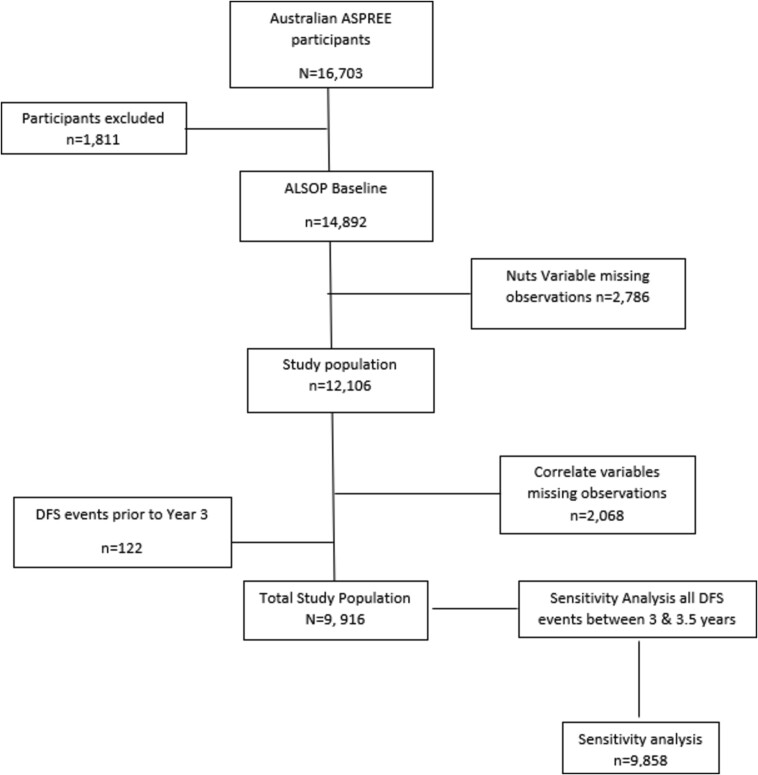
This prospective cohort study involved 9916 participants from the ASPREE Longitudinal Study of Older Persons. Participants completed a 49-item Food Frequency questionnaire from which frequency of nut intake was obtained and were asked to categories usual intake as no/infrequent [never/rarely, 1-2 times/month], weekly [1-2 times/week, often 3-6 times/week] or daily [every day or several times a day]. The outcome measured was a composite of first-event mortality, onset of dementia, or persistent physical disability. Cox proportional hazards regression models, adjusted for socio-demographic factors, health-related and clinical covariates and overall dietary quality were conducted to examine the association between varying levels of nut intake and disability-free survival.
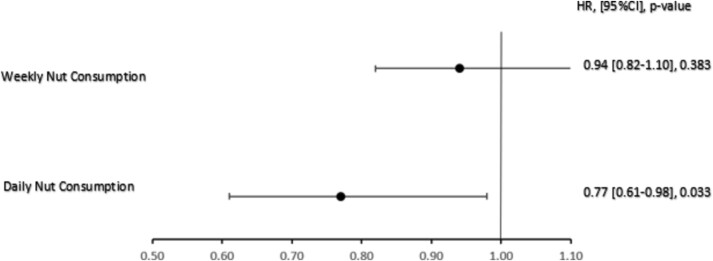
Over a mean of 3.9 years of follow-up, the risk of reaching the DFS endpoint were 23% lower (HR 0.77 [0.61-0.98]) for those who consumed nuts daily, when compared to those with no/infrequent nut consumption. Subgroup analysis demonstrated a significant association between daily nut consumption and healthy lifespan among individuals in the second dietary quality tertile (HR 0.71[0.51-0.98]).
For community-dwelling adults aged 70 years and over with sub-optimal diets, daily nut consumption is associated with the promotion of healthy lifespan (disability-free survival).
坚果摄入量与晚年无残疾生存(健康寿命)之间的关系尚不清楚。本研究旨在评估 70 岁及以上成年人中坚果摄入量与无残疾生存之间的关系,并评估其是否因总体饮食质量而异。
这是一项前瞻性队列研究,涉及 ASPREE 老年人纵向研究中的 9916 名参与者。参与者完成了一份包含 49 项食物频率问卷,从中获得了坚果摄入量的频率,并被要求将通常的摄入量分为无/很少摄入[从不/很少,每月 1-2 次]、每周[1-2 次/周,经常 3-6 次/周]或每天[每天或每天几次]。测量的结果是首次死亡、痴呆发作或持续性身体残疾的综合指标。采用 Cox 比例风险回归模型,调整了社会人口因素、健康相关和临床协变量以及总体饮食质量,以检验不同水平的坚果摄入量与无残疾生存之间的关系。
在平均 3.9 年的随访期间,与无/很少摄入坚果的人相比,每天食用坚果的人达到 DFS 终点的风险降低了 23%(HR 0.77 [0.61-0.98])。亚组分析表明,在饮食质量处于第二 tertile 的个体中,每天食用坚果与健康寿命之间存在显著关联(HR 0.71 [0.51-0.98])。
对于饮食质量较差、年龄在 70 岁及以上的社区居住成年人,每天食用坚果与促进健康寿命(无残疾生存)有关。