D. O. Ott Research Institute of Obstetrics, Gynecology and Reproductology, Mendeleevskaya line 3, 199034 St. Petersburg, Russia.
Int J Mol Sci. 2020 May 2;21(9):3223. doi: 10.3390/ijms21093223.
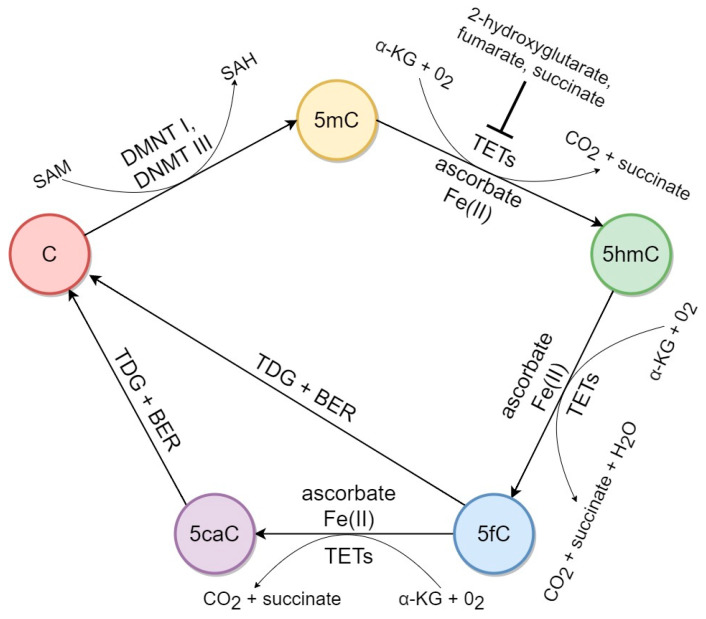
Convincing evidence accumulated over the last decades demonstrates the crucial role of epigenetic modifications for mammalian genome regulation and its flexibility. DNA methylation and demethylation is a key mechanism of genome programming and reprogramming. During ontogenesis, the DNA methylome undergoes both programmed changes and those induced by environmental and endogenous factors. The former enable accurate activation of developmental programs; the latter drive epigenetic responses to factors that directly or indirectly affect epigenetic biochemistry leading to alterations in genome regulation and mediating organism response to environmental transformations. Adverse environmental exposure can induce aberrant DNA methylation changes conducive to genetic dysfunction and, eventually, various pathologies. In recent years, evidence was derived that apart from 5-methylcytosine, the DNA methylation/demethylation cycle includes three other oxidative derivatives of cytosine-5-hydroxymethylcytosine (5hmC), 5-formylcytosine, and 5-carboxylcytosine. 5hmC is a predominantly stable form and serves as both an intermediate product of active DNA demethylation and an essential hallmark of epigenetic gene regulation. This makes 5hmC a potential contributor to epigenetically mediated responses to environmental factors. In this state-of-the-art review, we consolidate the latest findings on environmentally induced adverse effects on 5hmC patterns in mammalian genomes. Types of environmental exposure under consideration include hypnotic drugs and medicines (i.e., phenobarbital, diethylstilbestrol, cocaine, methamphetamine, ethanol, dimethyl sulfoxide), as well as anthropogenic pollutants (i.e., heavy metals, particulate air pollution, bisphenol A, hydroquinone, and pentachlorophenol metabolites). We put a special focus on the discussion of molecular mechanisms underlying environmentally induced alterations in DNA hydroxymethylation patterns and their impact on genetic dysfunction. We conclude that DNA hydroxymethylation is a sensitive biosensor for many harmful environmental factors each of which specifically targets 5hmC in different organs, cell types, and DNA sequences and induces its changes through a specific metabolic pathway. The associated transcriptional changes suggest that environmentally induced 5hmC alterations play a role in epigenetically mediated genome flexibility. We believe that knowledge accumulated in this review together with further studies will provide a solid basis for new approaches to epigenetic therapy and chemoprevention of environmentally induced epigenetic toxicity involving 5hmC patterns.
过去几十年积累的令人信服的证据表明,表观遗传修饰对于哺乳动物基因组调控及其灵活性具有至关重要的作用。DNA 甲基化和去甲基化是基因组编程和重编程的关键机制。在个体发生过程中,DNA 甲基组经历了程序性变化和由环境和内源性因素诱导的变化。前者使发育程序的准确激活成为可能;后者驱动对直接或间接影响表观遗传生物化学的因素的表观遗传反应,导致基因组调控的改变,并介导生物体对环境转化的反应。不利的环境暴露会诱导有利于遗传功能障碍的异常 DNA 甲基化变化,并最终导致各种病理。近年来,有证据表明,除了 5-甲基胞嘧啶外,DNA 甲基化/去甲基化循环还包括胞嘧啶-5-羟甲基化(5hmC)、5-甲酰基胞嘧啶和 5-羧基胞嘧啶的另外三种氧化衍生物。5hmC 是一种主要的稳定形式,既是活性 DNA 去甲基化的中间产物,也是表观遗传基因调控的重要标志。这使得 5hmC 成为对环境因素的表观遗传介导反应的潜在贡献者。在这篇最新综述中,我们总结了环境因素对哺乳动物基因组中 5hmC 模式的不利影响的最新发现。考虑的环境暴露类型包括催眠药物和药物(即苯巴比妥、己烯雌酚、可卡因、苯丙胺、乙醇、二甲基亚砜)以及人为污染物(即重金属、颗粒状空气污染、双酚 A、对苯二酚和五氯酚代谢物)。我们特别关注讨论环境诱导的 DNA 羟甲基化模式改变的分子机制及其对遗传功能障碍的影响。我们得出结论,DNA 羟甲基化是许多有害环境因素的敏感生物传感器,每种因素都专门针对不同器官、细胞类型和 DNA 序列中的 5hmC,并通过特定的代谢途径诱导其变化。相关的转录变化表明,环境诱导的 5hmC 改变在表观遗传介导的基因组灵活性中起作用。我们相信,本综述中积累的知识以及进一步的研究将为涉及 5hmC 模式的表观遗传治疗和环境诱导的表观遗传毒性的化学预防的新方法提供坚实的基础。