Department of Biological Sciences and Sustainability Studies Theme, Ohio University, 107 Irvine Hall, Athens, OH, 45701, USA.
Earth to Ocean Research Group, Department of Biological Sciences, Simon Fraser University, 8888 University Dr., Burnaby, BC, V5A 1S6, Canada.
Sci Rep. 2020 May 5;10(1):7603. doi: 10.1038/s41598-020-64501-7.
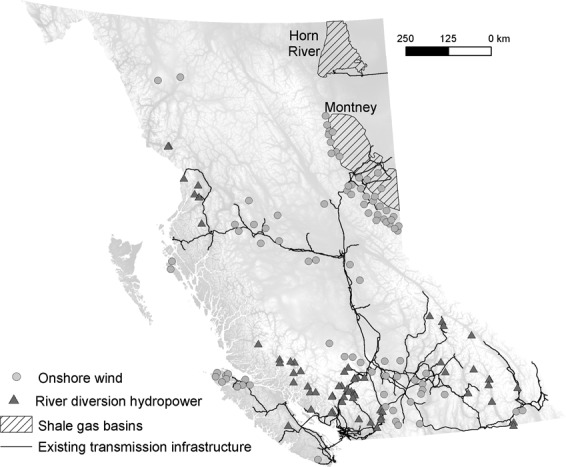
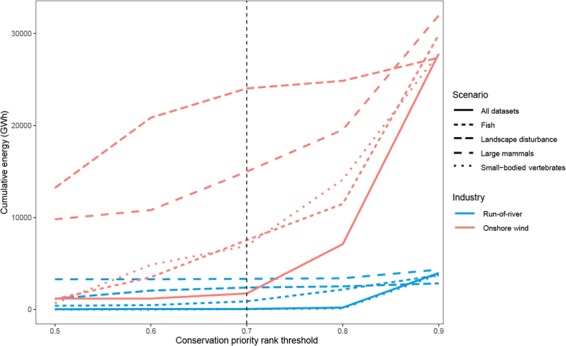
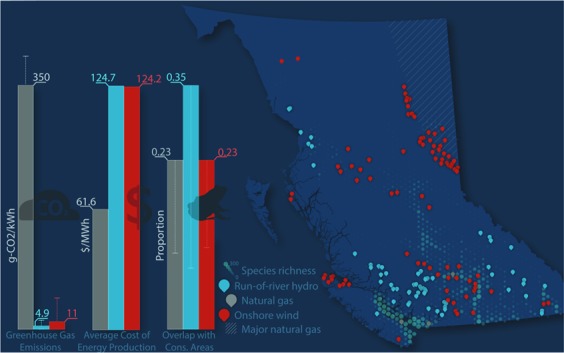
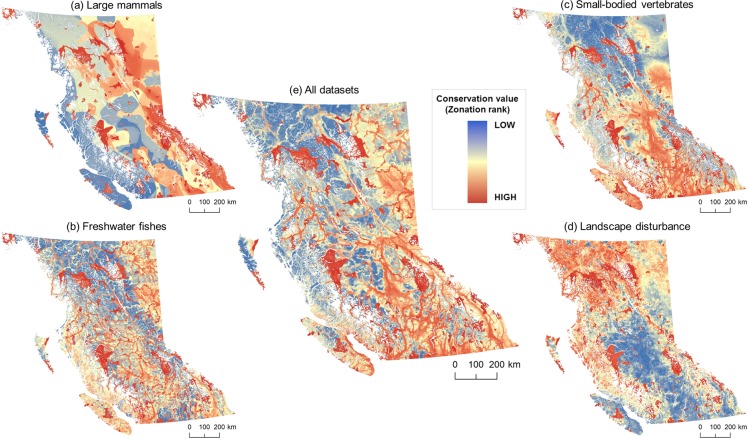
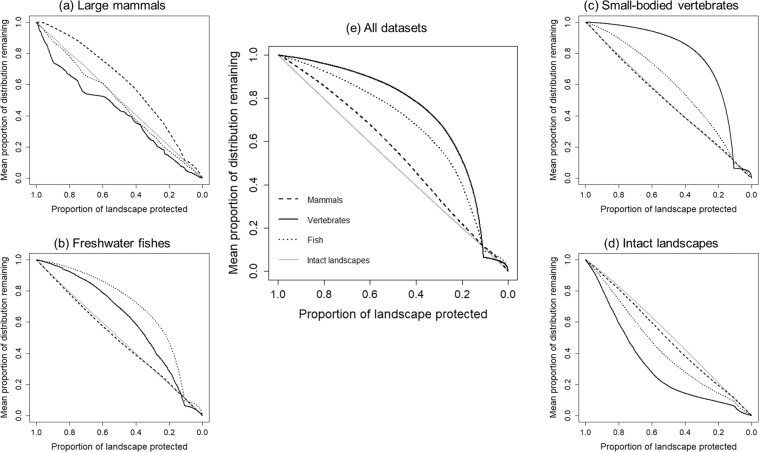
The challenge of balancing biodiversity protection with economic growth is epitomized by the development of renewable and unconventional energy, whose adoption is aimed at stemming the impacts of global climate change, yet has outpaced our understanding of biodiversity impacts. We evaluated the potential conflict between biodiversity protection and future electricity generation from renewable (wind farms, run-of-river hydro) and non-renewable (shale gas) sources in British Columbia (BC), Canada using three metrics: greenhouse gas (GHG) emissions, electricity cost, and overlap between future development and conservation priorities for several fish and wildlife groups - small-bodied vertebrates, large mammals, freshwater fish - and undisturbed landscapes. Sharp trade-offs in global versus regional biodiversity conservation exist for all energy technologies, and in BC they are currently smallest for wind energy: low GHG emissions, low-moderate overlap with top conservation priorities, and competitive energy cost. GHG emissions from shale gas are 1000 times higher than those from renewable sources, and run-of-river hydro has high overlap with conservation priorities for small-bodied vertebrates. When all species groups were considered simultaneously, run-of-river hydro had moderate overlap (0.56), while shale gas and onshore wind had low overlap with top conservation priorities (0.23 and 0.24, respectively). The unintended cost of distributed energy sources for regional biodiversity suggest that trade-offs based on more diverse metrics must be incorporated into energy planning.
平衡生物多样性保护与经济增长的挑战,集中体现在可再生和非传统能源的发展上,其采用旨在遏制全球气候变化的影响,但我们对生物多样性影响的理解却落后了。我们使用三个指标评估了在加拿大不列颠哥伦比亚省(BC),从可再生能源(风力发电场、河流径流式水力发电)和非可再生能源(页岩气)中未来发电与生物多样性保护之间潜在冲突:温室气体(GHG)排放、电力成本,以及几种鱼类和野生动物群体(小体型脊椎动物、大哺乳动物、淡水鱼类)以及未受干扰景观的未来发展与保护重点之间的重叠。所有能源技术在全球与区域生物多样性保护之间都存在明显的权衡取舍,而在不列颠哥伦比亚省,风能的权衡取舍最小:温室气体排放量低,与保护重点的重叠低到中等,且能源成本具有竞争力。页岩气的温室气体排放量比可再生能源高出 1000 倍,而径流式水力发电与小体型脊椎动物的保护重点高度重叠。当同时考虑所有物种群体时,径流式水力发电具有中度重叠(0.56),而页岩气和陆上风力发电与保护重点的重叠度较低(分别为 0.23 和 0.24)。分布式能源对区域生物多样性的意外代价表明,必须在能源规划中纳入基于更多元指标的权衡取舍。