Zhang Lei, Jiang Yankai, Zhu Jie, Liang Huazheng, He Xiangyang, Qian Jiahong, Lin Hai, Tao Yubo, Zhu Keqing
China Brain Bank and Department of Neurology in Second Affiliated Hospital, Key Laboratory of Medical Neurobiology of Zhejiang Province, and Department of Neurobiology, Zhejiang University School of Medicine, 866 Yu Hang Tang Road, Hangzhou, 310058, China.
Department of Pathology, Zhejiang University School of Medicine, Hangzhou, 310058, China.
J Mol Neurosci. 2020 Nov;70(11):1808-1811. doi: 10.1007/s12031-020-01573-0. Epub 2020 May 5.
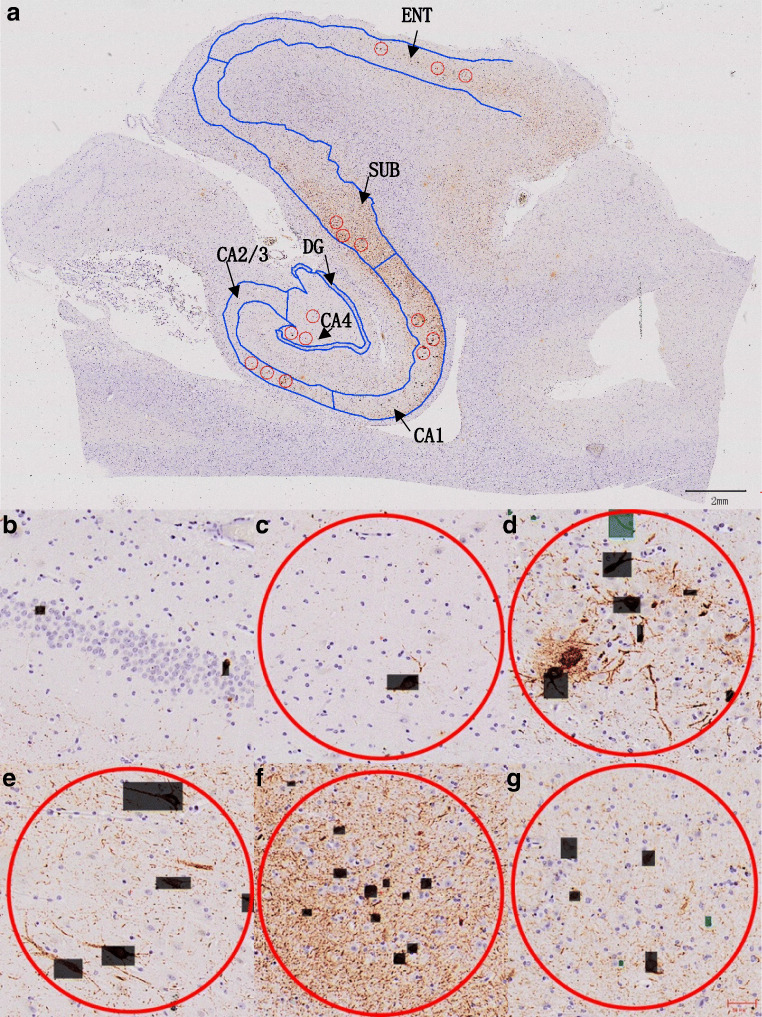
To quantitatively assess the distribution pattern of hippocampal tau pathology in Alzheimer's disease (AD) and primary age-related tauopathy (PART), we investigated the distribution of phosphorylated tau protein (AT8) in 6 anatomically defined subregions of the hippocampal formation and developed a mathematical algorithm to compare the patterns of tau deposition in PART and AD. We demonstrated regional patterns of selective vulnerability as distinguishing features of PART and AD in functionally relevant structures of the hippocampus. In AD cases, tau pathology was high in both CA1 and subiculum, followed by CA2/3, entorhinal cortex (EC), CA4, and dentate gyrus (DG). In PART, the severity of tau pathology in CA1 and subiculum was high, followed by EC, CA2/3, CA4, and DG. There are significant differences between sector DG and CA1, DG and subiculum in both AD and PART.
为了定量评估阿尔茨海默病(AD)和原发性年龄相关性tau蛋白病(PART)中海马体tau蛋白病变的分布模式,我们研究了磷酸化tau蛋白(AT8)在海马结构6个解剖学定义子区域中的分布,并开发了一种数学算法来比较PART和AD中tau蛋白沉积的模式。我们证明了在海马体功能相关结构中,选择性易损性的区域模式是PART和AD的显著特征。在AD病例中,CA1区和下托的tau蛋白病变程度较高,其次是CA2/3区、内嗅皮质(EC)、CA4区和齿状回(DG)。在PART中,CA1区和下托的tau蛋白病变严重程度较高,其次是EC、CA2/3、CA4和DG。在AD和PART中,齿状回扇形区与CA1区、齿状回扇形区与下托之间均存在显著差异。