Department of Health, Medicine and Caring Sciences, Division of Nursing Sciences and Reproductive Health, Linköping University, 581 83, Linköping, Sweden.
Department of Health, Medicine and Caring Sciences, Division of Physiotherapy, Linköping University, Linköping, Sweden.
ESC Heart Fail. 2020 Aug;7(4):1467-1476. doi: 10.1002/ehf2.12709. Epub 2020 May 6.
The purpose of this study was to explore the utility of two single-item self-report (SR) questions to assess physical inactivity in patients with heart failure (HF).
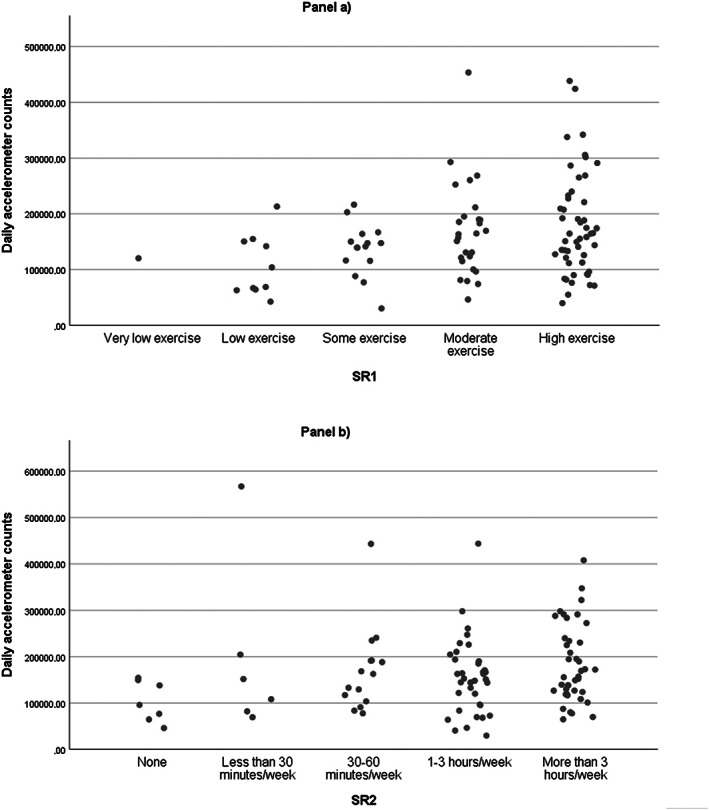
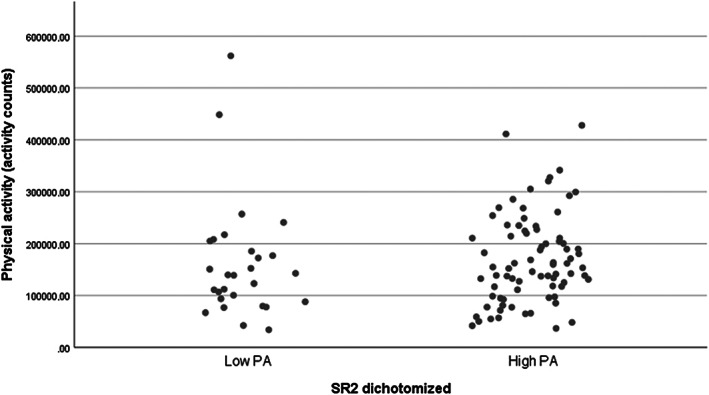
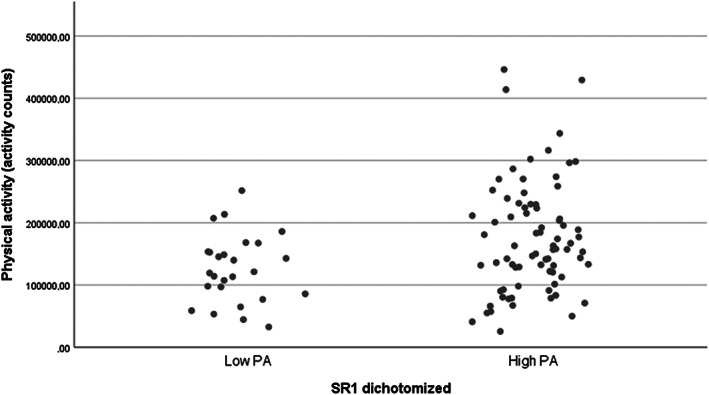
This is a cross-sectional study using data from 106 patients with HF equipped with accelerometers for 1 week each. Two SR items relating to physical activity were also collected. Correlations between accelerometer activity counts and the SR items were analysed. Patients were classified as physically active or inactive on the basis of accelerometer counts, and the SR items were used to try to predict that classification. Finally, patients were classified as having high self-reported physical activity or low self-reported physical activity, on the basis of the SR items, and the resulting groups were analysed for differences in actual physical activity. There were significant but weak correlations between the SR items and accelerometer counts: ρ = 0.24, P = 0.016 for SR1 and ρ = 0.21, P = 0.033 for SR2. Using SR items to predict whether a patient was physically active or inactive produced an area under the curve of 0.62 for SR1, with a specificity of 92% and a sensitivity of 30%. When dividing patients into groups on the basis of SR1, there was a significant difference of 1583 steps per day, or 49% more steps in the high self-reported physical activity group (P < 0.001).
There might be utility in the single SR question for high-specificity screening of large populations to identify physically inactive patients in order to assign therapeutic interventions efficiently where resources are limited.
本研究旨在探讨两项单项自我报告(SR)问题在评估心力衰竭(HF)患者体力活动不足中的效用。
这是一项横断面研究,使用了 106 名配备了 1 周加速度计的 HF 患者的数据。还收集了与体力活动相关的两项 SR 项目。分析了加速度计活动计数与 SR 项目之间的相关性。根据加速度计计数将患者分为体力活动活跃或不活跃,并使用 SR 项目尝试预测该分类。最后,根据 SR 项目将患者分为高自我报告体力活动或低自我报告体力活动,并分析实际体力活动的差异。SR 项目与加速度计计数之间存在显著但较弱的相关性:SR1 的 ρ=0.24,P=0.016,SR2 的 ρ=0.21,P=0.033。使用 SR 项目来预测患者是否活跃或不活跃,SR1 的曲线下面积为 0.62,特异性为 92%,敏感性为 30%。根据 SR1 将患者分为两组时,高自我报告体力活动组每天的步数差异显著,多出 1583 步,即多出 49%(P<0.001)。
在资源有限的情况下,单项 SR 问题可能具有高度特异性的大规模人群筛查的效用,以识别不活跃的患者,从而有效地分配治疗干预措施。