Izbicki Patricia, Zaman Andrew, Stegemöller Elizabeth L
Department of Kinesiology, Iowa State University, Ames, IA, United States.
Front Hum Neurosci. 2020 Apr 16;14:127. doi: 10.3389/fnhum.2020.00127. eCollection 2020.
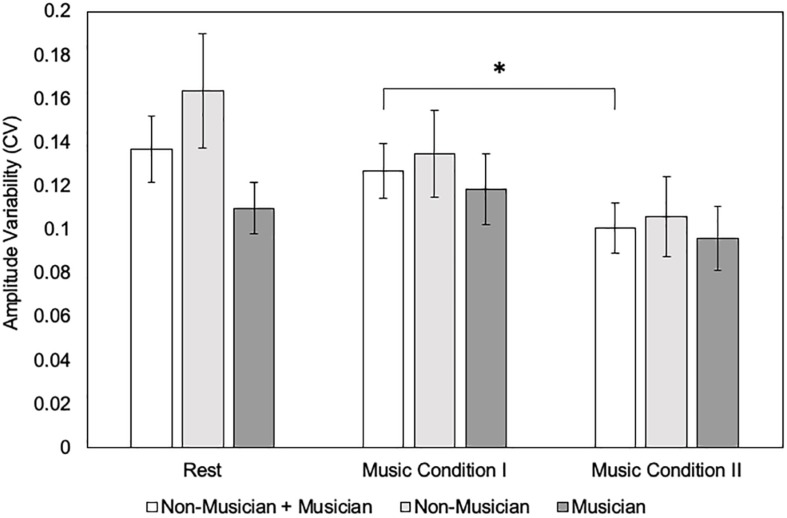
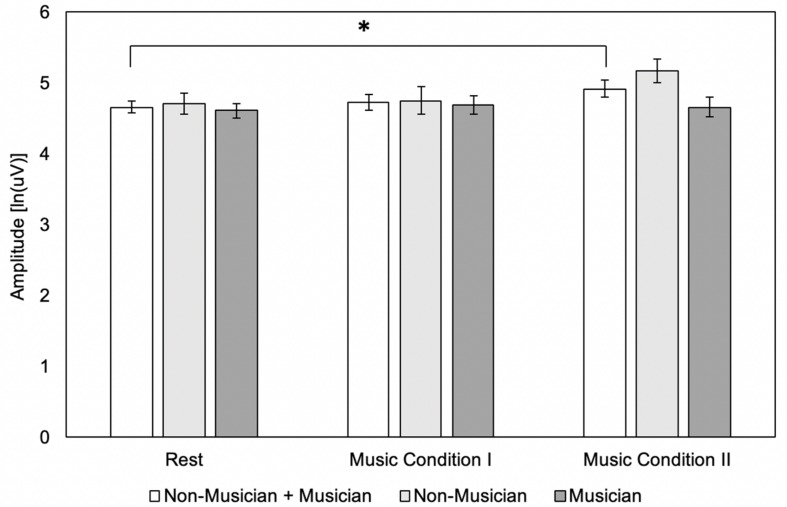
External cues, such as music, improve movement performance in persons with Parkinson's disease. However, research examining the motor cortical mechanisms by which this occurs is lacking. Research using electroencephalography in healthy young adults has revealed that moving to music can modulate motor cortical activity. Moreover, motor cortical activity is further influenced by music experience. It remains unknown whether these effects extend to corticomotor excitability. Therefore, the primary aim of this study was to determine the effects of novel music on corticomotor excitability using transcranial magnetic stimulation (TMS) in a pilot study of healthy young adults. A secondary aim of this study was to determine the influence of music experience on corticomotor excitability. We hypothesized that corticomotor excitability will change during music conditions, and that it will differ in those with formal music training. Motor evoked potentials (MEPs) were recorded from the first dorsal interosseous using single-pulse TMS in three conditions: (1) No Music, (2) Music Condition I, and (3) Music Condition II. Both pieces were set to novel MIDI piano instrumentation and part-writing conventions typical of early nineteenth-century Western classical practices. Results revealed Music Condition II (i.e., more relaxing music) compared to rest increased MEP amplitude (i.e., corticomotor excitability). Music Condition II as compared to Music Condition I (i.e., more activating music) reduced MEP variability (i.e., corticomotor variability). Finally, years of formal music training did not significantly influence corticomotor excitability while listening to music. Overall, results revealed that unfamiliar music modulates motor cortical excitability but is dependent upon the form of music and possibly music preference. These results will be used to inform planned studies in healthy older adults and people with Parkinson's disease.
外部线索,如音乐,可改善帕金森病患者的运动表现。然而,目前缺乏对其发生的运动皮层机制的研究。在健康的年轻成年人中使用脑电图进行的研究表明,随着音乐运动可以调节运动皮层活动。此外,运动皮层活动还会受到音乐体验的进一步影响。这些影响是否会扩展到皮质运动兴奋性仍不清楚。因此,本研究的主要目的是在一项针对健康年轻成年人的初步研究中,使用经颅磁刺激(TMS)来确定新颖音乐对皮质运动兴奋性的影响。本研究的第二个目的是确定音乐体验对皮质运动兴奋性的影响。我们假设在音乐条件下皮质运动兴奋性会发生变化,并且在接受过正规音乐训练的人群中会有所不同。在三种条件下,使用单脉冲TMS从第一背侧骨间肌记录运动诱发电位(MEP):(1)无音乐,(2)音乐条件I,和(3)音乐条件II。两首曲子均采用新颖的MIDI钢琴乐器编制和19世纪早期西方古典音乐典型的声部写作惯例。结果显示,与休息相比,音乐条件II(即更舒缓的音乐)增加了MEP波幅(即皮质运动兴奋性)。与音乐条件I(即更具活力的音乐)相比,音乐条件II降低了MEP的变异性(即皮质运动变异性)。最后,在听音乐时,正规音乐训练的年限并未对皮质运动兴奋性产生显著影响。总体而言,结果表明不熟悉的音乐会调节运动皮层兴奋性,但这取决于音乐的形式以及可能的音乐偏好。这些结果将用于为针对健康老年人和帕金森病患者的计划研究提供参考。