Gandhi Chandrashekhar R
Divisions of Gastroenterology, Hepatology and Nutrition, Department of Pediatrics, Cincinnati Children's Hospital Medical Center, Cincinnati, OH, United States.
Cincinnati VA Medical Center, Cincinnati, OH, United States.
Front Med (Lausanne). 2020 Apr 21;7:130. doi: 10.3389/fmed.2020.00130. eCollection 2020.
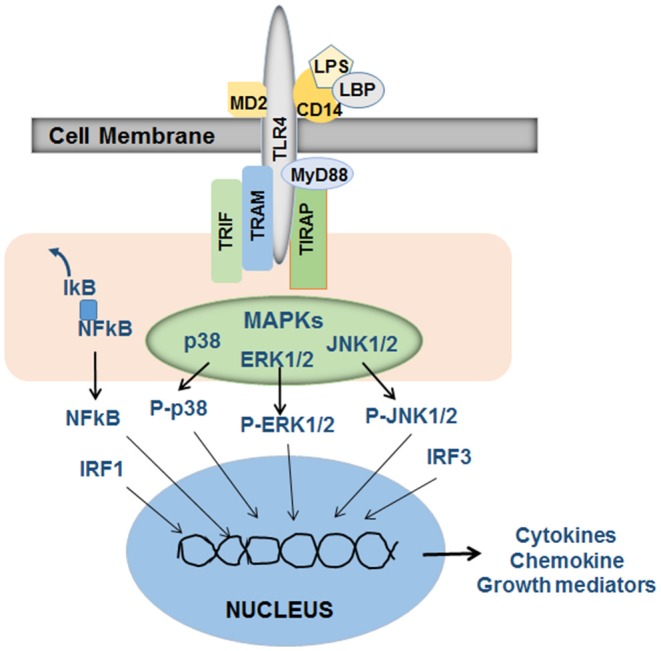
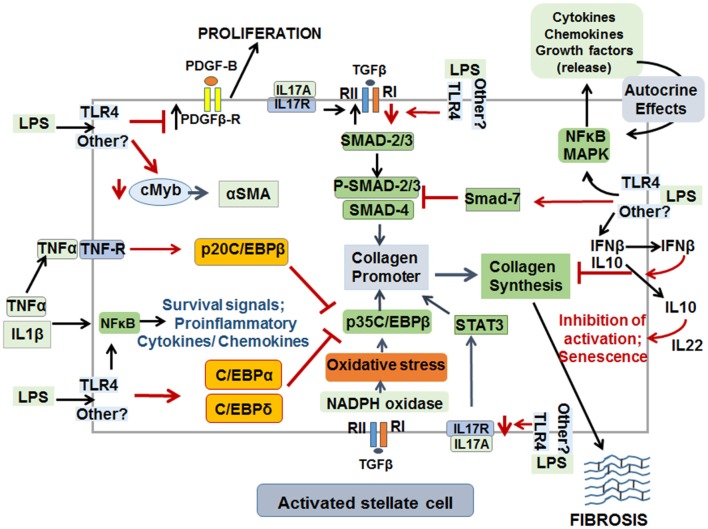
Extensive research performed over several decades has identified cells participating in the initiation and progression of fibrosis, and the numerous underlying inter- and intra-cellular signaling pathways. However, liver fibrosis continues to be a major clinical challenge as the precise targets of treatment are still elusive. Activation of physiologically quiescent perisinusoidal hepatic stellate cells (HSCs) to a myofibroblastic proliferating, contractile and fibrogenic phenotype is a critical event in the pathogenesis of chronic liver disease. Thus, elucidation of the mechanisms of the reversal to quiescence or inhibition of activated HSCs, and/or their elimination via apoptosis has been the focus of intense investigation. Lipopolysaccharide (LPS), a gut-resident Gram-negative bacterial endotoxin, is a powerful pro-inflammatory molecule implicated in hepatic injury, inflammation and fibrosis. In both acute and chronic liver injury, portal venous levels of LPS are elevated due to increased intestinal permeability. LPS, via CD14 and Toll-like receptor 4 (TLR4) and its adapter molecules, stimulates macrophages, neutrophils and several other cell types to produce inflammatory mediators as well as factors that can activate HSCs and stimulate their fibrogenic activity. LPS also stimulates synthesis of pro- and anti-inflammatory cytokines/chemokines, growth mediators and molecules of immune regulation by HSCs. However, LPS was found to arrest proliferation of activated HSCs and to convert them into non-fibrogenic phenotype. Interestingly, LPS can elicit responses in HSCs independent of CD14 and TLR4. Identifying and/or developing non-inflammatory but anti-fibrogenic mimetics of LPS could be relevant for treating liver fibrosis.
几十年来进行的广泛研究已经确定了参与纤维化起始和进展的细胞,以及众多潜在的细胞间和细胞内信号通路。然而,肝纤维化仍然是一个重大的临床挑战,因为治疗的精确靶点仍然难以捉摸。生理性静止的肝窦周肝星状细胞(HSCs)激活为肌成纤维细胞增殖、收缩和纤维化表型是慢性肝病发病机制中的一个关键事件。因此,阐明激活的HSCs恢复静止或受到抑制的机制,和/或通过凋亡将其清除,一直是深入研究的重点。脂多糖(LPS)是一种存在于肠道的革兰氏阴性细菌内毒素,是一种强大的促炎分子,与肝损伤、炎症和纤维化有关。在急性和慢性肝损伤中,由于肠道通透性增加,门静脉血中LPS水平升高。LPS通过CD14和Toll样受体4(TLR4)及其衔接分子,刺激巨噬细胞、中性粒细胞和其他几种细胞类型产生炎症介质以及可激活HSCs并刺激其纤维化活性的因子。LPS还刺激HSCs合成促炎和抗炎细胞因子/趋化因子、生长介质和免疫调节分子。然而,发现LPS可阻止激活的HSCs增殖,并将它们转化为非纤维化表型。有趣的是,LPS可在不依赖CD14和TLR4的情况下在HSCs中引发反应。鉴定和/或开发LPS的非炎性但抗纤维化模拟物可能与治疗肝纤维化有关。