
自闭症谱系障碍儿童的非典型价值驱动选择性注意。
Atypical Value-Driven Selective Attention in Young Children With Autism Spectrum Disorder.
机构信息
Child Study Center, Yale School of Medicine, New Haven, Connecticut.
Key Laboratory of Spectral Imaging Technology, Key Laboratory of Biomedical Spectroscopy of Xi'an, Xi'an Institute of Optics and Precision Mechanics of Chinese Academy of Sciences.
出版信息
JAMA Netw Open. 2020 May 1;3(5):e204928. doi: 10.1001/jamanetworkopen.2020.4928.
IMPORTANCE
Enhanced selective attention toward nonsocial objects and impaired attention to social stimuli constitute key clinical features of autism spectrum disorder (ASD). Yet, the mechanisms associated with atypical selective attention in ASD are poorly understood, which limits the development of more effective interventions. In typically developing individuals, selective attention to social and nonsocial stimuli is associated with the informational value of the stimuli, which is typically learned over the course of repeated interactions with the stimuli.
OBJECTIVE
To examine value learning (VL) of social and nonsocial stimuli and its association with selective attention in preschoolers with and without ASD.
DESIGN, SETTING, AND PARTICIPANTS: This case-control study compared children with ASD vs children with developmental delay (DD) and children with typical development (TD) recruited between March 3, 2017, and June 13, 2018, at a university-based research laboratory. Participants were preschoolers with ASD, DD, or TD.
MAIN OUTCOMES AND MEASURES
Procedure consisted of an eye-tracking gaze-contingent VL task involving social (faces) and nonsocial (fractals) stimuli and consisting of baseline, training, and choice test phases. Outcome measures were preferential attention to stimuli reinforced (high value) vs not reinforced (low value) during training. The hypotheses were stated before data collection.
RESULTS
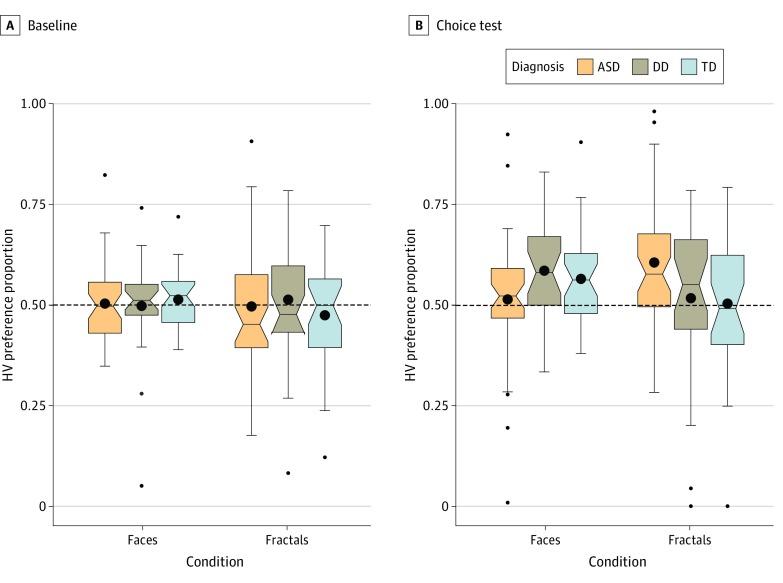
Included were 115 preschoolers with ASD (n = 48; mean [SD] age, 38.30 [15.55] months; 37 [77%] boys), DD (n = 31; mean [SD] age, 45.73 [19.49] months; 19 [61%] boys), or TD (n = 36; mean [SD] age, 36.53 [12.39] months; 22 [61%] boys). The groups did not differ in sex distribution; participants with ASD or TD had similar chronological age; and participants with ASD or DD had similar verbal IQ and nonverbal IQ. After training, the ASD group showed preference for the high-value nonsocial stimuli (mean proportion, 0.61 [95% CI, 0.56-0.65]; P < .001) but not for the high-value social stimuli (mean proportion, 0.51 [95% CI, 0.46-0.56]; P = .58). In contrast, the DD and TD groups demonstrated preference for the high-value social stimuli (DD mean proportion, 0.59 [95% CI, 0.54-0.64]; P = .001 and TD mean proportion, 0.57 [95% CI, 0.53-0.61]; P = .002) but not for the high-value nonsocial stimuli (DD mean proportion, 0.52 [95% CI, 0.44-0.59]; P = .64 and TD mean proportion, 0.50 [95% CI, 0.44-0.57]; P = .91). Controlling for age and nonverbal IQ, autism severity was positively correlated with enhanced learning in the nonsocial domain (r = 0.22; P = .03) and with poorer learning in the social domain (r = -0.26; P = .01).
CONCLUSIONS AND RELEVANCE
Increased attention to objects in preschoolers with ASD may be associated with enhanced VL in the nonsocial domain. When paired with poor VL in the social domain, enhanced value-driven attention to objects may play a formative role in the emergence of autism symptoms by altering attentional priorities and thus learning opportunities in affected children.
重要性
对非社交对象的选择性注意力增强和对社交刺激的注意力受损是自闭症谱系障碍(ASD)的关键临床特征。然而,与 ASD 中异常选择性注意力相关的机制仍知之甚少,这限制了更有效的干预措施的发展。在正常发育的个体中,对社交和非社交刺激的选择性注意力与刺激的信息价值有关,而信息价值通常是通过与刺激的反复互动来学习的。
目的
研究学龄前 ASD 儿童与无 ASD 儿童在社会和非社会刺激的价值学习(VL)及其与选择性注意力的关系。
设计、设置和参与者:本病例对照研究比较了 ASD 与发育迟缓(DD)和典型发育(TD)的儿童,参与者为 ASD、DD 或 TD 学龄前儿童。参与者于 2017 年 3 月 3 日至 2018 年 6 月 13 日在大学研究实验室招募。
主要结果和措施
程序包括一个基于眼动追踪的注视条件 VL 任务,涉及社会(面孔)和非社会(分形)刺激,包括基线、训练和选择测试阶段。测量指标是在训练过程中对强化(高价值)和未强化(低价值)的刺激的偏好注意力。在数据收集之前提出了假设。
结果
包括 115 名 ASD 学龄前儿童(n = 48;平均[SD]年龄,38.30[15.55]个月;37[77%]男孩)、DD(n = 31;平均[SD]年龄,45.73[19.49]个月;19[61%]男孩)或 TD(n = 36;平均[SD]年龄,36.53[12.39]个月;22[61%]男孩)。三组在性别分布上没有差异;ASD 或 TD 组的参与者年龄相似;ASD 或 DD 组的参与者的言语智商和非言语智商相似。经过训练,ASD 组对高价值的非社交刺激表现出偏好(平均比例,0.61[95%置信区间,0.56-0.65];P < .001),但对高价值的社交刺激没有偏好(平均比例,0.51[95%置信区间,0.46-0.56];P = .58)。相比之下,DD 和 TD 组对高价值的社交刺激表现出偏好(DD 平均比例,0.59[95%置信区间,0.54-0.64];P = .001,TD 平均比例,0.57[95%置信区间,0.53-0.61];P = .002),但对高价值的非社交刺激没有偏好(DD 平均比例,0.52[95%置信区间,0.44-0.59];P = .64,TD 平均比例,0.50[95%置信区间,0.44-0.57];P = .91)。在控制年龄和非言语智商后,自闭症严重程度与非社交领域的增强学习呈正相关(r = 0.22;P = .03),与社交领域的学习能力下降呈负相关(r = -0.26;P = .01)。
结论和相关性
ASD 学龄前儿童对物体的注意力增加可能与非社交领域的增强 VL 有关。当与社交领域的 VL 能力下降结合时,对物体的增强价值驱动注意力可能通过改变注意力优先级并因此改变受影响儿童的学习机会,在自闭症症状的出现中发挥重要作用。


 Zotero 插件