Nemoto Miyuki, Sasai Hiroyuki, Yabushita Noriko, Tsuchiya Keito, Hotta Kazushi, Fujita Yoshihiko, Kim Taeho, Tsujimoto Takehiko, Arai Tetsuaki, Tanaka Kiyoji
Dementia Medical Center, University of Tsukuba Hospital, Tsukuba 3058575, Japan.
Research Team for Promoting Independence and Mental Health, Tokyo Metropolitan Institute of Gerontology, Tokyo 1730015, Japan.
Geriatrics (Basel). 2020 May 3;5(2):29. doi: 10.3390/geriatrics5020029.
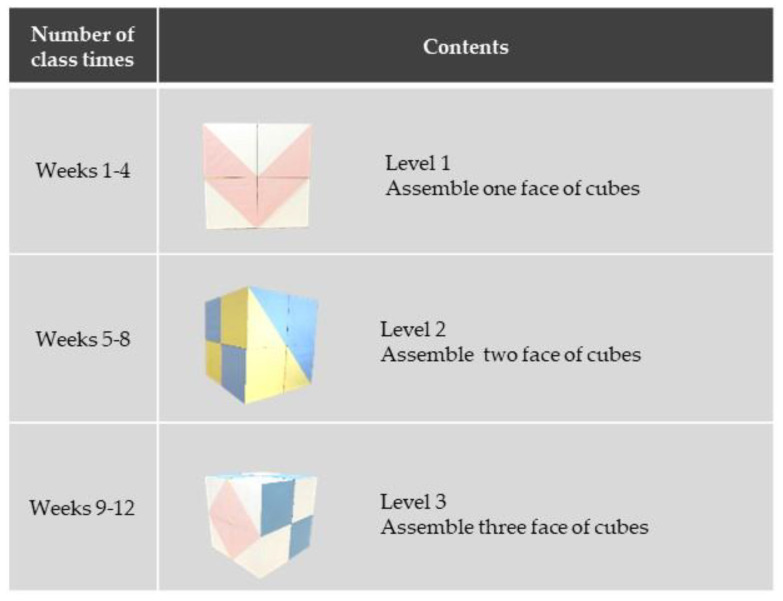
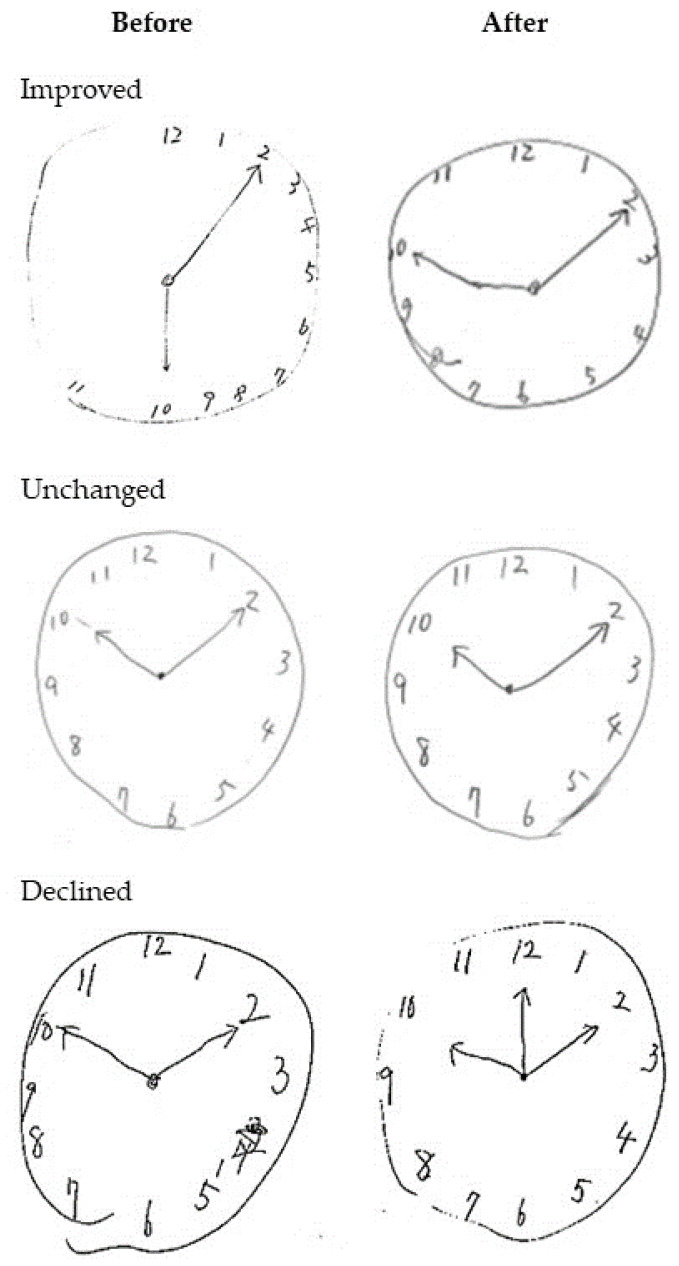
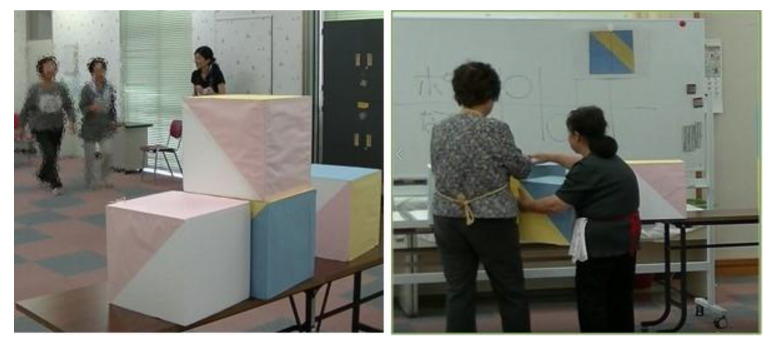
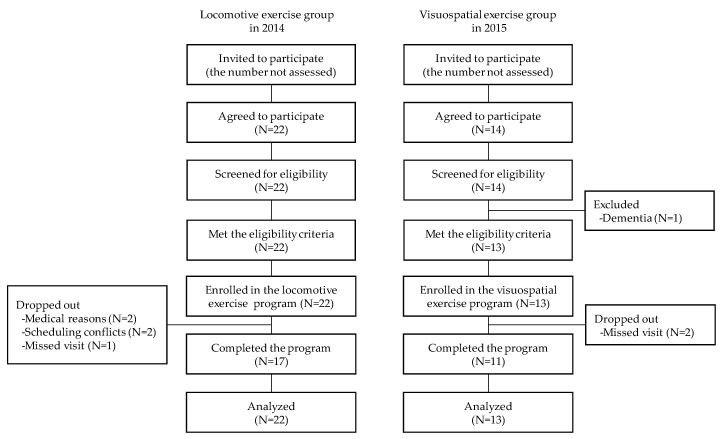
We aimed to develop a novel exercise to improve visuospatial ability and evaluate its feasibility and effectiveness in older adults with frailty. A non-randomized preliminary trial was conducted between June 2014 and March 2015. We recruited 35 adults with frailty (24 women), aged 66-92 years. Participants were assigned to either locomotive- or visuospatial-exercise groups. All participants exercised under the supervision of physiotherapists for 90 min/week for 12 weeks. The visuospatial exercise participants used cubes with six colored patterns and were instructed to "reproduce the same colored pattern as shown in the photo", using the cubes. In the locomotive exercise group, lower extremity functional training was provided. Rates of retention and attendance measured feasibility. Most participants completed the intervention (77.3%, locomotive; 84.6%, visuospatial) and had good attendance (83.8%, locomotive; 90.7%, visuospatial). Mini-mental state examination (MMSE), clock drawing test (CDT), and seven physical performance tests were conducted before and after interventions. The improvement in the MMSE score, qualitative analysis of CDT, grip strength, and sit and reach assessments were significantly greater in the visuospatial exercise group than in the locomotive exercise group. The cube exercise might be a feasible exercise program to potentially improve visuospatial ability and global cognition in older adults with frailty.
我们旨在开发一种新型锻炼方法,以提高视觉空间能力,并评估其在体弱老年人中的可行性和有效性。2014年6月至2015年3月期间进行了一项非随机初步试验。我们招募了35名体弱成年人(24名女性),年龄在66 - 92岁之间。参与者被分配到运动锻炼组或视觉空间锻炼组。所有参与者在物理治疗师的监督下每周锻炼90分钟,共锻炼12周。视觉空间锻炼组的参与者使用带有六种彩色图案的立方体,并被要求用这些立方体“重现照片中所示的相同彩色图案”。在运动锻炼组中,提供了下肢功能训练。通过留存率和出勤率来衡量可行性。大多数参与者完成了干预(运动锻炼组为77.3%,视觉空间锻炼组为84.6%),且出勤率较高(运动锻炼组为83.8%,视觉空间锻炼组为90.7%)。在干预前后进行了简易精神状态检查表(MMSE)、画钟测试(CDT)和七项身体性能测试。视觉空间锻炼组在MMSE评分的改善、CDT的定性分析、握力以及坐位体前屈评估方面的改善明显大于运动锻炼组。立方体锻炼可能是一种可行的锻炼方案,有可能提高体弱老年人的视觉空间能力和整体认知能力。