International Health Policy Program, Ministry of Public Health, Nonthaburi 11000, Thailand.
Division of Epidemiology, Department of Disease Control, Ministry of Public Health, Nonthaburi 11000, Thailand.
Int J Environ Res Public Health. 2020 May 4;17(9):3198. doi: 10.3390/ijerph17093198.
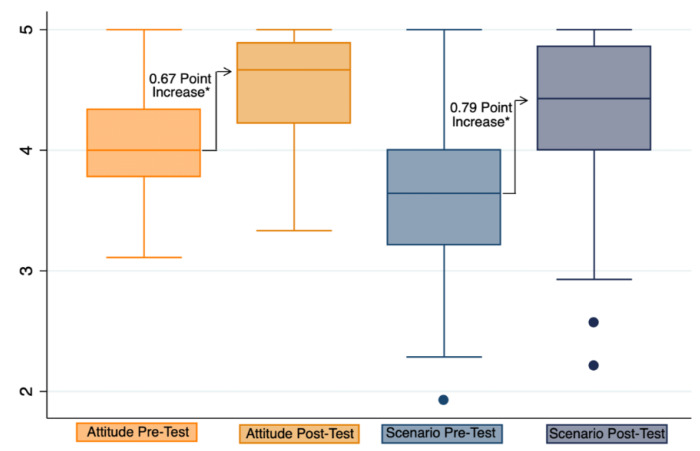
Although physicians in Thailand can carry out abortions legally, unsafe abortion rates remain high and have serious consequences for women's health. Training programs for healthcare providers on the 'Care of unplanned and adolescent pregnancies for the prevention of unsafe abortions' have been implemented in Thailand with the aim of providing information and challenging negative attitudes about abortions. This study investigated the participants of the training courses in order to: (i) evaluate their knowledge and attitudes towards safe abortions; and (ii) investigate the factors that determine their knowledge and attitudes. A pre-post study design was applied. Descriptive statistics were calculated to provide an overview of the data. Bivariate analysis, a Wilcoxon signed rank test and a multivariable analysis using multiple linear regression were applied to determine the changes in attitudes and assess the likelihood of behaviour change towards adolescents and women experiencing unplanned pregnancy and abortions, according to demographic and professional characteristics. Having had the training, healthcare providers' change in attitudes towards adolescents and women experiencing unplanned pregnancies and abortions were found to be 0.67 points for the nine responses of attitudes and 0.79 points for the 14 responses on various abortion scenarios. Changes in attitude were significantly different among the varying health professional types, with non-doctors increasing by 0.53 points, non-obstetricians and non-gynaecologists increasing by 0.46 points and obstetricians and gynaecologists (OBGYN) increasing by 0.32 points. Positive attitudes towards unplanned pregnancies and unsafe abortions and attitudes towards abortion scenarios significantly increased. The career type of the health professional was a significant factor in improving attitudes. The training program was more effective among non-doctor healthcare providers. Therefore, non-doctors could be the target population for training in the future.
尽管泰国的医生可以合法进行堕胎,但不安全堕胎的比例仍然很高,这对妇女的健康造成了严重后果。泰国已经实施了医疗保健提供者关于“意外怀孕和青少年妊娠护理以预防不安全堕胎”的培训计划,旨在提供信息并挑战对堕胎的负面态度。本研究调查了培训课程的参与者,目的是:(i)评估他们对安全堕胎的知识和态度;(ii)调查决定他们知识和态度的因素。采用了预-后研究设计。描述性统计数据用于提供数据概述。应用了双变量分析、Wilcoxon 符号秩检验和使用多元线性回归的多变量分析,以确定根据人口统计学和专业特征,对青少年和经历意外怀孕和堕胎的妇女的态度变化,并评估行为改变的可能性。在接受培训后,医疗保健提供者对经历意外怀孕和堕胎的青少年和妇女的态度变化为 9 个态度回答的 0.67 分和 14 个各种堕胎情况回答的 0.79 分。不同类型的卫生专业人员的态度变化存在显著差异,非医生增加了 0.53 分,非妇产科医生增加了 0.46 分,妇产科医生增加了 0.32 分。对意外怀孕和不安全堕胎的积极态度以及对堕胎情况的态度显著增加。卫生专业人员的职业类型是改善态度的重要因素。培训计划对非医生医疗保健提供者更有效。因此,非医生可能是未来培训的目标人群。