Cresswell Jenny A, Schroeder Rosalyn, Dennis Mardieh, Owolabi Onikepe, Vwalika Bellington, Musheke Maurice, Campbell Oona, Filippi Veronique
MARCH Centre for Maternal, Adolescent, Reproductive and Child Health, LSHTM, London, UK.
MARCH Centre for Maternal, Adolescent, Reproductive and Child Health, LSHTM, London, UK Bixby Center for Global Reproductive Health, University of California, San Francisco, California, USA.
BMJ Open. 2016 Mar 21;6(3):e010076. doi: 10.1136/bmjopen-2015-010076.
In Zambia, despite a relatively liberal legal framework, there remains a substantial burden of unsafe abortion. Many women do not use skilled providers in a well-equipped setting, even where these are available. The aim of this study was to describe women's knowledge of the law relating to abortion and attitudes towards abortion in Zambia.
Community-based survey in Central, Copperbelt and Lusaka provinces.
1484 women of reproductive age (15-44 years).
Correct knowledge of the legal grounds for abortion, attitudes towards abortion services and the previous abortions of friends, family or other confidants. Descriptive statistics and multivariable logistic regression were used to analyse how knowledge and attitudes varied according to sociodemographic characteristics.
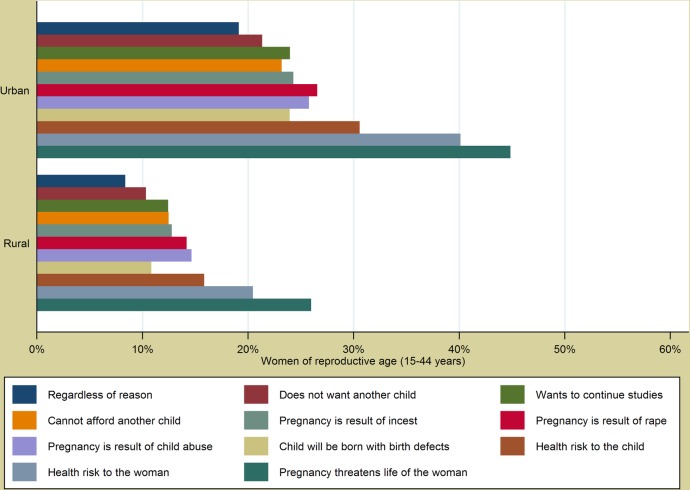
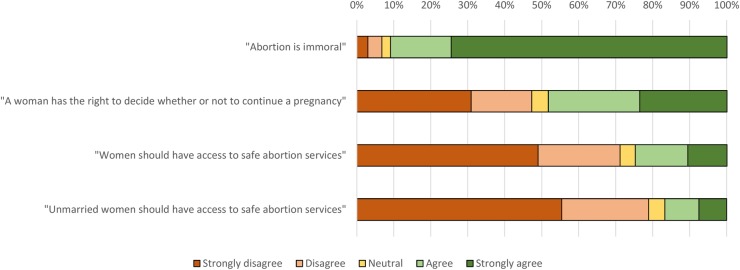
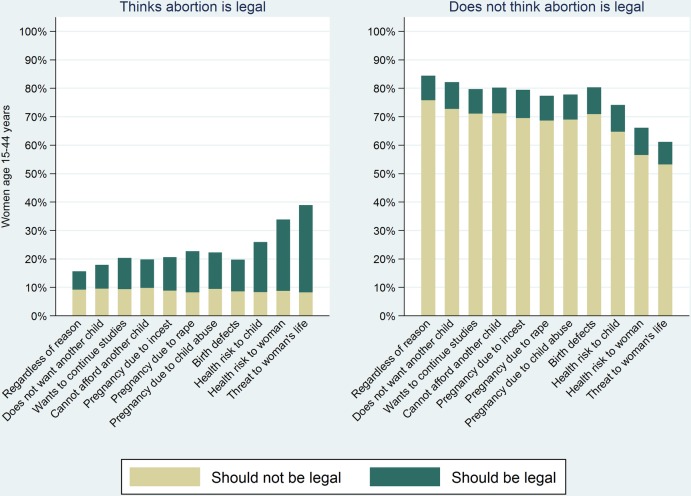
Overall, just 16% (95% CI 11% to 21%) of women of reproductive age correctly identified the grounds for which abortion is legal. Only 40% (95% CI 32% to 45% of women of reproductive age knew that abortion was legally permitted in the extreme situation where the pregnancy threatens the life of the mother. Even in urban areas of Lusaka province, only 55% (95% CI 41% to 67%) of women knew that an abortion could legally take place to save the mother's life. Attitudes remain conservative. Women with correct knowledge of abortion law in Zambia tended to have more liberal attitudes towards abortion and access to safe abortion services. Neither correct knowledge of the law nor attitudes towards abortion were associated with knowing someone who previously had an induced abortion.
Poor knowledge and conservative attitudes are important obstacles to accessing safe abortion services. Changing knowledge and attitudes can be challenging for policymakers and public health practitioners alike. Zambia could draw on its previous experience in dealing with its large HIV epidemic to learn cross-cutting lessons in effective mass communication on what is a difficult and sensitive issue.
在赞比亚,尽管法律框架相对宽松,但不安全堕胎的负担仍然很重。许多妇女即使在有条件的情况下,也不寻求在设备完善的场所由专业人员实施堕胎。本研究的目的是描述赞比亚妇女对堕胎相关法律的了解以及对堕胎的态度。
在中央省、铜带省和卢萨卡省开展的基于社区的调查。
1484名育龄妇女(15 - 44岁)。
对堕胎法律依据的正确认知、对堕胎服务的态度以及朋友、家人或其他知己以往的堕胎情况。采用描述性统计和多变量逻辑回归分析知识和态度如何因社会人口学特征而异。
总体而言,只有16%(95%可信区间为11%至21%)的育龄妇女正确识别了堕胎合法的依据。只有40%(95%可信区间为32%至45%)的育龄妇女知道在怀孕危及母亲生命这种极端情况下堕胎是合法的。即使在卢萨卡省的城市地区,也只有55%(95%可信区间为41%至67%)的妇女知道为挽救母亲生命而进行的堕胎在法律上是允许的。态度仍然保守。对赞比亚堕胎法律有正确认知的妇女往往对堕胎和获得安全堕胎服务持更开明的态度。对法律的正确认知和对堕胎的态度都与认识曾有过人工流产的人无关。
知识匮乏和态度保守是获得安全堕胎服务的重要障碍。改变知识和态度对政策制定者和公共卫生从业者来说都可能具有挑战性。赞比亚可以借鉴其以往应对大规模艾滋病疫情的经验,在这个困难且敏感的问题上,从有效的大众传播中汲取跨领域的经验教训。