Department of Pathology, University of Sulaimani College of Medicine and Shoresh Teaching Hospital, Quirga Road, Sulaimani, Iraq.
Department of Nephrology, University of Hawler College of Medicine, Erbil, Iraq.
BMC Nephrol. 2020 May 6;21(1):164. doi: 10.1186/s12882-020-01834-5.
The incidence of kidney diseases among bodybuilders is unknown.
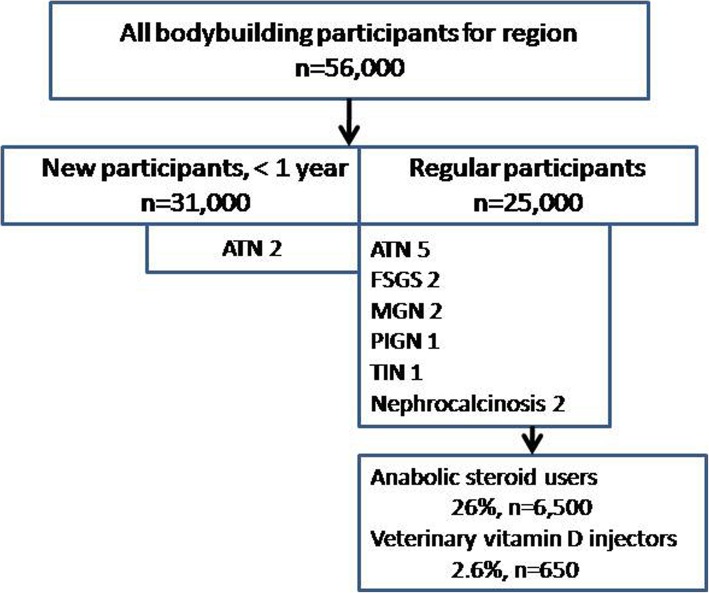
Between January 2011 and December 2019, the Iraqi Kurdistan 15 to 39 year old male population averaged 1,100,000 with approximately 56,000 total participants and 25,000 regular participants (those training more than 1 year). Annual age specific incidence rates (ASIR) with (95% confidence intervals) per 100,000 bodybuilders were compared with the general age-matched male population.
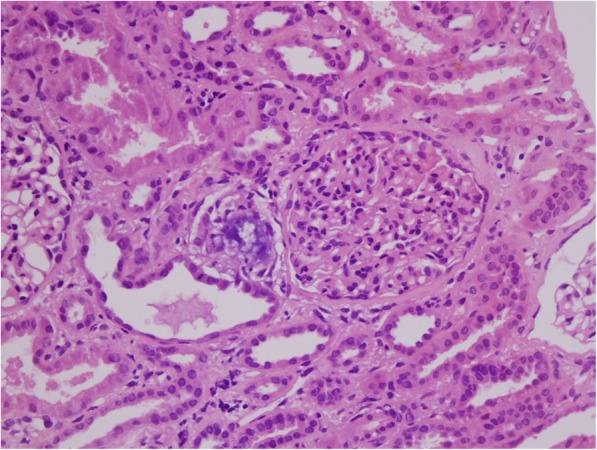
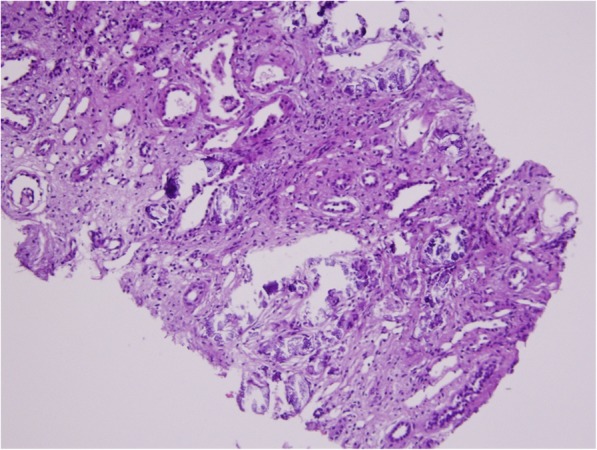
Fifteen male participants had kidney biopsies. Among regular participants, diagnoses were: focal segmental glomerulosclerosis (FSGS), 2; membranous glomerulonephritis (MGN), 2; post-infectious glomeruonephritis (PIGN), 1; tubulointerstitial nephritis (TIN), 1; and nephrocalcinosis, 2. Acute tubular necrosis (ATN) was diagnosed in 5 regular participants and 2 participants training less than 1 year. Among regular participants, anabolic steroid use was self-reported in 26% and veterinary grade vitamin D injections in 2.6%. ASIR for FSGS, MGN, PIGN, and TIN among regular participants was not statistically different than the general population. ASIR of FSGS adjusted for anabolic steroid use was 3.4 (- 1.3 to 8.1), a rate overlapping with FSGS in the general population at 2.0 (1.2 to 2.8). ATN presented as exertional muscle injury with myoglobinuria among new participants. Nevertheless, ASIR for ATN among total participants at 1.4 (0.4 to 2.4) was not significantly different than for the general population at 0.3 (0.1 to 0.5). Nephrocalcinosis was only diagnosed among bodybuilders at a 9-year cumulative rate of one per 314 vitamin D injectors.
Kidney disease rates among bodybuilders were not significantly different than for the general population, except for nephrocalcinosis that was caused by injections of veterinary grade vitamin D compounds.
健美运动员患肾脏疾病的发病率尚不清楚。
在 2011 年 1 月至 2019 年 12 月期间,伊拉克库尔德斯坦的 15 至 39 岁男性人口平均为 110 万,总共有大约 56000 名参与者和 25000 名定期参与者(那些训练超过 1 年的人)。每 10 万名健美运动员的特定年龄发病率(ASIR)与年龄匹配的一般男性人口进行了比较。
15 名男性参与者接受了肾脏活检。在定期参与者中,诊断结果为:局灶节段性肾小球硬化症(FSGS)2 例,膜性肾小球肾炎(MGN)2 例,感染后肾小球肾炎(PIGN)1 例,肾小管间质性肾炎(TIN)1 例,肾钙质沉着症 2 例。急性肾小管坏死(ATN)在 5 名定期参与者和 2 名训练不足 1 年的参与者中被诊断出来。在定期参与者中,26%的人自我报告使用合成代谢类固醇,2.6%的人使用兽医级维生素 D 注射剂。FSGS、MGN、PIGN 和 TIN 在定期参与者中的发病率与一般人群无统计学差异。调整合成代谢类固醇使用后的 FSGS 的发病率为 3.4(-1.3 至 8.1),与一般人群中的 FSGS 发病率 2.0(1.2 至 2.8)重叠。新参与者的 ATN 表现为运动性肌肉损伤伴肌红蛋白尿。然而,总参与者中 ATN 的发病率为 1.4(0.4 至 2.4),与一般人群中的发病率 0.3(0.1 至 0.5)无显著差异。仅在健美运动员中,9 年累积发病率为每 314 名接受兽医级维生素 D 注射剂者中有 1 例诊断为肾钙质沉着症。
除了因注射兽医级维生素 D 化合物引起的肾钙质沉着症外,健美运动员的肾脏疾病发病率与一般人群无显著差异。