Department of Radiation Oncology, Seoul National University Bundang Hospital, Seongnam-si, Republic of Korea.
Department of Neurosurgery, Seoul National University Bundang Hospital, Seongnam-si, Republic of Korea.
Radiat Oncol. 2020 May 6;15(1):98. doi: 10.1186/s13014-020-01552-0.
To identify the pattern of failure and oncological safety of hippocampus (HC)-sparing IMRT (HSRT) in newly diagnosed glioblastoma (GBM) patients.
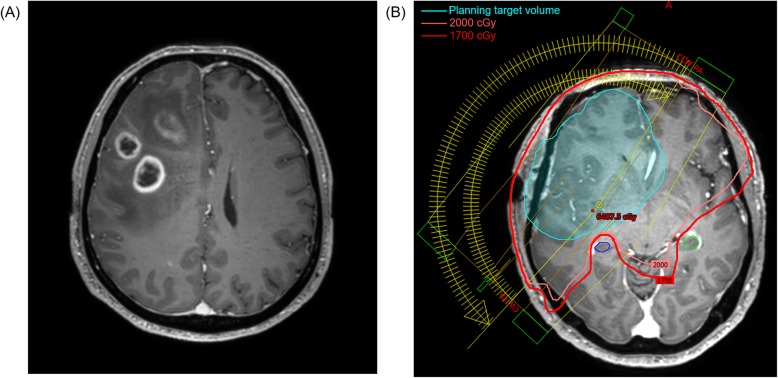
Eighty-two GBM patients treated with temozolomide-based chemoradiation using HSRT between 2014 and 2018 were retrospectively reviewed. HSRT consisted of a sparing of D of the contralateral HC < 17 Gy. Fifteen patients were unable to achieve the dose-constraints for adequate target coverage. The dose to ipsilateral HC was kept as low as possible. The pattern of failure was investigated, focusing on the area in the vicinity of the spared HC (organ and + 1 cm area). The median HSRT dose was 60 Gy in 30 fractions.
The median follow-up for survivors was 11.7 months. The median progression-free and overall survival were 9.7 and 23.5 months, respectively. Six (7.3%) and eight (9.8%) patients eventually demonstrated progressive disease at the contralateral HC and HC + 1 cm, respectively. The 12-month contralateral HC and HC + 1 cm failure-free rate were 97.2 and 93.4%, respectively. However, no patient (0%) and two patients (2.4%) showed failure at contralateral HC and HC + 1 cm at initial progression, respectively. The dominant pattern of failure at the contralateral HC was by subependymal seeding (66.7%).
The incidence of failure at the contralateral HC and HC + 1 cm is very low and mostly accompanied by disseminated disease progression after HSRT. Since HSRT does not compromise oncological outcomes, it could be considered especially for GBM patients who are expected to have favorable survival outcomes.
本研究旨在明确新诊断胶质母细胞瘤(GBM)患者行海马回避调强放疗(HSRT)的失败模式和肿瘤安全性。
回顾性分析了 2014 年至 2018 年间 82 例接受替莫唑胺为基础的放化疗且行 HSRT 的 GBM 患者。HSRT 采用对侧海马结构 D 区(HC-D)<17Gy 剂量的 sparing。有 15 例患者未能达到充分靶区覆盖的剂量限制。同侧 HC 的剂量尽可能保持在最低水平。重点研究了 HSRT 靶区包括(HC-D 区+1cm 区域)的失败模式。中位 HSRT 剂量为 60Gy/30 次。
生存患者的中位随访时间为 11.7 个月。中位无进展生存期和总生存期分别为 9.7 个月和 23.5 个月。分别有 6(7.3%)例和 8(9.8%)例患者最终出现对侧 HC 和 HC+1cm 部位的疾病进展。12 个月时对侧 HC 和 HC+1cm 无失败生存率分别为 97.2%和 93.4%。然而,在初始进展时,无患者(0%)和 2 例患者(2.4%)出现对侧 HC 和 HC+1cm 部位的失败。对侧 HC 失败的主要模式为室管膜下播散(66.7%)。
HSRT 后对侧 HC 和 HC+1cm 部位的失败发生率非常低,且大多伴有播散性疾病进展。由于 HSRT 不影响肿瘤学结果,因此对于预期生存结局较好的 GBM 患者,可考虑采用 HSRT。