Department of Neuropsychiatry, Seoul National University Bundang Hospital Hospital, 29 Gumi-ro 173 Beon-gil, Bundang-gu, Seongnam-si, 13619, Gyeonggi-do, Republic of Korea.
Samsung Advanced Institute for Health Sciences and Technology (SAIHST), Sungkyunkwan University, Samsung Medical Center, 81 Irwon-ro, Gangnam-gu, Seoul, 06351, Republic of Korea.
Alzheimers Res Ther. 2020 May 6;12(1):52. doi: 10.1186/s13195-020-00618-1.
Subjective cognitive decline (SCD) is a potential risk factor for dementia. We aimed to investigate the association between SCD and subsequent dementia in a nationwide population-based cohort in South Korea.
This cohort included 579,710 66-year-old adults who were followed for a total of 3,870,293 person-years (average 6.68 ± 1.33 years per person). All subjects completed a questionnaire about subjective memory impairment, the Pre-screening Korean Dementia Screening Questionnaire (KDSQ-P), which included a validated 5-item derivative, and were determined to have SCD based on a single question assessing memory decline. Depressive symptoms were assessed in all subjects using a 3-item modified geriatric depression scale. Hazard ratios were estimated using the Cox proportional hazards model and compared between subjects with and without SCD.
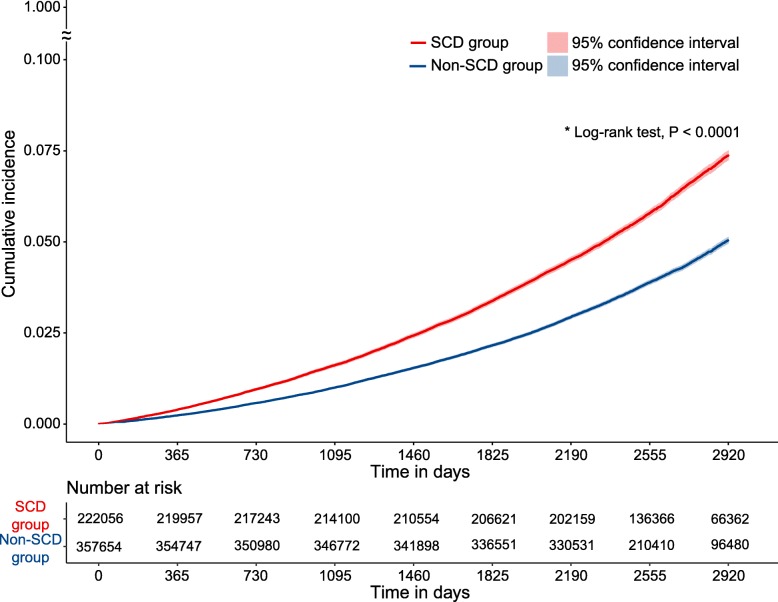
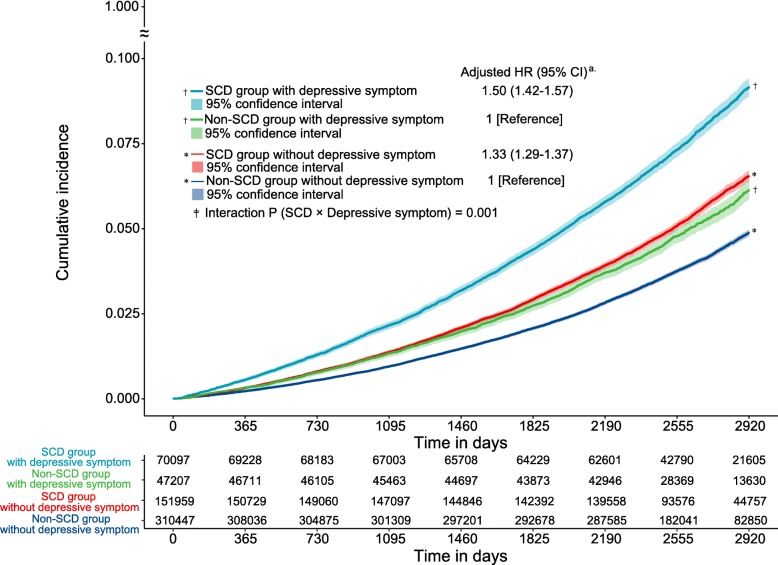
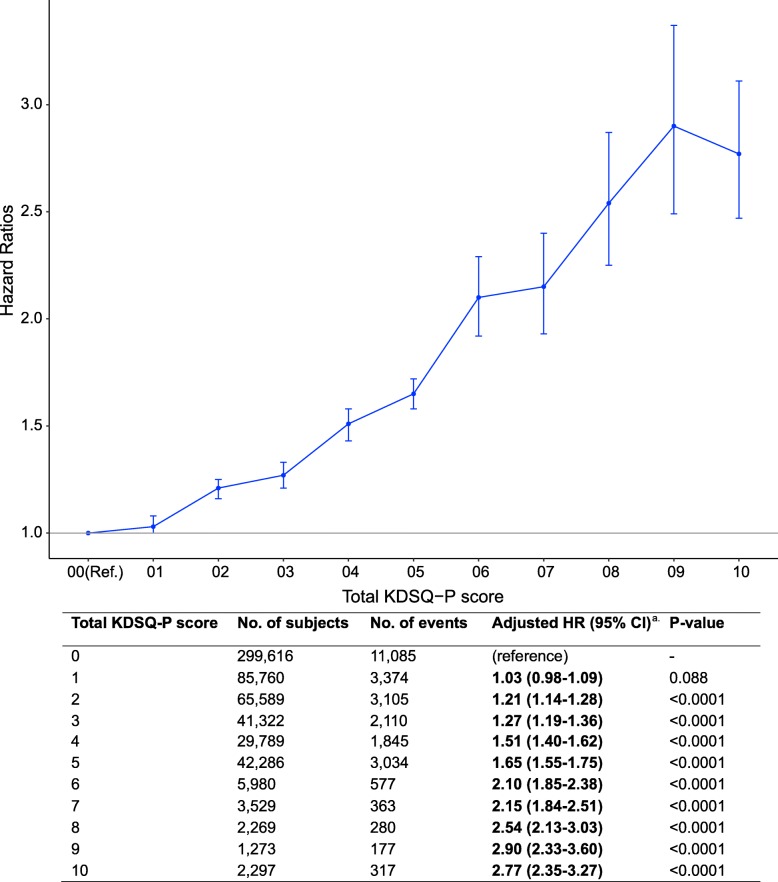
Compared to subjects without SCD, those with SCD were more likely to develop dementia (incidence per 1000 person-years: non-SCD, 5.66; SCD, 8.59). After adjusting for potential confounding factors, the risk of subsequent dementia significantly increased in subjects with SCD, with an adjusted hazard ratio (aHR) of 1.38 (95% confidence interval [CI] 1.34 to 1.41). The risk of subsequent dementia was greatly increased in subjects with higher KDSQ-P scores (aHR = 2.77, 95% CI 2.35 to 3.27). A significant association between SCD and dementia was observed in both depressive and non-depressive symptom groups (aHR = 1.50, 95% CI 1.42 to 1.57 in subjects with depressive symptoms; aHR = 1.33, 95% CI 1.29 to 1.37 in subjects without depressive symptoms; P = 0.001).
In this population of 66-year-old individuals, SCD was significantly associated with an increased risk of subsequent dementia. This association was found in both depressive and non-depressive groups, with an increased risk of dementia in the presence of depressive symptoms. Our findings suggest that SCD indicates a risk for dementia. Further studies are needed to delineate potential approaches to preventing the development of dementia in individuals with SCD.
主观认知下降(SCD)是痴呆的潜在危险因素。我们旨在调查韩国全国人群队列中 SCD 与随后发生痴呆的关系。
本队列纳入了 579710 名 66 岁的成年人,共随访了 3870293 人年(平均每人 6.68±1.33 年)。所有受试者均完成了一份关于主观记忆障碍的问卷,即预筛查韩国痴呆筛查问卷(KDSQ-P),其中包括一个经过验证的 5 项衍生项,并根据一项评估记忆下降的单一问题确定存在 SCD。所有受试者均使用改良老年抑郁量表(3 项)评估抑郁症状。使用 Cox 比例风险模型估计风险比,并比较 SCD 组与无 SCD 组之间的差异。
与无 SCD 的受试者相比,SCD 受试者更有可能发展为痴呆(每 1000 人年的发生率:无 SCD 为 5.66;SCD 为 8.59)。调整潜在混杂因素后,SCD 受试者发生后续痴呆的风险显著增加,校正风险比(aHR)为 1.38(95%置信区间 [CI] 1.34 至 1.41)。KDSQ-P 评分较高的受试者发生后续痴呆的风险显著增加(aHR=2.77,95%CI 2.35 至 3.27)。在存在抑郁症状的受试者(aHR=1.50,95%CI 1.42 至 1.57)和无抑郁症状的受试者(aHR=1.33,95%CI 1.29 至 1.37)中,SCD 与痴呆之间均存在显著关联(P=0.001)。
在本 66 岁人群中,SCD 与随后发生痴呆的风险显著增加相关。在存在抑郁症状和无抑郁症状的人群中均存在这种关联,并且在存在抑郁症状时痴呆的风险增加。我们的研究结果表明,SCD 表明存在痴呆风险。需要进一步的研究来阐明在 SCD 个体中预防痴呆发展的潜在方法。