Department of Neurology, Tangshan Central Hospital, Tangshan, China.
Institute of Biomedical Engineering, School of Life Science, Shanghai University, Shanghai, China.
Alzheimers Dement. 2024 Sep;20(9):6542-6555. doi: 10.1002/alz.14149. Epub 2024 Aug 6.
Subjective cognitive decline (SCD) has been recognized as a potential risk stage for progression to Alzheimer's disease (AD), while glymphatic dysfunction is considered an important characteristic of AD. We hypothesize that glymphatic dysfunction occurs during the SCD stage, aiming to discover potential biomarkers for SCD.
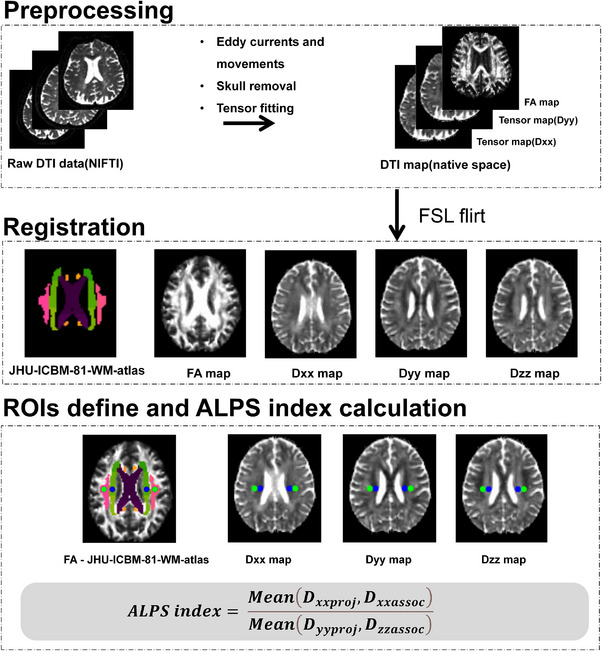
Participants from two independent studies, Sino Longitudinal Study on Cognitive Decline (SILCODE, n = 654) and the Alzheimer's Disease Neuroimaging Initiative (ADNI, n = 650), representing different ethnicities and disease stages, were included to assess glymphatic function using diffusion tensor image analysis along the perivascular space (DTI-ALPS).
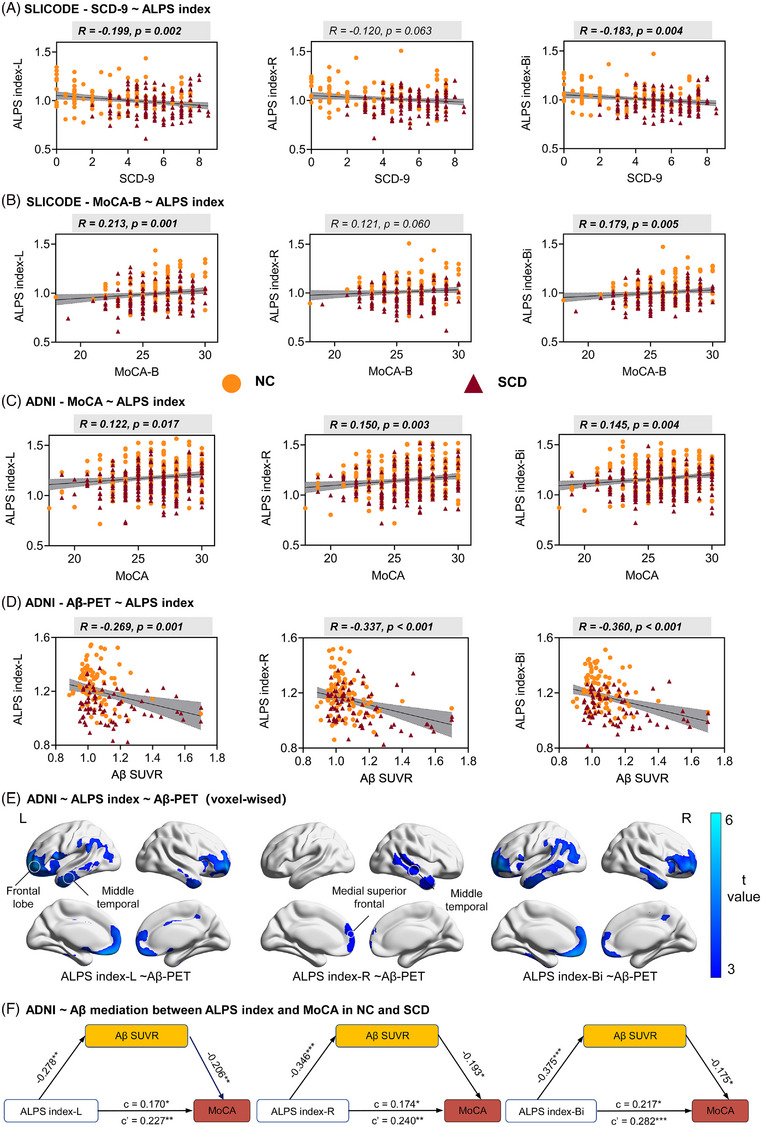
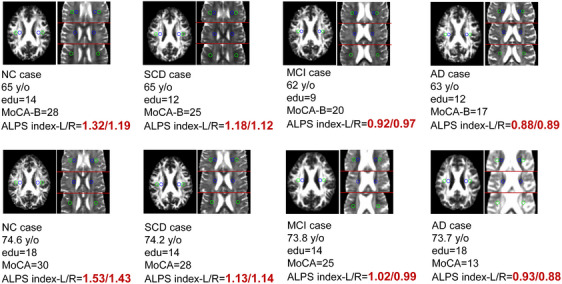
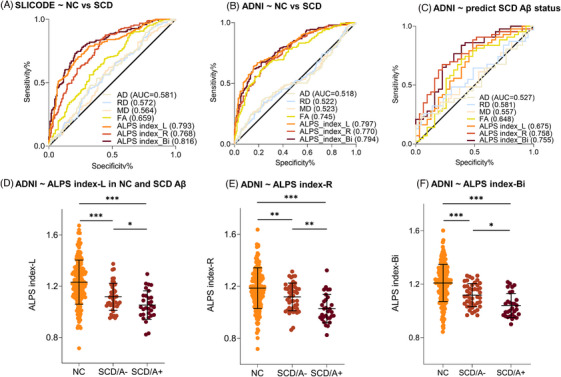
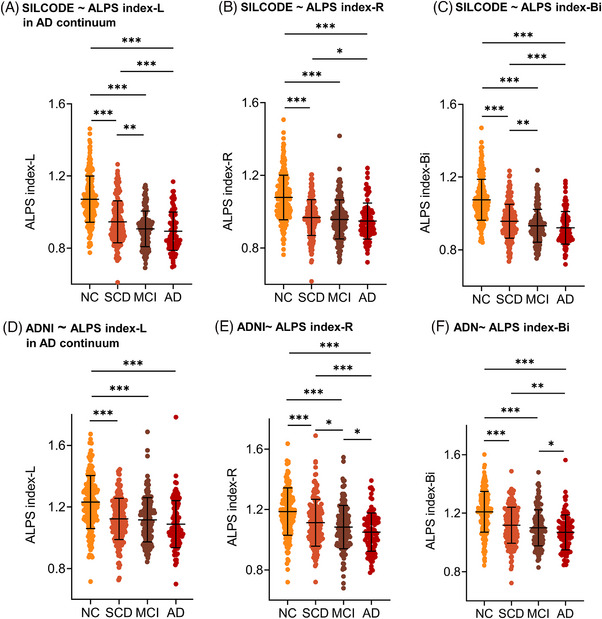
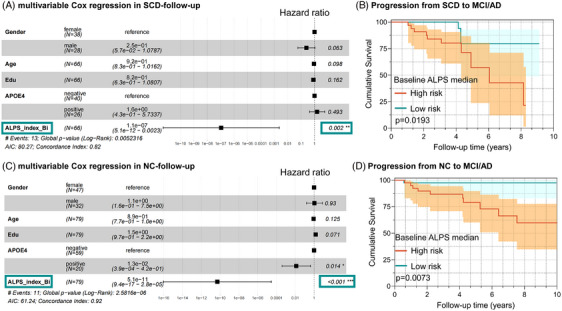
Abnormal glymphatic function occurs during the SCD stage, with the ALPS index demonstrating excellent classification performance for SCD and normal controls (area under the receiver operating characteristic curve [AUC] = 0.816, AUC = 0.797). Lower ALPS index indicates higher risk of cognitive progression, which is negatively correlated with Subjective Cognitive Decline Questionnaire 9 scores and amyloid positron emission tomography burden.
Our study suggests the ALPS index has the potential to serve as a biomarker for SCD.
Glymphatic function characterized by the analysis along the perivascular space (ALPS) index becomes abnormal in subjective cognitive decline (SCD), the earliest symptomatic manifestation and preclinical stage of Alzheimer's disease (AD). The ALPS index demonstrates excellent classification performance for SCD and normal controls in the East Asian and Western cohorts. Participants with a lower ALPS index show a higher risk of clinical progression. The ALPS index is closely associated with serval cognitive scales and amyloid beta burden.
主观认知衰退(SCD)已被认为是向阿尔茨海默病(AD)进展的潜在风险阶段,而神经胶淋巴功能障碍被认为是 AD 的一个重要特征。我们假设神经胶淋巴功能障碍发生在 SCD 阶段,旨在发现 SCD 的潜在生物标志物。
本研究纳入了来自两个独立研究的参与者,即中国认知衰退纵向研究(SILCODE,n=654)和阿尔茨海默病神经影像学倡议(ADNI,n=650),他们代表不同的种族和疾病阶段,使用扩散张量图像分析评估血管周围空间的神经胶淋巴功能(DTI-ALPS)。
SCD 阶段存在异常的神经胶淋巴功能,ALPS 指数对 SCD 和正常对照组具有出色的分类性能(受试者工作特征曲线下面积[AUC]为 0.816,AUC 为 0.797)。较低的 ALPS 指数表明认知进展的风险更高,与主观认知衰退问卷 9 评分和淀粉样蛋白正电子发射断层扫描负担呈负相关。
我们的研究表明,ALPS 指数有可能成为 SCD 的生物标志物。
通过血管周围空间(ALPS)分析所确定的神经胶淋巴功能在主观认知衰退(SCD)中变得异常,SCD 是阿尔茨海默病(AD)最早的有症状表现和临床前阶段。ALPS 指数在东亚和西方队列中对 SCD 和正常对照组具有出色的分类性能。ALPS 指数较低的参与者显示出更高的临床进展风险。ALPS 指数与几个认知量表和淀粉样蛋白β负担密切相关。